Ashok Gehlot Questions Claims on Paper Leaks in Rajasthan
Source:punjab-kesari ↗
Why It Matters
The integrity of public recruitment examinations is a critical governance issue. Understanding state-level legislative measures, such as stringent anti-paper leak laws, is essential for analyzing administrative accountability and public sector employment reforms.
Summary
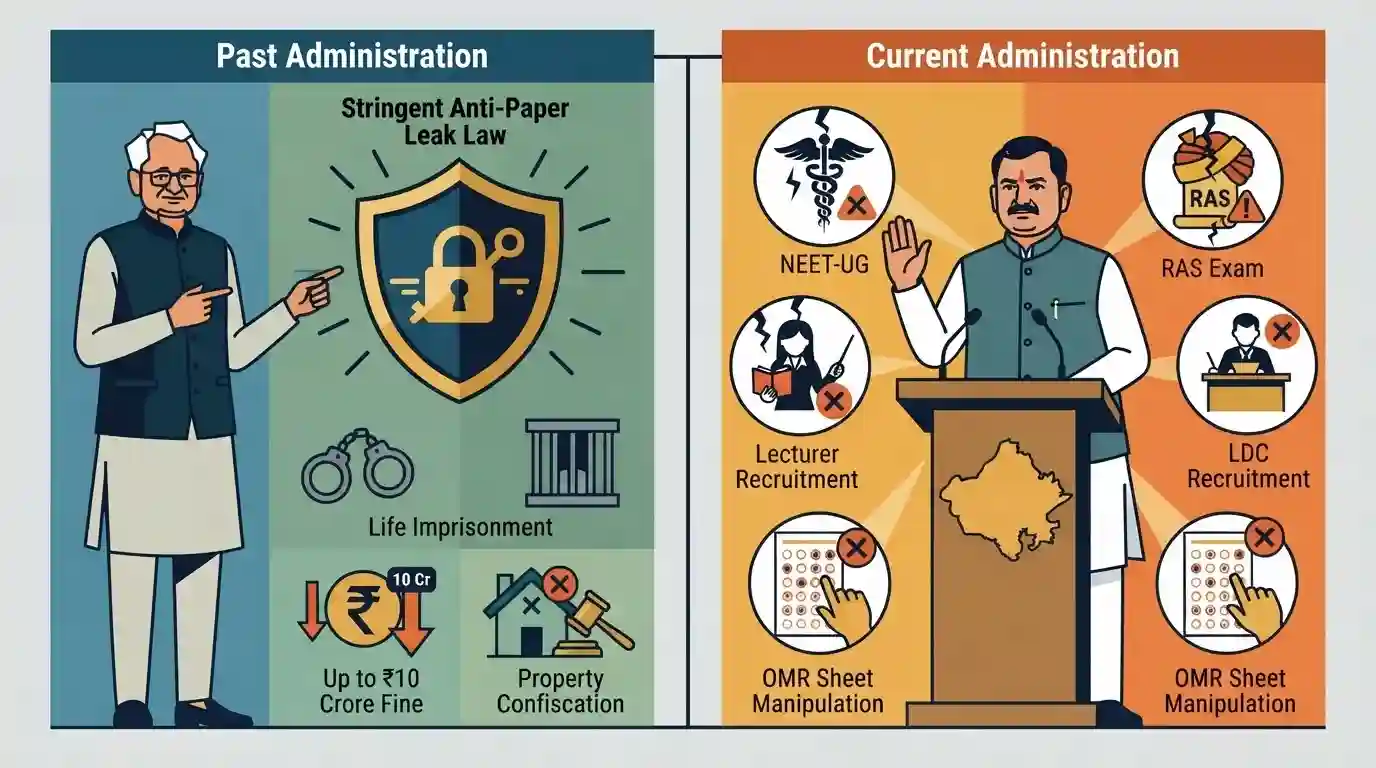
Former Rajasthan Chief Minister Ashok Gehlot has publicly challenged incumbent CM Bhajan Lal Sharma’s assertion that no paper leaks have occurred under the current BJP administration. Gehlot cited multiple alleged compromises in exams such as NEET-UG, the RAS exam, lecturer recruitment, and LDC recruitment, alongside instances of OMR sheet manipulation. Furthermore, he defended his administration's track record by highlighting the passage of a stringent anti-paper leak law during his tenure, which includes severe penalties such as life imprisonment, fines of up to ₹10 crore, and property confiscation to deter examination fraud.
Key Points
- Former Rajasthan Chief Minister Ashok Gehlot disputed CM Bhajan Lal Sharma's claim that no paper leaks occurred during his tenure, citing specific exams like NEET-UG, RAS, and LDC recruitment.
- Gehlot pointed out irregularities such as tampering with OMR sheets and issues in lecturer recruitment exams.
- He emphasized that the previous Congress government enacted the strictest anti-paper leak legislation in the country to curb examination malpractices.
- The enacted law prescribes stringent punishments, including life imprisonment, fines up to ₹10 crore, and confiscation of the offenders' property.
Important Terms
Rajasthan Anti-Paper Leak Law

A stringent state legislation enacted to prevent cheating and paper leaks in competitive exams. It features severe penalties, including up to life imprisonment, fines of up to ₹10 crore, and confiscation of offenders' properties.
UPSC context
GS-2 Governance. Demonstrates state-level legal frameworks aimed at ensuring transparency and combating corruption in public recruitment.
Rajasthan Public Service Commission
A constitutional body established under Article 315 of the Constitution, responsible for conducting civil services exams like the RAS and advising the Rajasthan government on recruitment and disciplinary matters.
UPSC context
GS-2 Polity. Focuses on the mandate, functioning, and accountability of State Public Service Commissions in maintaining exam integrity.
Rajasthan Staff Selection Board
A state recruitment agency established to conduct examinations and select candidates for non-gazetted, subordinate, and ministerial service posts, such as Lower Division Clerks, across Rajasthan government departments.
UPSC context
GS-2 Governance. Tests the role of state statutory bodies in public employment and the challenges of ensuring leak-proof recruitment processes.
Prelims Trap
The Central Public Examinations (Prevention of Unfair Means) Act, 2024 mandates life imprisonment for organized paper leaks.
The maximum penalty of life imprisonment and Rs 10 crore fine applies under Rajasthan's state law, whereas the Central Act of 2024 prescribes a maximum of 10 years imprisonment.
Static Concepts Connected
What constitutional safeguards govern State Public Service Commissions (SPSCs)?
- Removal authority: Members are appointed by the Governor but can only be removed by the President of India, ensuring functional independence.
- Mandatory consultation: Under Article 320, SPSCs must be consulted on recruitment methods, principles of appointment, and disciplinary matters.
What is the legal and administrative status of the National Testing Agency?
- Legal nature: It is an autonomous testing organization registered as a society under the Societies Registration Act, 1860.
- Administrative control: It operates under the Ministry of Education, guided by a Governing Body rather than being a statutory commission.
Cross-Topic Patterns
Federal dynamics in penal legislation
State-specific anti-leak laws imposing life sentences coexist with the 10-year cap under the Central Unfair Means Act, exemplifying legislative dynamics on the Concurrent List.
Article 16 & recruitment integrity
Repeated administrative lapses in state recruitments directly threaten Article 16's guarantee of equal public employment opportunities, prompting judicial scrutiny of PSC autonomy.

UPSC 2026 may contrast the penal scope of the Central Unfair Means Act, 2024 with the constitutional mandate of State PSCs.
Linked PYQs · 2
Linked PYQs · 2
- 2025RPSC_PRELIMSGS1
Under which article of the Constitution is there a mandatory consultation provision with the Rajasthan Public Service Commission in disciplinary cases affecting serving personnel under the Government of Rajasthan?
- 2024RPSC_PRELIMSGS1
According to the Rajasthan Lokayukta and Deputy Lokayukta Act, 1973, the Lokayukta in Rajasthan can investigate allegations against ministers and public servants in certain cases. Which of the following subject is included in such cases? (i) Involves grievance/any suffering caused by public servant. (ii) Used his position as a public servant to obtain, for himself or for any other person, any valuable thing or financial benefit. (iii) Sexual harassment of woman, cause injury to any person. (iv) Can be related to being guilty of corruption of the trust reposed in him as a public servant.
