Lakhisarai Ashok Dham temple stampede highlights crowd control gaps
Source:The Hindu ↗
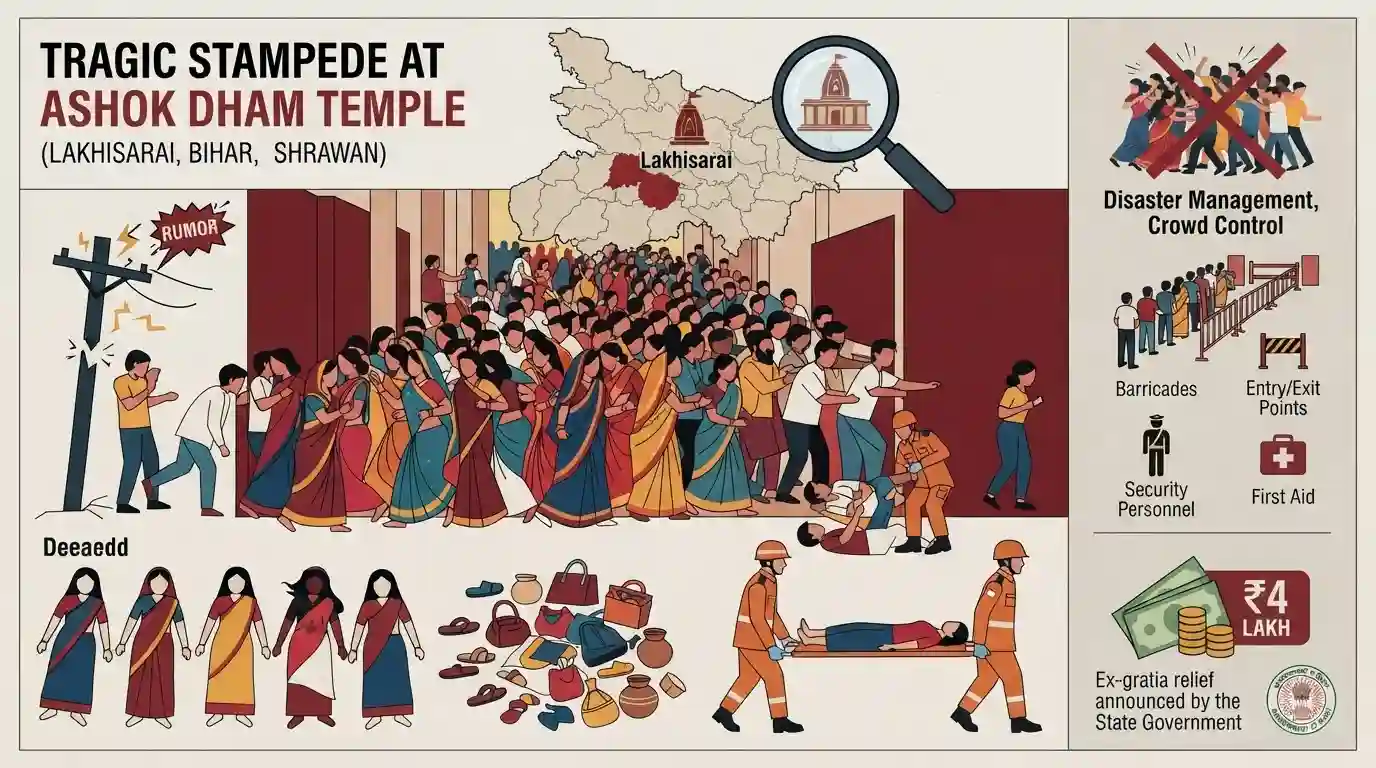
Why It Matters
Highlights the recurring challenge of crowd management and disaster preparedness at mass religious gatherings, and serves as a geographic and cultural reference point (Ashok Dham in Lakhisarai) for state-specific questions.
Summary
Seven women lost their lives and over a dozen devotees were injured in a stampede at the Ashok Dham temple in Bihar's Lakhisarai district. The stampede broke out during the heavy rush of the holy Shrawan month, reportedly triggered by a rumor of a snapping electric pole. The incident has raised serious questions about crowd management and disaster preparedness at religious sites in Bihar. The State Government announced an ex-gratia relief of ₹4 lakh for the families of the deceased.
Key Points
- A tragic stampede at the Ashok Dham temple in Lakhisarai, Bihar, resulted in the deaths of seven women and injured several others.
- The incident occurred during the holy month of Shrawan when tens of thousands of devotees gather to offer holy water.
- Preliminary reports suggest the panic was triggered by a rumor regarding a snapped electric wire amidst heavy crowding.
- The Lakhisarai district administration faced criticism for inadequate crowd management measures.
- Chief Minister Samrat Choudhary announced an ex-gratia payment of ₹4 lakh for the families of the deceased.
Important Terms
Ashok Dham Temple

Also known as Indradamneshwar Mahadev Mandir, this prominent Lord Shiva temple in Bihar's Lakhisarai features a massive Pala-period Shivling discovered in 1977.
UPSC context
Tests knowledge of Bihar's religious tourism, historical sites, and cultural geography for BPSC Prelims and GS Paper 1.
Stampede
A human-induced disaster involving uncontrolled mass movement of a crowd, leading to injuries and fatalities. It is largely preventable through proactive infrastructure and crowd management.
UPSC context
Relevant for BPSC Mains GS Paper 2 (Disaster Management), testing knowledge of public safety protocols and mass gathering risks.
Compressive Asphyxia
The primary cause of death in stampedes, occurring when intense crowd pressure squeezes individuals so tightly that their chests cannot expand, causing fatal suffocation.
UPSC context
Combines General Science and Disaster Management concepts, useful for BPSC Prelims and GS Paper 2 analytical answers.
Lakhisarai District Administration
The local executive authority, headed by the District Magistrate, responsible for law and order, public safety, and coordinating emergency disaster response during mass gatherings.
UPSC context
Tests understanding of local governance, administrative accountability, and disaster preparedness under BPSC GS Paper 2 (Polity).
Bihar Police
The state law enforcement agency tasked with maintaining public order, managing crowds at religious sites, and serving as primary first responders during emergencies like stampedes.
UPSC context
Important for GS Paper 2 (Governance), focusing on the effectiveness of state machinery in maintaining public safety.
Ex-gratia Relief
Voluntary financial compensation provided by the government to disaster victims on humanitarian grounds, such as the ₹4 lakh announced for the Lakhisarai victims.
UPSC context
Connects to state welfare policies and disaster rehabilitation mechanisms, relevant for BPSC Mains GS Paper 2 (Governance).
Prelims Trap
"Ashok Dham (Shri Indradamaneshwar Mahadev) is located in Munger district."
While Lakhisarai falls under the Munger administrative division, the temple is specifically in Lakhisarai district. BPSC often swaps district names to confuse candidates.
Static Concepts Connected
What are the prominent Shaivite pilgrimage sites and their locations in Bihar?
- Ashok Dham: Located in Lakhisarai, also known as Shri Indradamaneshwar Mahadev Temple.
- Ajgaibinath Dham: Located in Sultanganj (Bhagalpur), famously associated with the Shravani Mela and Kanwar Yatra.
- Baba Garibnath Temple: Located in Muzaffarpur, a major center for Shaivite devotees in North Bihar.
What is the structure of the Bihar State Disaster Management Authority (BSDMA)?
- Establishment: Created under the national Disaster Management Act, 2005.
- Chairperson: The Chief Minister of Bihar serves as the ex-officio chairman of the authority.
- SDRF Compensation: Under SDRF norms, a standard ex-gratia of ₹4 lakh is disbursed for lives lost in localized disasters and stampedes.
Cross-Topic Patterns
Religious Tourism & NDMA Guidelines
Stampedes at religious sites frequently prompt questions on NDMA guidelines for crowd management, bridging Bihar's cultural tourism with GS Paper 2 disaster mitigation topics.
Munger Division District Composition
Lakhisarai's placement in Munger division highlights BPSC's tendency to test the exact district composition of Bihar's 9 administrative divisions in Prelims.

BPSC often tests temple locations as match-the-following. Expect Ashok Dham (Lakhisarai) paired with Ajgaibinath (Sultanganj).
Linked PYQs · 2
Linked PYQs · 2
- 2024-EBPSC_PRELIMSGS1
Which of the following centres in Bihar is proposed to develop under Vishnupad Yojana for promotion of tourism in Union Budget 2024?
- 2024-EBPSC_PRELIMSGS1
The sikh pilgrimage site “TAKHAT SRI HARIMANDIR JI PATNA SAHIB” which is considered as the second holiest Takhat is located at
