Ashok Barnwal Appointed New Chief Secretary of Madhya Pradesh
Source:indian-mandarins ↗
Why It Matters
Appointments to top bureaucratic positions like the Chief Secretary are crucial for understanding the state administrative machinery. For MPPSC Prelims, questions frequently appear regarding the roles of key state officials, current officeholders, and the constitutional/statutory framework of the state executive.
Summary
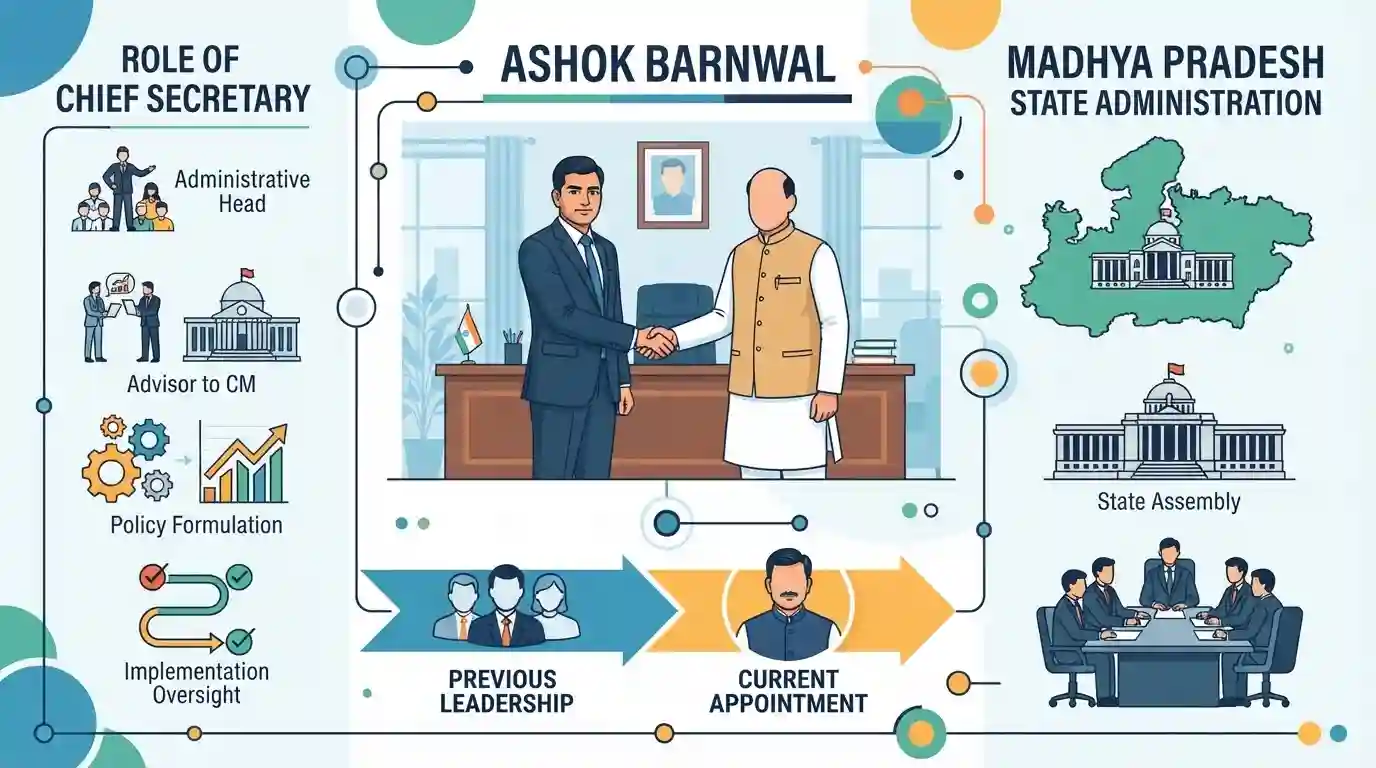
Ashok Barnwal, an IAS officer, has been appointed as the new Chief Secretary of Madhya Pradesh. The Chief Secretary is the administrative head of the state and serves as the principal advisor to the Chief Minister, playing a critical role in policy formulation and implementation at the state level. This change in bureaucratic leadership highlights the ongoing administrative reorganizations within the state government.
Key Points
- Ashok Barnwal has been appointed as the new Chief Secretary of Madhya Pradesh.
- The Chief Secretary is the highest-ranking civil servant in a state government and acts as the principal advisor to the Chief Minister.
- This appointment marks a significant change in the bureaucratic leadership of the state administration.
Important Terms
Chief Secretary

The highest-ranking civil servant and administrative head of an Indian state government, acting as the principal advisor to the Chief Minister and ex-officio cabinet secretary.
UPSC context
GS Paper II (State Administration); tests understanding of bureaucratic roles, center-state relations, and policy implementation.
Indian Administrative Service (IAS)
The premier All India Service responsible for policy formulation, public administration, and executive governance at both the Central and State levels in India.
UPSC context
GS Paper II (Civil Services); tests understanding of the civil service's role in a democratic framework and executive functions.
State Secretariat
The administrative nerve center of a state government, housing offices of ministers and administrative secretaries to formulate and coordinate government policies and programs.
UPSC context
GS Paper II (State Governance); tests structural hierarchy, division of executive power, and administrative workflow.
State Civil Services Board
A state-level committee chaired by the Chief Secretary that recommends transfers, postings, and disciplinary actions for civil servants within the state cadre.
UPSC context
GS Paper II (Governance/Administrative Reforms); tests civil service accountability, reform commissions, and tenure security of bureaucrats.
All India Services
The three civil services of India—IAS, IPS, and IFoS—whose officers are recruited by the Union but serve under both Central and State governments.
UPSC context
GS Paper II (Federalism); tests federal-state balance, constitutional provisions under Article 312, and administrative relations.
NITI Aayog
The apex policy think tank of the Indian government, established in 2015 to replace the Planning Commission and foster cooperative federalism and decentralized planning.
UPSC context
GS Paper II (Governance & Planning); tests planning institutions, cooperative federalism, and public policy formulation.
Prelims Trap
The Chief Secretary of a state holds a constitutional post with a fixed tenure under Article 163 of the Constitution.
The post is neither constitutional nor has a fixed tenure. It operates via state Rules of Business and serves at the Chief Minister's executive discretion.
Static Concepts Connected
How does the State Chief Secretary differ from the Union Cabinet Secretary?
- Administrative Scope: The Chief Secretary is the administrative head of all state departments, unlike the Union Cabinet Secretary who does not head all central ministries.
- Tenure Security: The Cabinet Secretary enjoys a minimum fixed tenure of two years, whereas the Chief Secretary has no fixed tenure and serves at the CM's discretion.
- Staff Agency Role: The Chief Secretary acts as the chief coordinator and head of state civil services, a combined role far wider than the Cabinet Secretary's federal duties.
Cross-Topic Patterns
Bureaucracy vs Executive Autonomy
The lack of fixed tenure for Chief Secretaries highlights the delicate balance between civil service neutrality and executive discretion in state administrative structures.
Wellesley's Reforms & Bureaucratic Evolution
Wellesley's 1799 creation of the Chief Secretary post traces the transition of colonial oversight bodies into modern democratic developmental machinery.

State Executive questions may test the non-constitutional origin, discretionary tenure, and cabinet-presiding rules of the Chief Secretary.
Linked PYQs · 3
Linked PYQs · 3
- 2022MPPSC_PRELIMSGS1
Who among the following shall preside the meeting of Council of Ministers in Madhya Pradesh in the absence of the Chief Minister?
- 2021MPPSC_PRELIMSGS1
The Madhya Pradesh Public Service Commission shall consist of maximum
- 2022MPPSC_PRELIMSGS1
Who was the first Chief Minister of Madhya Pradesh?
