ASEAN GCC China summit amid US trade protectionism threats
Source:The Hindu ↗
Why It Matters
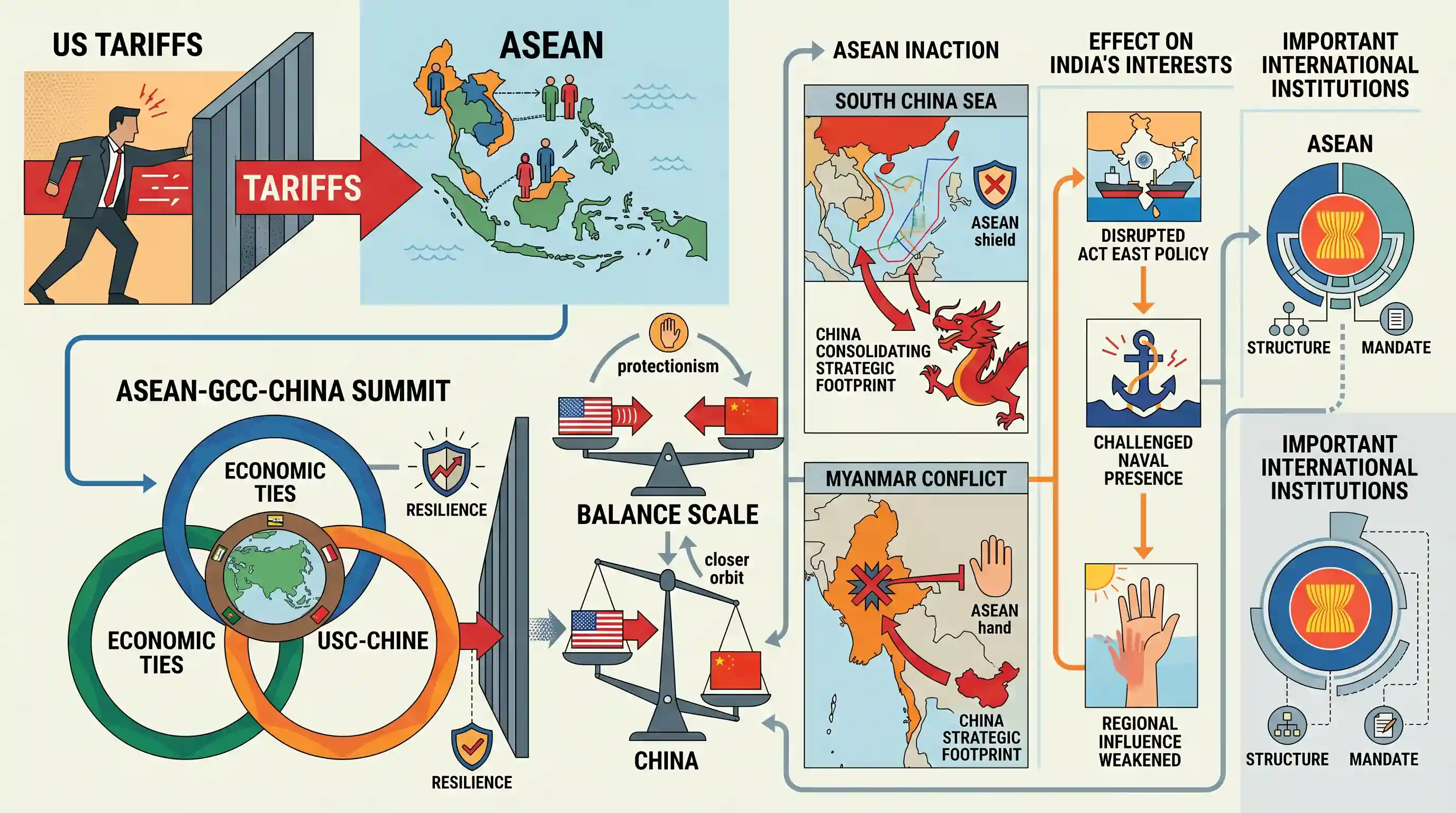
ASEAN is the cornerstone of India's Act East Policy, and the GCC is vital for India's energy security and diaspora. A strategic tilt of ASEAN towards China due to US protectionist policies could alter the balance of power in the Indo-Pacific, directly impacting India's maritime and economic interests. Understanding how global trade wars reshape regional alliances is highly relevant for GS2 (International Relations) and GS3 (Economy).
Summary
The Association of Southeast Asian Nations (ASEAN) convened a summit in Malaysia with the Gulf Cooperation Council (GCC) and China to strengthen economic ties and build resilience against looming US tariffs threatened by the incoming Trump administration. While ASEAN officially maintains a policy of regional neutrality, geopolitical analysts warn that aggressive US protectionism could alienate Southeast Asian economies, pushing them into a closer orbit with Beijing. Additionally, ASEAN's perceived inaction regarding overlapping territorial claims in the South China Sea and the ongoing conflict in Myanmar may further allow China to consolidate its strategic footprint in the Indo-Pacific region.
Key Points
- ASEAN held a summit with the Gulf Cooperation Council (GCC) and China in Malaysia to bolster economic resilience amid global volatility.
- A key catalyst for this summit is the impending threat of steep tariffs proposed by the incoming US administration under Donald Trump.
- The GCC (comprising Bahrain, Kuwait, Oman, Qatar, Saudi Arabia, and UAE) currently stands as ASEAN's 7th largest trading partner, and both blocs seek deeper economic integration.
- Analysts warn that US protectionist policies could inadvertently push ASEAN closer to China, deepening Beijing's economic and political influence in Southeast Asia.
- ASEAN faces criticism for its neutral stance and lack of unified action on contentious issues like the South China Sea territorial disputes and the crisis in Myanmar.
Important Terms
ASEAN

A regional union of 10 (plus Timor-Leste) Southeast Asian nations established in 1967 to promote economic, security, and socio-cultural cooperation.
UPSC context
GS Paper 2: Important International institutions; essential pillar of India's Act East Policy and regional strategic balance.
Gulf Cooperation Council (GCC)
A political and economic alliance of six Middle Eastern monarchies (Saudi Arabia, UAE, Qatar, Kuwait, Oman, Bahrain) established in 1981.
UPSC context
GS Paper 2: Bilateral/regional groupings; vital for India's energy security and diaspora welfare.
Indo-Pacific
The vast maritime region connecting the Indian and Pacific Oceans, serving as a global hub for trade, energy, and geopolitical competition.
UPSC context
GS Paper 2: Global groupings affecting India's interests; tests understanding of maritime security and a rules-based order.
South China Sea
A strategic waterway in the Pacific Ocean where multiple nations, primarily China, have overlapping territorial and maritime resource claims.
UPSC context
GS Paper 2: International Relations; crucial for freedom of navigation and India's commercial trade-flows.
Protectionism
Economic policy of restricting imports through tariffs or quotas to protect domestic industries from foreign competition.
UPSC context
GS Paper 2: Effect of policies of developed countries; tests impact of US trade shifts on India's interests.
UNCLOS
The 1982 international treaty establishing a legal framework for all marine and maritime activities, including territorial waters and economic zones.
UPSC context
GS Paper 2: Important international agencies; the legal benchmark for resolving maritime disputes like the South China Sea.
Act East Policy
India's proactive foreign policy focused on strengthening economic, strategic, and cultural ties with the Asia-Pacific region, particularly ASEAN.
UPSC context
GS Paper 2: India's foreign policy; central to India's engagement with Southeast Asia and countering regional hegemony.
Prelims Trap
"The Gulf Cooperation Council (GCC) includes all countries that share a coastline with the Persian Gulf."
The GCC consists of only six Arab states. It strictly excludes Iran and Iraq despite them sharing the Persian Gulf coastline, and also excludes Yemen.
Static Concepts Connected
Which major island groups form the core of the South China Sea dispute?
- Spratly Islands: Claimed entirely by China, Taiwan, and Vietnam, and partially by Malaysia, the Philippines, and Brunei.
- Paracel Islands: Currently controlled by China, but heavily contested by both Vietnam and Taiwan.
- Scarborough Shoal: A highly contested atoll claimed by China, Taiwan, and the Philippines, located near the Luzon Strait.
What defines the "ASEAN Way" of regional diplomacy?
- Non-interference: A foundational principle preventing member states from intervening in each other's domestic affairs, which complicates unified responses to internal crises like Myanmar.
- Consensus-building: Decisions require unanimous agreement, often leading to diluted, lowest-common-denominator stances on contentious geopolitical issues like Chinese maritime expansion.
Cross-Topic Patterns
US Tariffs & "China Plus One"
Aggressive US trade protectionism threatens to push neutral ASEAN economies closer to Beijing, inadvertently undermining India and the West's "China Plus One" supply chain diversification strategy.
Gulf Capital pivoting East
The ASEAN-GCC summit reflects a South-South geoeconomic realignment where Gulf petrodollars actively seek Asian manufacturing hubs, directly competing with India's own FDI and trade outreach.

Expect a multi-statement Prelims question mapping GCC/ASEAN membership alongside the north-south geographical arrangement of South China Sea islands.
Linked PYQs · 5
Linked PYQs · 5
- 2014MainsGS2
With respect to the South China sea, maritime territorial disputes and rising tension affirm the need for safeguarding maritime security to ensure freedom of navigation and over flight throughout the region. In this context, discuss the bilateral issues between India and China.
- 2018MainsGS2
What are the key areas of reform if the WTO has to survive in the present context of "Trade War', especially keeping in mind the interest of India?
- 2012MainsGS2
Discuss the likely negative impact of the protectionist measures proposed by the US on India's software industry.
- 2025MainsGS2
"With the waning of globalization, post-Cold War world is becoming a site of sovereign nationalism.” Elucidate.
- 2016PrelimsGS1
Which of the following is not a member of 'Gulf Cooperation Council'?
