West Asia Conflict Threatens India Energy Security and Macroeconomy
Source:Indian Express ↗
Why It Matters
Understanding the multi-dimensional impact of the West Asian crisis is crucial for UPSC aspirants, as it integrates core GS2 themes (diaspora, regional geopolitics, bilateral relations) with critical GS3 components (energy security, inflation, and macroeconomic stability in a globalized economy).
Summary
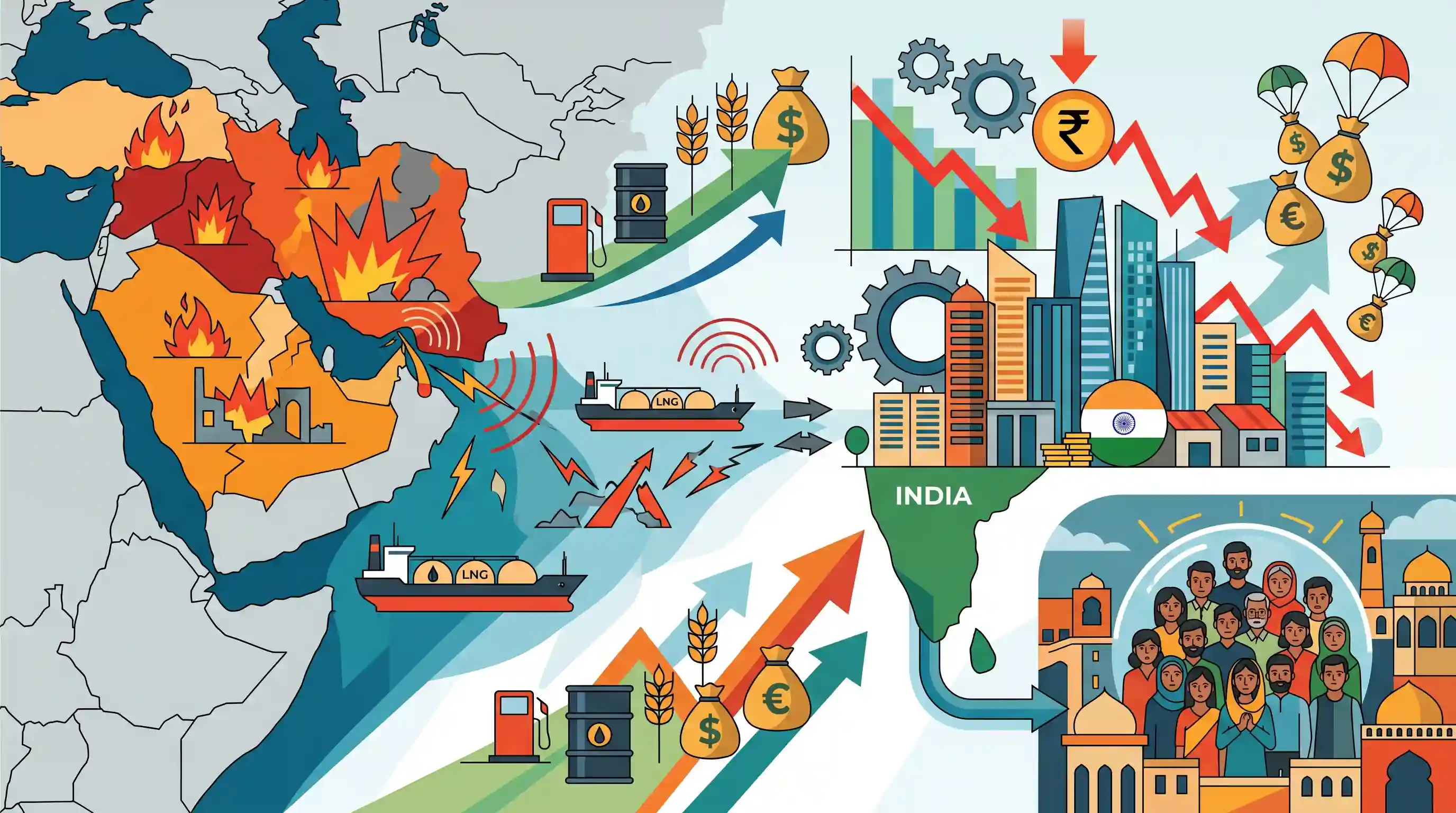
The prolonged conflict in West Asia presents severe geopolitical and macroeconomic risks for India, primarily threatening its energy security and financial stability. With vital oil and LNG shipments transiting the volatile Strait of Hormuz, any disruption could spike inflation through higher fuel and fertilizer costs. The crisis has already precipitated significant capital flight, currency depreciation, and stock market corrections. Furthermore, the safety of roughly 1 crore Indian expatriates in the region remains a critical diplomatic challenge, highlighting the deep linkages between India's domestic economic resilience and Middle Eastern stability.
Key Points
- Prime Minister Narendra Modi likened the uncertainties of the ongoing West Asia conflict to the Covid-19 pandemic, warning of severe economic shocks.
- India's energy security is highly vulnerable, as crucial oil and liquefied natural gas (LNG) supplies from the Gulf, notably Qatar, transit through conflict-prone choke points like the Strait of Hormuz.
- The conflict has already triggered macroeconomic volatility in India, evidenced by $11.8 billion in FPI withdrawals in a month, a roughly 5% drop in stock indices, and a depreciating rupee.
- An escalation could severely impact India's inflation by increasing the cost of imported crude oil and critical fertilizer inputs such as sulphur and ammonia.
- The safety of approximately 1 crore Indian diaspora living in the Middle East remains a paramount foreign policy and humanitarian concern amid expanding missile strikes.
Important Terms
Foreign Portfolio Investors (FPIs)

Foreign entities investing in India's financial assets like stocks and bonds without acquiring management control. FPI is highly liquid and volatile, often retreating during global geopolitical or economic uncertainty.
UPSC context
GS Paper III (Economy); tests understanding of capital flows, market volatility, and impact on the Indian Rupee.
Strait of Hormuz
A narrow maritime chokepoint between Iran and Oman connecting the Persian Gulf to the Gulf of Oman. It handles roughly 20% of global petroleum and LNG trade.
UPSC context
GS Paper I (Geography) and Paper II (International Relations); critical for India's energy security and regional stability.
Macroeconomic Stability
A condition where an economy maintains low inflation, sustainable fiscal deficits, and a stable currency. It ensures resilience against external shocks like oil price spikes or capital outflows.
UPSC context
GS Paper III (Economy); core concept for analyzing economic growth, inflation management, and fiscal policy.
Sensex
The benchmark index of the Bombay Stock Exchange (BSE), tracking 30 of India's largest and most liquid companies. It acts as a primary barometer for investor sentiment.
UPSC context
GS Paper III (Economy); tests the role of stock indices in reflecting national economic health.
Nifty
The flagship index of the National Stock Exchange (NSE), comprising 50 major blue-chip companies across various sectors. It is used to gauge overall market performance and stability.
UPSC context
GS Paper III (Economy); central benchmark for financial markets and corporate performance evaluation.
Indian Diaspora
The community of overseas Indians, including roughly 90 lakh in West Asia. They are vital for remittances, which bolster India’s foreign exchange reserves and economic resilience.
UPSC context
GS Paper II (International Relations); focuses on the community's role in diplomacy, remittances, and bilateral ties.
Prelims Trap
"The Strait of Hormuz connects the Red Sea to the Gulf of Aden, serving as a primary route for LNG."
Aspirants often confuse West Asian chokepoints. Hormuz connects the Persian Gulf to the Gulf of Oman. Bab el-Mandeb connects the Red Sea to the Gulf of Aden.
Static Concepts Connected
What are the key maritime chokepoints in West Asia?
- Strait of Hormuz: Connects the Persian Gulf to the Gulf of Oman and the Arabian Sea. It is a critical transit route for global crude oil and India's LNG imports from Qatar.
- Bab el-Mandeb: Connects the Red Sea to the Gulf of Aden. Currently volatile due to regional conflicts, impacting India's trade towards Europe.
- Suez Canal: An artificial sea-level waterway in Egypt, connecting the Mediterranean Sea to the Red Sea, facilitating direct shipping between Europe and Asia.
How do rising global crude oil prices impact India's macroeconomic stability?
- Current Account Deficit: Higher import bills for crude oil and fertilizers widen the CAD, which puts downward pressure on the Indian Rupee.
- Imported Inflation: Surging global fuel prices cascade into the domestic economy through elevated transportation, logistics, and manufacturing costs.
- Capital Flight: Inflationary pressures and global uncertainty often prompt Foreign Portfolio Investors (FPIs) to withdraw funds from emerging markets like India.
Cross-Topic Patterns
West Asia crisis & India's food security
Disruptions in the Gulf directly threaten India's agriculture due to high reliance on GCC nations for urea, ammonia, and sulphur imports, linking international geopolitics directly to domestic food inflation.
Diaspora safety & remittance dependency
With roughly 1 crore Indians in the Middle East, regional conflict triggers complex evacuation operations and threatens the crucial inward remittances that historically help balance India's Current Account Deficit.

Expect a multi-statement Prelims question mapping West Asian chokepoints to traded commodities (LNG/Fertilizers) and macroeconomic impacts.
Linked PYQs · 4
Linked PYQs · 4
- 2025MainsGS2
"Energy security constitutes the dominant kingpin of India's foreign policy, and is linked with India's overarching influence in Middle Eastern countries.” How would you integrate energy security with India's foreign policy trajectories in the coming years?
- 2017MainsGS2
The question of India's Energy Security constitutes the most important part of India's economic progress. Analyze India's energy policy cooperation with West Asian countries.
- 2018MainsGS3
How would the recent phenomena of protectionism and currency manipulations in world trade affect macroeconomic stability of India?
- 2023MainsGS2
Indian diaspora has scaled new heights in the West. Describe its economic and political benefits for India.
