University Grants Commission Reservation De-Reservation Dilemma
Source:Indian Express ↗
Why It Matters
The controversy underscores the enduring tension between institutional administrative guidelines and constitutional mandates for social justice (Articles 15 and 16). It highlights how electoral dynamics and political compulsions dictate the strict enforcement of reservation policies in India's governance.
Summary
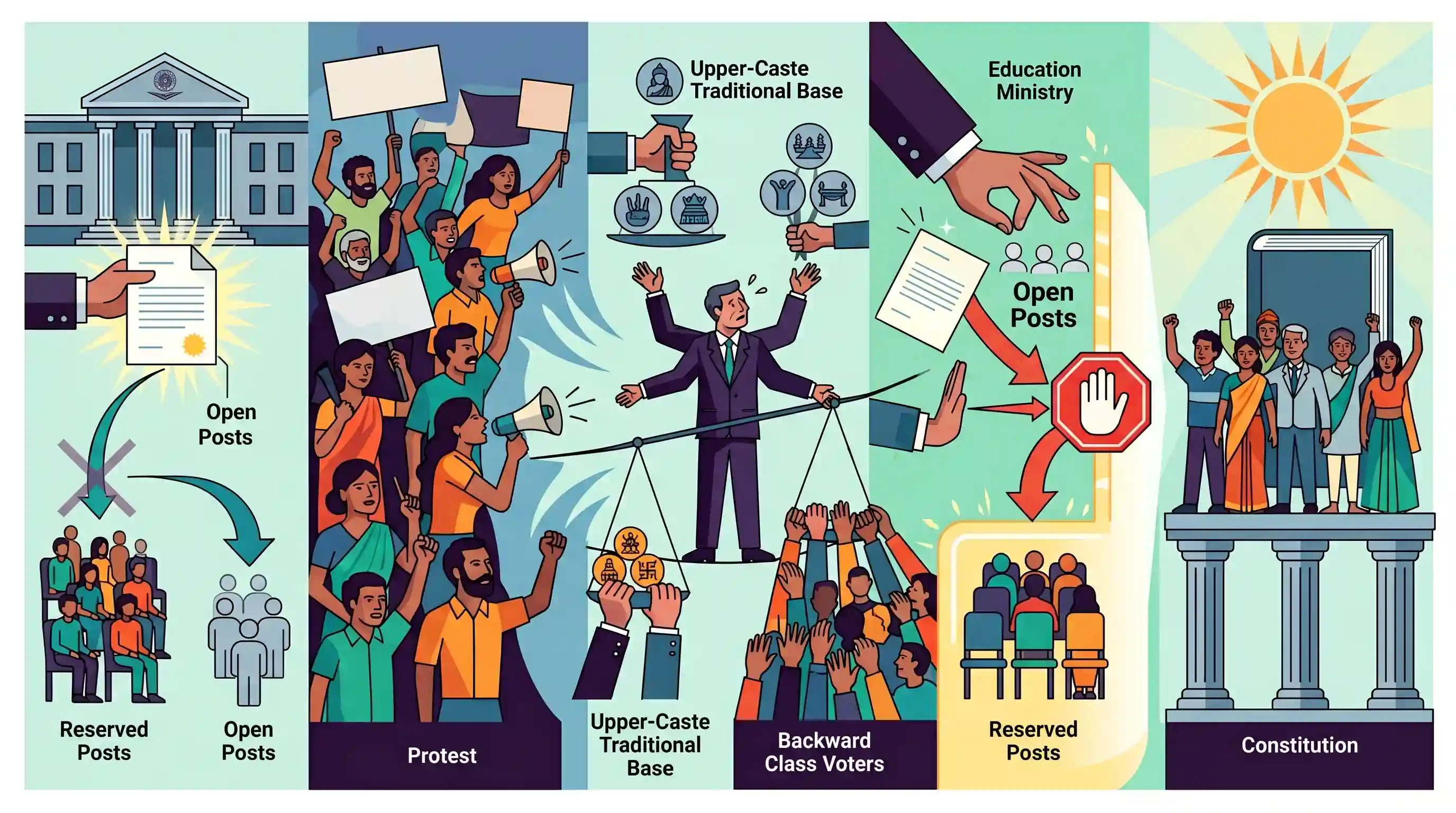
The article examines the political fallout surrounding the University Grants Commission's (UGC) draft guidelines, which proposed a provision for de-reserving unfilled SC, ST, and OBC posts in higher education institutions. The immediate backlash from opposition parties and social justice groups highlighted the acute political sensitivity of caste-based affirmative action. The ruling BJP was caught in a dilemma between appeasing its traditional upper-caste base and securing its crucial backward-class voter coalition. Consequently, the Union Education Ministry swiftly retracted the idea, reaffirming the absolute nature of constitutional reservation policies.
Key Points
- The UGC released draft guidelines containing a controversial clause that permitted the "de-reservation" of unfilled SC, ST, and OBC faculty posts in higher education institutions in exceptional circumstances.
- The proposal triggered severe backlash from opposition parties, student groups, and social justice advocates, who argued it undermined constitutional affirmative action and marginalized communities.
- The ruling BJP faced a severe political dilemma, caught between its traditional upper-caste "forward" voter base and its significantly expanded "backward" (OBC, SC, ST) electoral coalition.
- To quell the unrest ahead of elections, the Union Education Ministry and the UGC Chairman swiftly issued clarifications that statutory reservation mandates are absolute and no reserved posts will be de-reserved.
Important Terms
University Grants Commission (UGC)

A statutory organization established by the UGC Act 1956 to coordinate, determine, and maintain standards of university education, including the recognition of universities and disbursement of grants.
UPSC context
GS-II: Statutory, regulatory and various quasi-judicial bodies. Tests understanding of higher education governance.
De-reservation
The administrative process of converting a vacancy reserved for SC, ST, or OBC candidates into an unreserved one if no suitable candidates from the reserved categories are found.
UPSC context
GS-II: Social Justice and affirmative action. Tests knowledge of safeguards for vulnerable sections.
UGC Guidelines for Implementation of the Reservation Policy
A 2024 draft document that sparked controversy by suggesting "de-reservation" of faculty posts in "exceptional cases," leading to a swift retraction by the Ministry of Education.
UPSC context
GS-II: Government policies and interventions. Relevant for issues related to higher education.
Social Justice
A core constitutional principle (Preamble, Articles 15 and 16) aimed at removing historical inequalities and ensuring equitable representation for marginalized groups like SCs, STs, and OBCs.
UPSC context
GS-I and II: Social empowerment and Constitutional provisions for equality. Core philosophical pillar.
Ministry of Education
The Union ministry responsible for national education policy and standards. It oversees the UGC and ensures compliance with the Central Educational Institutions (Reservation in Teachers’ Cadre) Act, 2019.
UPSC context
GS-II: Governance and Ministry-led interventions in the social sector.
Central Educational Institutions (Reservation in Teachers’ Cadre) Act, 2019
Legislation that mandates reservation for SCs, STs, OBCs, and EWS in faculty recruitment. Importantly, this Act prohibits the de-reservation of reserved posts in Central Educational Institutions.
UPSC context
GS-II: Significant Acts related to reservation and education. Essential for administrative updates.
Prelims Trap
The Constitution of India explicitly prohibits the de-reservation of unfilled SC/ST posts in direct recruitment.
The Constitution enables reservations (Art 16) but does not mention de-reservation. Bans on de-reservation stem from executive instructions (DoPT) and statutory laws (CEI Act 2019), not the Constitution itself.
Static Concepts Connected
What are the key Constitutional articles governing public employment reservations?
- Article 16(4): Empowers the State to reserve appointments or posts for any backward class of citizens not adequately represented in state services.
- Article 16(4B): Allows the State to "carry forward" unfilled reserved vacancies to subsequent years without violating the 50% ceiling cap in those succeeding years.
- Article 335: Mandates that the claims of SCs/STs to services must be balanced consistently with the "maintenance of efficiency of administration."
How does the CEI (Reservation in Teachers' Cadre) Act 2019 regulate quotas?
- University as Unit: Treats the entire university or college as a single unit for preparing the reservation roster, replacing the fragmented department-wise calculation system.
- No De-reservation: Statutorily prohibits the de-reservation of reserved faculty positions in direct recruitment; unfilled posts must be strictly re-advertised rather than converted.
Cross-Topic Patterns
Sub-categorization vs. Unfilled Quotas
The debate over unfilled quotas runs parallel to recent Supreme Court judgments on SC/ST sub-classification, both highlighting the practical bottlenecks in translating reservation policy into actual representation.
Regulatory Guidelines vs. Statutory Mandates
The UGC's draft clashed directly with the CEI Act 2019, showcasing a recurring governance theme where subordinate regulatory bodies draft norms that contradict established parliamentary statutes.

Expect a 2026 Prelims statement linking Article 335's 'administrative efficiency' with the CEI Act's 'university as a single unit' rule.
Linked PYQs · 4
Linked PYQs · 4
- 2023PrelimsGS1
Consider the following statements: Statement-I: The Supreme Court of India has held in some judgements that the reservation policies made under Article 16(4) of the Constitution of India would be limited by Article 335 for maintenance of efficiency of administration. Statement-II: Article 335 of the Constitution of India defines the term 'efficiency of administration'. Which one of the following is correct in respect of the above statements?
- 2018MainsGS2
Whether National Commission for Scheduled Castes (NCSC) can enforce the implementation of constitutional reservation for the Scheduled Castes in the religious minority institutions? Examine.
- 2023PrelimsGS1
Consider the following organizations/bodies in India: 1. The National Commission for Backward Classes 2. The National Human Rights Commission 3. The National Law Commission 4. The National Consumer Disputes Redressal Commission How many of the above are constitutional bodies?
- 2020PrelimsGS1
Which one of the following categories of Fundamental Rights incorporates protection against untouchability as a form of discrimination?
