Bihar Raises Water Sharing Concerns as Ganga Treaty Nears Expiry
Source:india-mongabay ↗
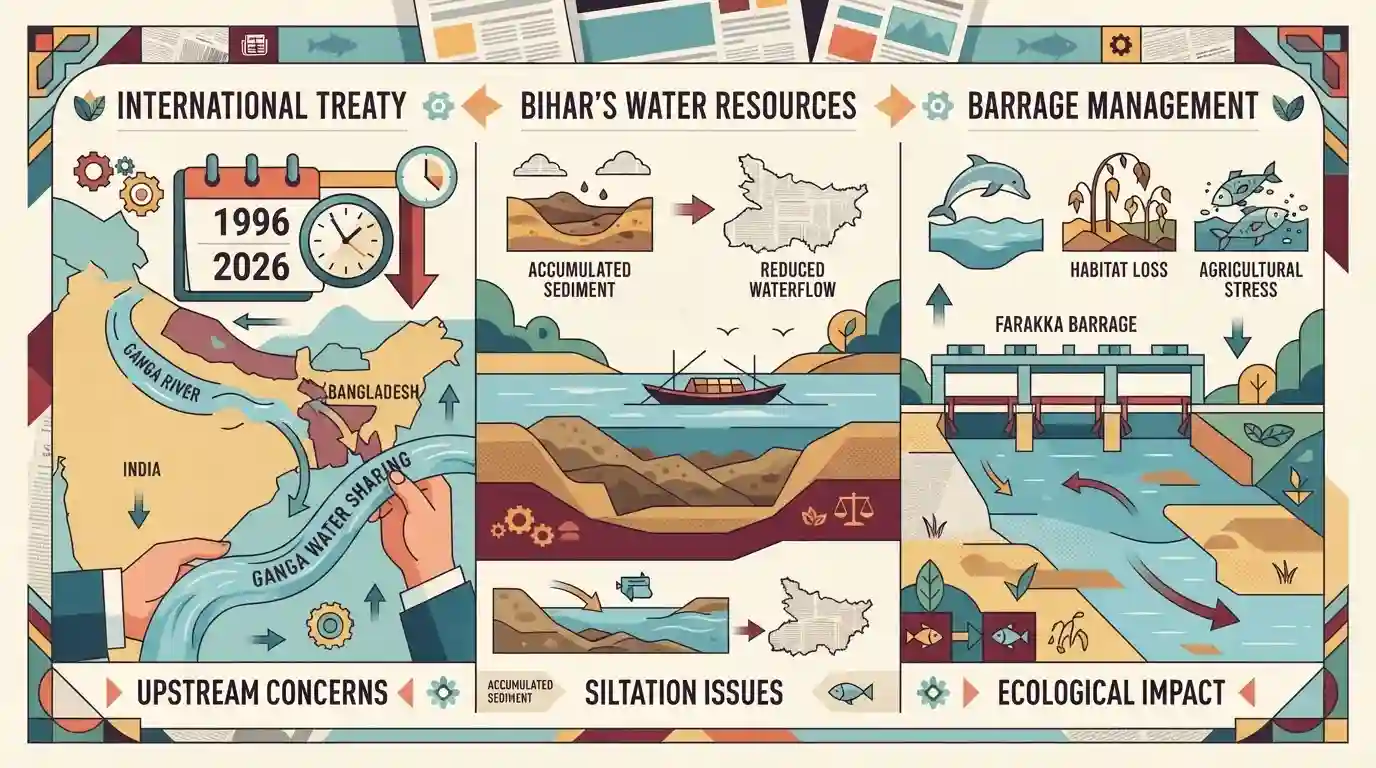
Why It Matters
Crucial for understanding Bihar's geopolitical and environmental stakes in interstate and international river water agreements, specifically the Ganga Water Treaty.
Summary
As the 1996 Ganga Water Treaty approaches its expiration, the Bihar government has renewed concerns regarding water-sharing arrangements, highlighting issues related to heavy siltation, Farakka barrage management, and ecological implications for the state.
Key Points
- The 1996 Ganga Water Treaty between India and Bangladesh is nearing its expiration, sparking renewed concerns from the Bihar government.
- Bihar has raised serious apprehensions regarding water sharing, siltation, and ecological impacts affecting the river flow and livelihood in the state.
- Farakka Barrage management and its consequences on upstream sedimentation and flooding in Bihar are central to the debate.
Important Terms
Ganga Water Treaty 1996

A 30-year bilateral agreement signed between India and Bangladesh in December 1996 to share the dry-season waters of the Ganga River at the Farakka Barrage, expiring in 2026.
UPSC context
Important for BPSC and UPSC General Studies (International Relations and Indian Geography), testing bilateral water diplomacy and federal river-sharing issues.
Farakka Barrage
A barrage constructed across the Ganga River in West Bengal near the Bangladesh border, operational since 1975, designed to divert water into the Hooghly River but heavily linked to upstream siltation in Bihar.
UPSC context
Critical for BPSC Indian Geography and Bihar Water Resources, testing geographical impacts of infrastructure projects on state flooding and siltation.
Siltation
The accumulation of heavy sediment deposits in riverbeds and reservoirs, which reduces the carrying capacity of rivers and significantly intensifies flood risks.
UPSC context
Relevant for BPSC Disaster Management and Environmental Geography, assessing challenges related to river ecology and flood mitigation in Bihar.
Prelims Trap
The Ganga Water Treaty is a bilateral agreement exclusively between India and Bangladesh, which has no direct administrative or ecological bearing on upstream Indian states like Bihar.
Aspirants often assume international water treaties like the 1996 Ganga Treaty are negotiated solely by the Centre without any formal institutional consultative mechanism or impact on upstream riparian states like Bihar.
Static Concepts Connected
What are the key provisions and historical context of the 1996 Ganga Water Treaty?
- Duration & Term: Signed in December 1996 for a 30-year duration, set to expire in December 2026.
- Sharing Formula: Provides a 50:50 water-sharing formula at Farakka when dry season flows drop below 70,000 cusecs.
- Farakka Barrage: Commissioned in 1975 to preserve the Kolkata Port by diverting water into the Hooghly River, but heavily criticized for upstream siltation in Bihar.
Cross-Topic Patterns
Interstate River Disputes & Bilateral Treaties
Bihar's recurring flood and siltation challenges intersect directly with the Farakka barrage design debate, linking state irrigation planning with bilateral international water diplomacy.
Cooperative Federalism in Treaty Making
The Ganga Water Treaty renewal parallels wider geopolitical negotiations where sub-national economic and ecological interests require formal representation in central foreign policy frameworks.

Ganga Treaty expiry + Farakka sedimentation impacts on Bihar likely to appear in BPSC Mains GS-II (Polity/Geography) or Prelims.
Linked PYQs · 2
Linked PYQs · 2
- 2025BPSC_PRELIMSGS1
Which districts in Bihar will benefit from the Kosi Mechi Link Project?
- 2024-IBPSC_PRELIMSGS1
Which river is known as the ‘Sorrow of Bihar’?
