Ganga Treaty expiry revives Bihar water sharing concerns
Source:india-mongabay ↗
Why It Matters
Directly impacts Bihar's state geography, flood management, and agricultural security amid international treaty renewals, making it vital for BPSC aspirants tracking regional issues.
Summary
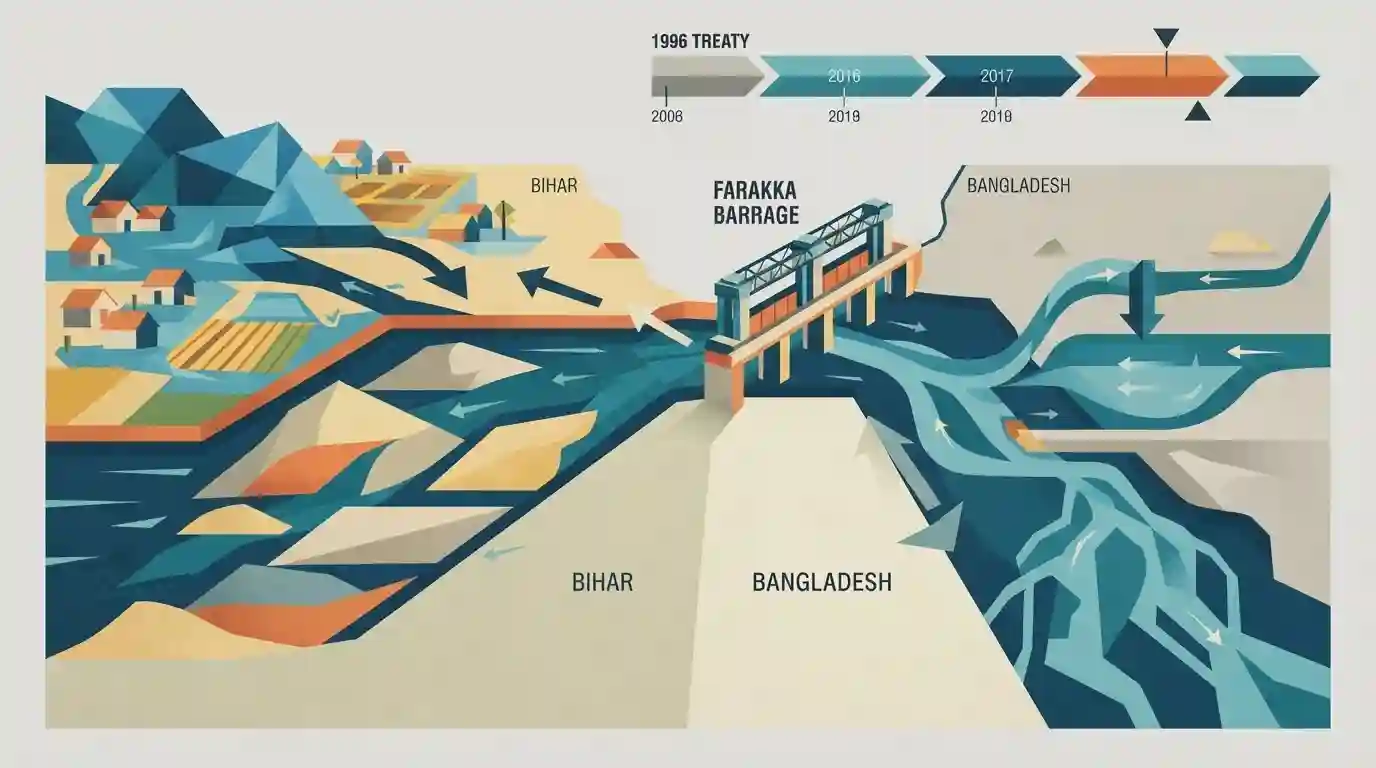
As the 1996 India-Bangladesh Ganga Waters Treaty nears its expiry, Bihar has renewed its concerns over water sharing, highlighting issues related to heavy siltation, drainage congestion, and increased flooding linked to the Farakka Barrage.
Key Points
- The 1996 Ganga Waters Treaty between India and Bangladesh is nearing its expiry, raising concerns in Bihar regarding water sharing and sediment management.
- Bihar has repeatedly expressed concerns that the Farakka Barrage has caused severe siltation, drainage congestion, and increased flooding in the state.
- The state government and local experts seek greater consultation and integration of Bihar's specific hydrological challenges into bilateral water-sharing frameworks.
- Sedimentation and changing river morphology in the Ganga basin pose direct challenges to agriculture and flood management in Bihar.
Important Terms
Ganga Waters Treaty 1996

A 30-year bilateral agreement signed in 1996 between India and Bangladesh for sharing the dry-season waters of the Ganga River at the Farakka Barrage, expiring in December 2026.
UPSC context
Important for BPSC and UPSC International Relations and bilateral diplomacy, testing India-Bangladesh relations and transboundary water management issues.
Joint Rivers Commission
A bilateral mechanism established in 1972 between India and Bangladesh to address issues relating to flood control, forecasting, and joint river basin management of common border rivers.
UPSC context
Relevant for IR and Bihar regional geography, testing institutional frameworks for transboundary river water disputes and cooperative federalism.
Prelims Trap
The Farakka Barrage was first commissioned under the 1996 Ganga Waters Treaty.
Aspirants often confuse the 1996 Ganga Treaty with the Farakka Barrage Agreement of 1977; the latter preceded it and focused solely on dry-season flows.
Static Concepts Connected
What are the key institutional mechanisms governing India-Bangladesh water diplomacy?
- JRC Mechanism: The Joint Rivers Commission (JRC) was established in 1972 to maintain liaison between India and Bangladesh on common rivers.
- 1996 Treaty: The 1996 Ganga Waters Treaty was signed for a 30-year period, establishing a sharing formula at Farakka during the lean season (Jan 1 - May 31).
Cross-Topic Patterns
Treaties + Federal Polity (Article 253)
International water sharing treaties under Article 253 of the Constitution intersect with state-level development concerns in Bihar's flood-prone basins.
Farakka Siltation + Bihar Agriculture Economy
Sedimentation caused by barrages changes river morphology, directly impacting agricultural yields and rural livelihoods across North and Central Bihar.

Expect a multi-statement question combining Farakka Barrage's impact on Bihar siltation with the 1996 Ganga Treaty renewal terms.
Linked PYQs · 3
Linked PYQs · 3
- 2024-EBPSC_PRELIMSGS1
Which of the following drainage systems drains the lands of Bihar?
- 2016BPSC_PRELIMSGS1
Which of the following canal systems irrigate areas of Bihar?
- 2023BPSC_PRELIMSGS1
Phalgu, a sacred river flowing in Bihar, is formed by the confluence of which of the following rivers?
