Supreme Court Examines Loopholes In Uncontested Election Laws
Source:Indian Express ↗
Why It Matters
The issue touches upon the core of democratic representation and voter rights. Uncontested elections highlight a loophole in the RPA 1951 that could potentially be exploited by forcing withdrawals. Understanding this debate is critical for GS Paper 2, particularly concerning electoral reforms, the right to reject (NOTA), and the Election Commission's mandate to ensure free and fair elections.
Summary
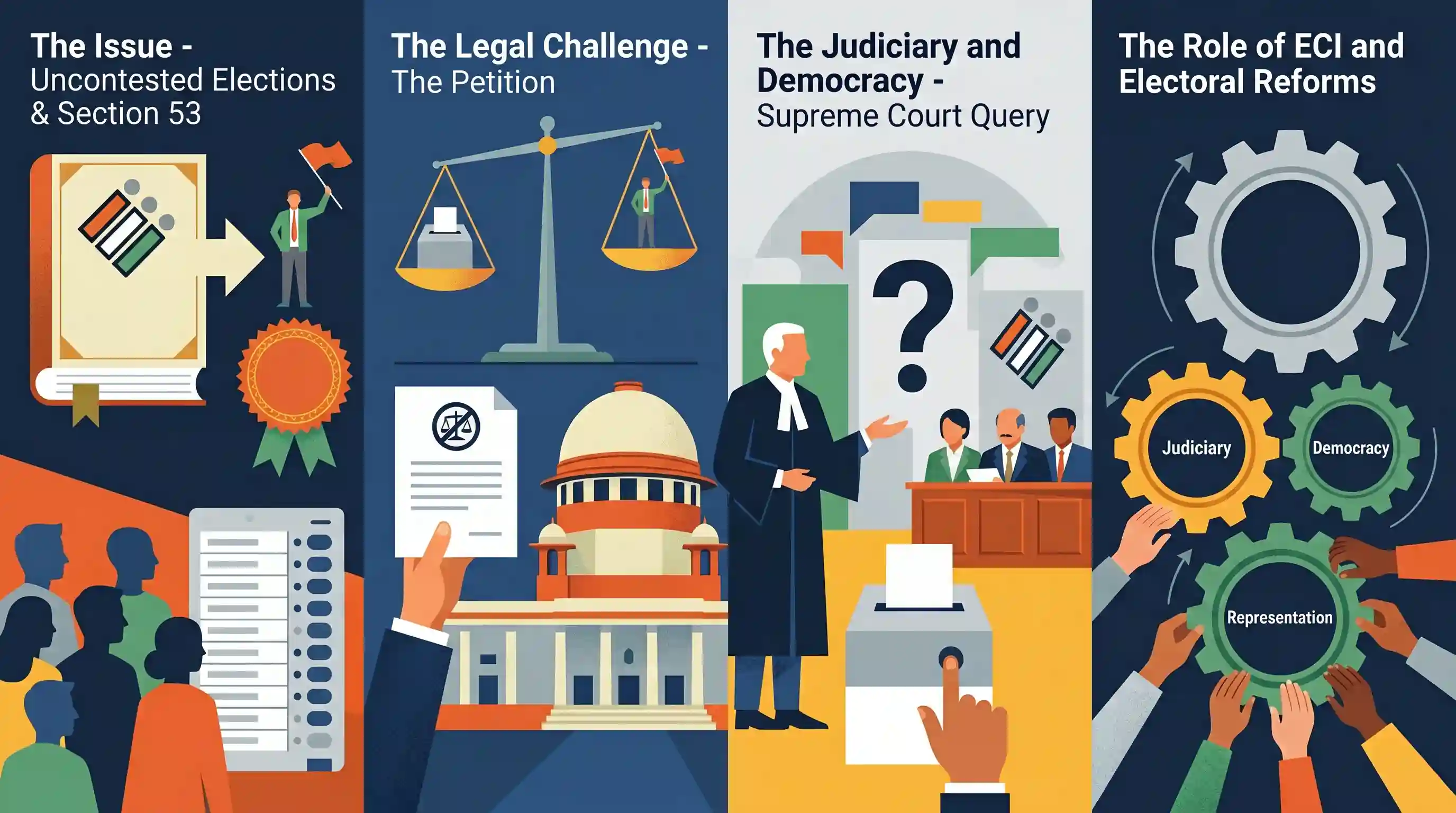
The Supreme Court has sought the Election Commission of India's response to a petition challenging the practice of declaring candidates victorious in uncontested elections without any voting. Under Section 53 of the Representation of the People Act, 1951, if the number of contesting candidates is equal to the number of seats, the sole candidate is declared elected forthwith. The petition argues that this "free pass" deprives voters of their right to reject the candidate via the NOTA (None of the Above) option, especially in cases where opponents' nominations are controversially rejected or withdrawn. The article traces the history of uncontested wins by MPs and MLAs—from recent examples like the Surat Lok Sabha seat in 2024 to past instances involving leaders like Y.B. Chavan and Dimple Yadav—highlighting a crucial debate on electoral reforms and democratic choice.
Key Points
- The Supreme Court is hearing a plea that challenges the practice of declaring a candidate victorious without polling when they are the sole contestant.
- Under Section 53(2) of the Representation of the People Act (RPA), 1951, a returning officer declares a candidate duly elected if the number of contestants equals the number of seats to be filled.
- The petition argues that uncontested elections deprive voters of their democratic right to reject the candidate by using the None of the Above (NOTA) option.
- Recent instances of uncontested victories, such as BJP's Mukesh Dalal from the Surat Lok Sabha seat in 2024 due to nomination rejections and withdrawals, have triggered calls for electoral reform.
- Historically, several prominent leaders, including Y.B. Chavan, Farooq Abdullah, and Dimple Yadav, have secured seats uncontested, receiving a 'free pass' to the legislature.
Important Terms
Representation of the People Act (RPA), 1951

A landmark parliamentary act regulating the actual conduct of elections, candidate qualifications, and seat allocations. Section 53(2) of this Act allows candidates to be declared winners 'unopposed' without a poll.
UPSC context
GS Paper II - Polity/Governance. Essential for understanding the legal framework of Indian elections and challenges to electoral provisions.
Election Commission of India (ECI)
An autonomous constitutional authority under Article 324 mandated to conduct free and fair elections. It currently argues that uncontested victories are valid and NOTA only applies when a poll occurs.
UPSC context
GS Paper II - Constitutional Bodies. Tests knowledge of election management and the Commission's response to judicial scrutiny.
Supreme Court of India
The highest judicial forum and final interpreter of the Constitution. It is currently examining if declaring uncontested winners violates voters' expressive rights under Article 19(1)(a).
UPSC context
GS Paper II - Judiciary. Tests understanding of judicial review and the Court's role in electoral reforms.
NOTA (None of the Above)
A voting choice introduced in 2013 that allows electors to officially register disapproval of all candidates. Its unavailability in uncontested elections is the core of the current legal challenge.
UPSC context
GS Paper II - Electoral Reforms. Focuses on voter empowerment, the right to dissent, and deepening democracy.
Section 53, RPA 1951
Mandates that if only one validly nominated candidate remains for a seat, the Returning Officer shall immediately declare them elected, effectively bypassing the public polling process.
UPSC context
GS Paper II - Polity. Important for specific statutory rules governing representative democracy and uncontested elections.
Article 19(1)(a)
Constitutional guarantee of freedom of speech and expression. Judicial interpretation suggests this includes the right to express dissatisfaction via voting, making it central to the NOTA debate.
UPSC context
GS Paper II - Fundamental Rights. Examines the intersection between constitutional expressive freedoms and statutory electoral processes.
Prelims Trap
If NOTA secures the highest number of votes, the election is invalidated and a re-poll is mandated.
Even if NOTA receives the highest votes, the candidate with the next highest valid votes is declared the winner. NOTA cannot invalidate an election.
Static Concepts Connected
What is the legal and constitutional standing of NOTA in Indian elections?
- Fundamental Right: Rooted in Article 19(1)(a) (Freedom of Speech and Expression) following the PUCL vs Union of India (2013) judgment.
- No Electoral Value: It has no legal consequence. It does not trigger re-elections if it gets the majority of votes.
- Rajya Sabha Excluded: The Supreme Court removed NOTA from Rajya Sabha polls (2018) to prevent cross-voting, corruption, and undermining party discipline.
Is the Right to Vote a Fundamental Right or a Statutory Right?
- Statutory Right: The 'right to vote' is governed strictly by the Representation of the People Act, 1951.
- Constitutional Basis: Universal Adult Suffrage is guaranteed by Article 326 of the Constitution, but the procedural right is statutory.
- Freedom of Voting: Expressing one's choice or dissent (NOTA) is recognized as a Fundamental Right under Article 19(1)(a).
Cross-Topic Patterns
Criminalization and Money Power in Elections
Uncontested elections often highlight intense money/muscle power or aggressive political maneuvering, connecting to broader debates on the criminalization of politics and the need for state funding of elections.
Judicial Review of the RPA 1951
The SC's scrutiny of Section 53 of the RPA parallels its proactive interventions in the ADR case (criminal antecedents) and striking down Electoral Bonds to ensure voter sovereignty.

Prelims 2026 will likely test the exact legal distinction between the statutory 'right to vote' and the fundamental 'freedom to dissent'.
Linked PYQs · 4
Linked PYQs · 4
- 2024MainsGS2
Examine the need for electoral reforms as suggested by various committees with particular reference to "one nation one election" principle.
- 2022MainsGS2
Discuss the procedures to decide the disputes arising out of the election of a Member of the Parliament or State Legislature under The Representation of the People Act, 1951. What are the grounds on which the election of any returned candidate may be declared void ? What remedy is available to the aggrieved party against the decision ? Refer to the case laws.
- 2020MainsGS2
There is a need for simplification of procedure for disqualification of persons found guilty of corrupt practices under the Representation of Peoples Act". Comment.
- 2019MainsGS2
On what grounds a people's representative can be disqualified under the Representation of Peoples Act, 1951? Also mention the remedies available to such person against his disqualification.
