Geopolitical Challenges and Strategic Cohesion within the Quad
Source:The Hindu ↗
Why It Matters
UPSC aspirants must understand the contemporary pressures acting upon the Quad. Analyzing how external events (like the Iran conflict and US-China ties) and internal bilateral frictions (India-US) impact multilateral groupings is a core requirement for GS Paper 2 (International Relations).
Summary
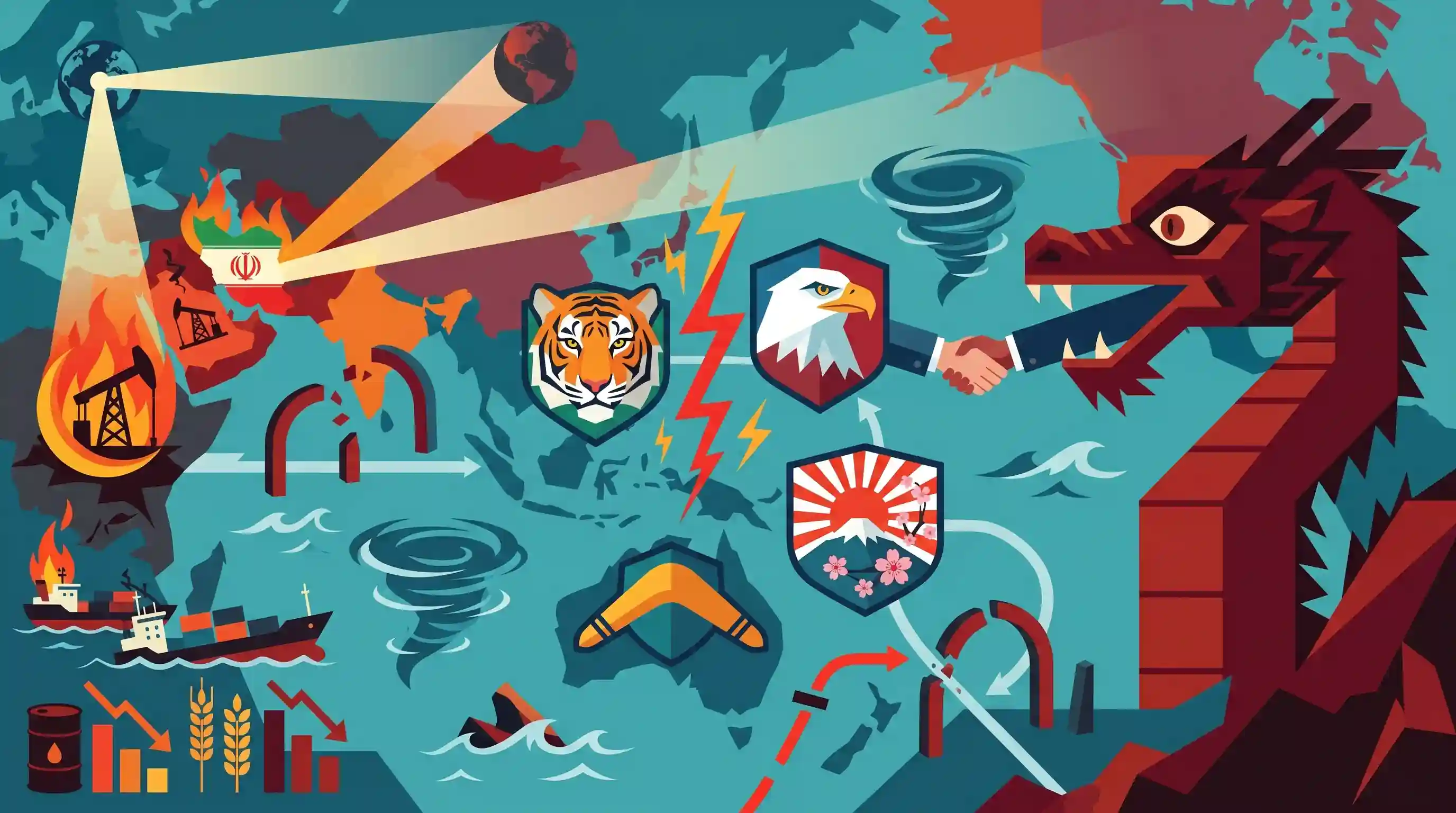
The Quad Foreign Ministers' meeting is taking place amidst a challenging geopolitical environment that tests the grouping's cohesion. Key obstacles include recent bilateral tensions between India and the United States, which complicate their strategic partnership. Additionally, the U.S.'s efforts to re-engage diplomatically with China threaten to dilute the Quad's primary focus on countering Beijing's influence in the Indo-Pacific. Concurrently, the escalating conflict in the Middle East involving Iran is diverting global strategic attention and raising broader security and economic concerns. Together, these factors pose significant challenges to the Quad's objective of maintaining a free, open, and inclusive Indo-Pacific.
Key Points
- Quad Foreign Ministers are meeting against a backdrop of complex and converging global strategic challenges.
- Recent bilateral frictions between India and the U.S. present a hurdle to the seamless strategic alignment expected within the Quad framework.
- U.S. diplomatic re-engagement with China introduces new variables into the Quad's informal objective of countering Chinese hegemony in the Indo-Pacific.
- Escalating conflicts in the Middle East, particularly involving Iran, threaten to divert strategic focus and destabilize global security and supply chains.
- These intersecting issues test the cohesion, relevance, and strategic resolve of the Quad partnership.
Important Terms
Quad (Quadrilateral Security Dialogue)

An informal strategic forum of four democracies—India, USA, Japan, and Australia—focused on ensuring a free, open, and prosperous Indo-Pacific through cooperation on maritime security and emerging technologies.
UPSC context
GS Paper-II: Important International institutions and agencies. Tests understanding of plurilateral groupings and their role in India's foreign policy.
Indo-Pacific
A strategic maritime region spanning from the eastern coast of Africa to the western Pacific Ocean, central to global trade and India's maritime security interests.
UPSC context
GS Paper-II: Bilateral, regional and global groupings. Tests knowledge of regional geopolitics and India's "Act East" policy.
Strategic Autonomy
A core principle of Indian foreign policy that prioritizes independent decision-making in international relations, avoiding formal military alliances while engaging with multiple global powers.
UPSC context
GS Paper-II: India's Foreign Policy. Tests ability to analyze India's balancing act between major powers like the US and Russia.
Indo-Pacific Maritime Domain Awareness (IPMDA)
A Quad-led technology initiative that provides near real-time, integrated, and cost-effective maritime data to partners in the Indo-Pacific to track "dark shipping" and illegal activities.
UPSC context
GS Paper-III: Security challenges and their management in border areas. Tests knowledge of maritime security frameworks.
Strait of Hormuz
A strategic narrow waterway between the Persian Gulf and the Gulf of Oman, essential for global oil transit and India's energy security.
UPSC context
GS Paper-II: Effect of policies and politics of developed and developing countries on India's interests. Relevant for energy security.
Quad Critical Minerals Initiative
A Quad initiative aimed at securing supply chains for minerals essential to high-tech industries and clean energy, reducing dependence on single-source suppliers like China.
UPSC context
GS Paper-III: Infrastructure: Energy, Ports, Roads, Airports, Railways etc. Tests knowledge of resource security and supply chain resilience.
Free and Open Indo-Pacific (FOIP)
A shared vision of Quad members for a region where sovereignty is respected, disputes are settled peacefully, and all nations enjoy freedom of navigation and commerce.
UPSC context
GS Paper-II: Regional and global groupings affecting India’s interests. Tests understanding of the normative goals of Indo-Pacific strategy.
Prelims Trap
The Quad is a formal military alliance with a binding mutual defense treaty among its members.
The Quad remains an informal strategic dialogue. Unlike NATO, it has no secretariat, no formal charter, and no mutual defense pact.
Static Concepts Connected
What is the evolutionary timeline of the Quad?
- 2004 Tsunami Core Group: Began informally as a collaborative effort for disaster relief operations following the Indian Ocean earthquake.
- 2007 Initiation: Initiated by Japanese PM Shinzo Abe but soon collapsed due to Australian and Indian hesitation regarding Chinese pushback.
- 2017 Revival: Resurrected as 'Quad 2.0' on the sidelines of the ASEAN Summit to counter China's growing maritime assertiveness and Belt and Road Initiative.
How has the Quad shifted toward geoeconomics?
- Critical Minerals Initiative: The grouping launched initiatives to map vulnerabilities and secure alternative, non-Chinese supply chains for critical tech inputs.
- Broadened Agenda: Moved beyond maritime security to include vaccine diplomacy, climate change mitigation, and standard-setting in emerging technologies (AI, 5G).
Cross-Topic Patterns
Middle East distraction & Indo-Pacific vacuum
US military diversion to counter Iranian influence and secure the Red Sea inadvertently creates strategic breathing room for China to assert hegemony in the South China Sea.
US De-risking vs India's Strategic Autonomy
While the US seeks tactical diplomatic re-engagement with China ('de-risking, not decoupling'), India maintains rigid border standoffs, leading to diverging tactical priorities within the grouping.

Expect a 2026 Prelims question testing the exact distinction between Quad's informal security dialogues and its formal mineral initiatives.
Linked PYQs · 4
Linked PYQs · 4
- 2020MainsGS2
Quadrilateral Security Dialogue (Quad)' is transforming itself into a trade bloc from a military alliance, in present times - Discuss.
- 2019MainsGS2
‘What introduces friction into the ties between India and the United States is that Washington is still unable to find for India a position in its global strategy, which would satisfy India's national self-esteem and ambitions.’ Explain with suitable examples.
- 2020MainsGS2
What is the significance of Indo-US defence deals over Indo-Russian defence deals? Discuss with reference to stability in the Indo-Pacific region.
- 2025MainsGS2
"Energy security constitutes the dominant kingpin of India's foreign policy, and is linked with India's overarching influence in Middle Eastern countries.” How would you integrate energy security with India's foreign policy trajectories in the coming years?
