Polavaram Project Displacement Threatens Koya Tribe Godavari Fishing
Source:The Hindu ↗
Why It Matters
Highlights the socio-cultural and economic impact of large irrigation projects like Polavaram on indigenous tribes (Koyas) and their traditional livelihoods. This intersection of tribal culture, river geography, and developmental displacement is highly relevant for APPSC General Studies.
Summary
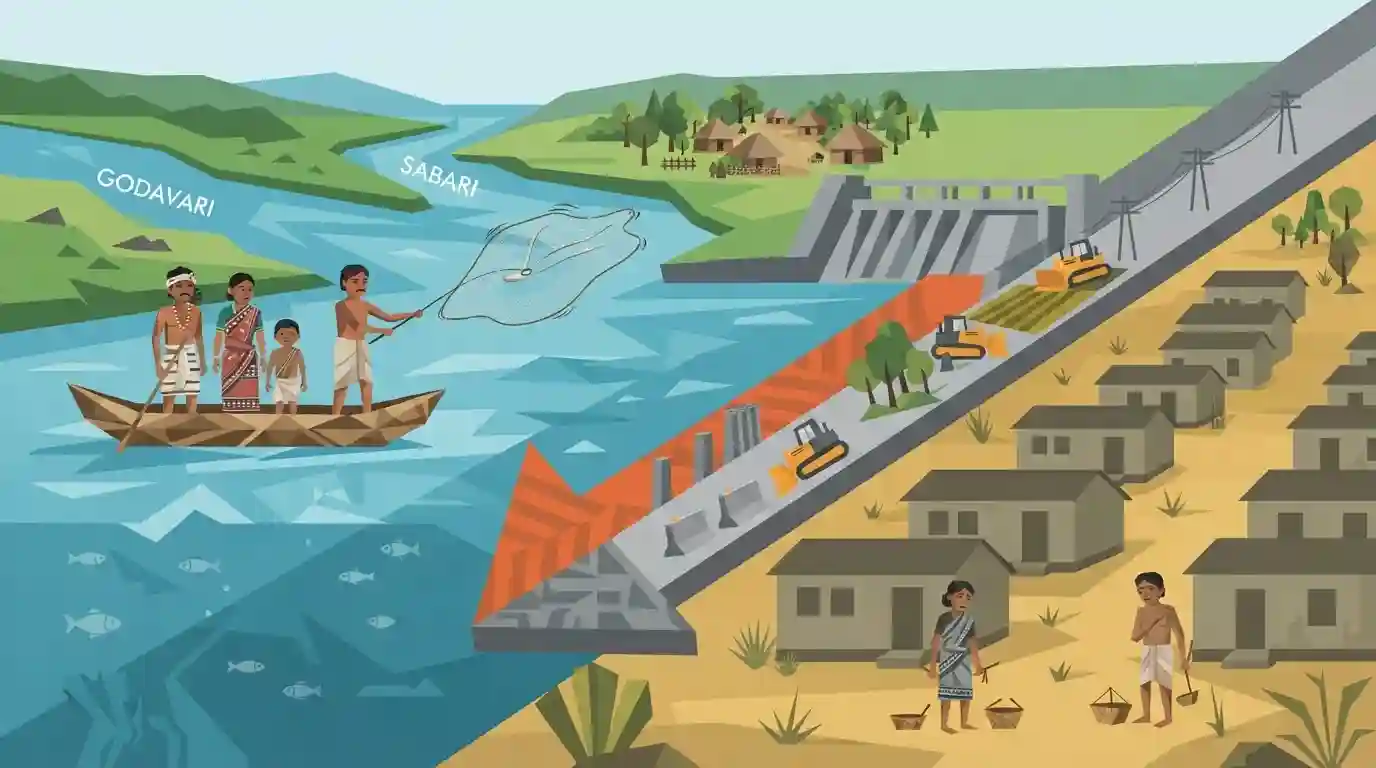
The impending Polavaram irrigation project threatens the traditional riverine lifestyle of the Koya tribals, who are currently casting their traditional fishing nets (*Pander Valla*) in the Godavari and Sabari floods. The tribals face displacement from their ancestral habitats in the AP-Telangana-Chhattisgarh border region, as Rehabilitation and Resettlement (R&R) plans will relocate them to non-riverine areas, endangering their fishing-dependent livelihood and culture.
Key Points
- The Koya tribe, residing in the border regions of Andhra Pradesh, Telangana, and Chhattisgarh, is using their traditional hand-held fishing net, the Pander Valla, in the swollen Godavari and Sabari rivers.
- The Sabari River enters Andhra Pradesh at Chintoor in the Polavaram district before merging with the Godavari River.
- The impending completion of the Polavaram irrigation project poses a massive submergence threat, leading to the displacement of Koya tribals from their ancestral riverine habitats.
- Under the Rehabilitation and Resettlement (R&R) plan, the Koyas are slated to be relocated to regions devoid of rivers, which threatens to extinguish their traditional fishing livelihood and river-centric cultural practices.
Important Terms
Polavaram Irrigation Project

A massive multi-purpose national irrigation project under construction on the Godavari River in Andhra Pradesh. It aims to provide irrigation, hydropower, and drinking water, alongside inter-basin water transfer to the Krishna river basin.
UPSC context
Highly relevant for GS-1 and GS-3. Tests knowledge on inter-state water disputes, river interlinking, and socio-environmental impacts like displacement.
Koya Tribe
A major tribal community residing primarily in the Godavari region across Andhra Pradesh, Telangana, Chhattisgarh, and Odisha. Traditionally practitioners of Podu cultivation, their riverine culture and livelihoods are severely threatened by dam displacements.
UPSC context
Important for GS-1 (Indian Society) and Anthropology. Tests knowledge of tribal habitats, vulnerable groups, and cultural displacement by infrastructure.
Sabari River
A major left-bank tributary of the Godavari River that originates in the Eastern Ghats of Odisha. It flows to form a natural border between Chhattisgarh and Odisha before entering Andhra Pradesh.
UPSC context
Vital for GS-1 (Indian Geography) and Prelims mapping questions focusing on Peninsular river tributaries, origin points, and state boundaries.
Rehabilitation and Resettlement (R&R)
The legal and policy framework—guided by the LARR Act 2013—aimed at mitigating development-induced displacement by mandating fair compensation, social impact assessments, and livelihood restoration for affected communities.
UPSC context
Crucial for GS-2 (Social Justice) and GS-3 (Development). Evaluates the balance between national infrastructure goals and vulnerable human rights.
Prelims Trap
"The Polavaram project facilitates water transfer from the Krishna basin to the Godavari basin."
This reverses the flow direction. The Polavaram inter-basin linkage actually diverts surplus floodwaters FROM the Godavari river basin TO the Krishna river basin.
Static Concepts Connected
What are the principal tributaries and features of the Godavari river system?
- Source: Originates at Trimbakeshwar in the Western Ghats (Nashik district, Maharashtra).
- Left Bank Tributaries: Pranahita (largest), Indravati, and Sabari (which merges with the Godavari near Kunavaram in Andhra Pradesh).
- Right Bank Tributaries: Pravara, Manjira, and Manair.
What frameworks protect Scheduled Tribes from arbitrary displacement by development projects?
- PESA Act, 1996: Mandates prior consultation with the Gram Sabha or Panchayats before acquiring land for projects in Scheduled V Areas.
- Xaxa Committee Report: The 2014 High-Level Committee noted that STs form 40% of India's dam-displaced population, advocating for robust R&R policies.
- LARR Act, 2013: Requires Social Impact Assessment and ensures fair compensation and rehabilitation for project-affected families.
Cross-Topic Patterns
Inter-basin transfers vs. Schedule V
Large projects like Polavaram (Godavari-Krishna linkage) frequently clash with Fifth Schedule protections, triggering PESA and Forest Rights Act debates over involuntary tribal displacement.
Tribal ecology mapping
UPSC increasingly links tribal identities to their ecological niches, resembling past questions matching the Changpa (cold desert) or Kharai camels (mangroves) to their specific geographic habitats.

Expect a paired-matching Prelims question linking specific tribes (like Koya, Gond) to their traditional river basins (Godavari) in 2026.
Linked PYQs · 2
Linked PYQs · 2
- 2023APPSC_PRELIMSGS1
Polavaram Project is a
- 2024APPSC_PRELIMSGS1
Within India, Ganga river basin has the largest catchment area. After that, following is the correct sequence in the decreasing order:
