Manipur Ethnic Conflict Demands and Separate Administration Issues
Source:Indian Express ↗
Why It Matters
The Manipur conflict represents a critical internal security challenge with multi-dimensional UPSC relevance. It touches upon GS3 topics like border management (India-Myanmar border) and internal peace processes, GS2 aspects of constitutional provisions for Scheduled Tribes and demands for regional autonomy/separate administration, and GS1 themes of ethnic identity and regionalism.
Summary
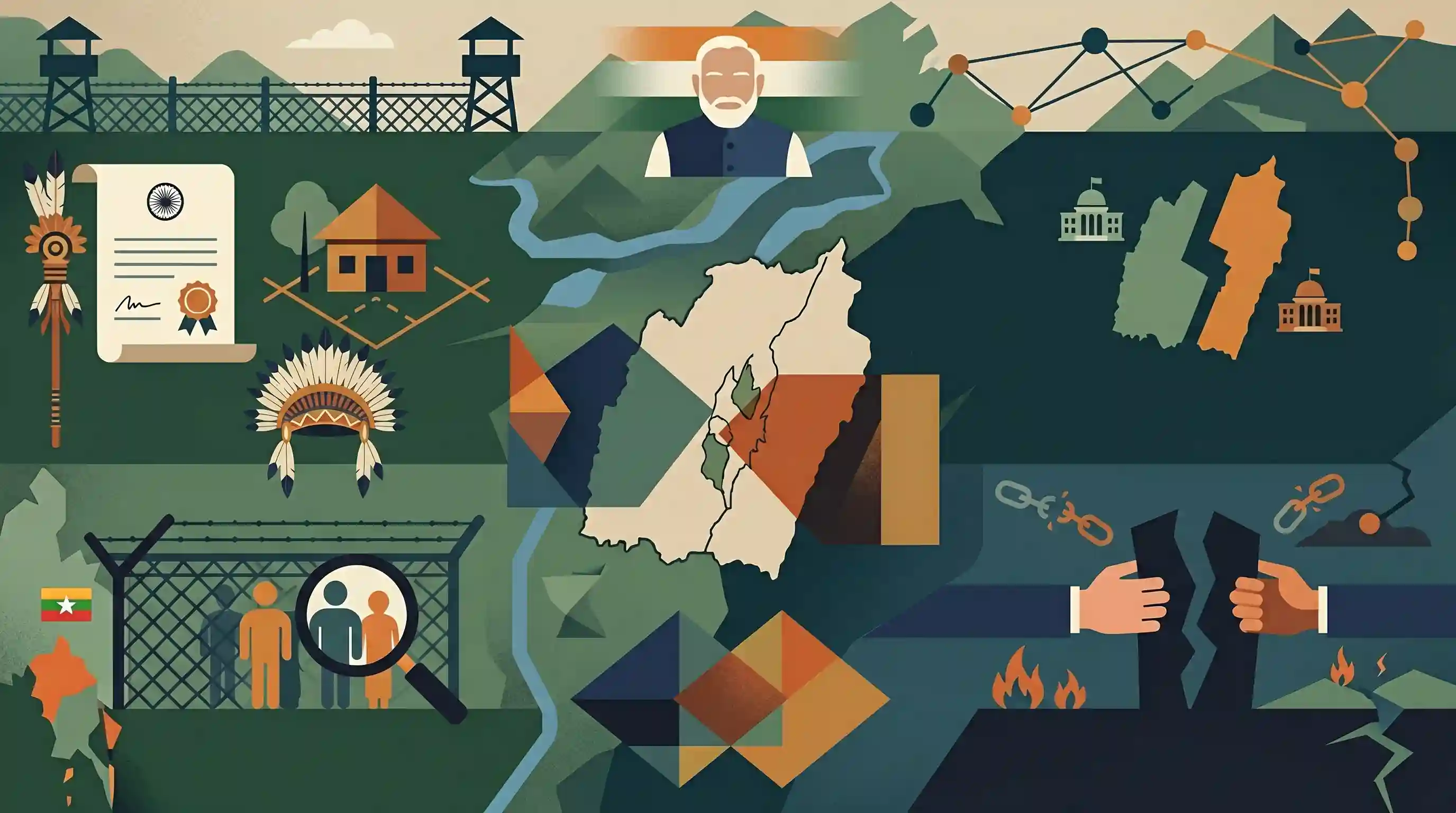
The article examines the ongoing ethnic crisis in Manipur between the majority Meitei community and the tribal Kuki-Zomi groups, coinciding with Prime Minister Narendra Modi's visit to the state. The conflict is driven by competing demands: Meiteis are advocating for Scheduled Tribe (ST) status to secure their land rights and the implementation of the NRC to curb illegal immigration from Myanmar. Conversely, the Kukis are demanding a "separate administration," arguing that the severe violence and complete breakdown of trust make coexistence under the current state administration impossible. The crisis highlights profound issues regarding ethnic identity, land rights, constitutional autonomy, and border security in Northeast India.
Key Points
- PM Modi is visiting Manipur against the backdrop of a prolonged and violent ethnic conflict between the Meitei and Kuki communities.
- Meiteis are primarily demanding Scheduled Tribe (ST) status to protect their ancestral lands and cultural identity from being marginalized.
- Meiteis also demand the implementation of the National Register of Citizens (NRC) to identify and deport illegal immigrants coming across the porous border from Myanmar.
- Kukis are demanding a "separate administration" (such as a separate state or Union Territory), asserting that trust with the Meitei-dominated state government has completely broken down due to the violence.
- The situation underscores critical internal security challenges, the complexities of ethnic identity, and the geopolitical implications of the India-Myanmar border.
Important Terms
National Register of Citizens (NRC)

An official record of legal Indian citizens. In Manipur, its implementation is demanded to identify and deport illegal immigrants, primarily from Myanmar, to protect indigenous demographic interests and resources.
UPSC context
GS Paper 2/3: Tests understanding of border management, illegal migration, and internal security challenges in Northeast India.
Scheduled Tribes (ST) List
A constitutional list (Article 342) of communities eligible for affirmative action and land protection. Meitei inclusion is a central flashpoint, opposed by existing STs who fear losing quotas and land.
UPSC context
GS Paper 2: Knowledge of Article 342, criteria for tribal status, and federal-state dynamics in reservation policy.
Article 371C
A special constitutional provision for Manipur empowering the President to constitute a Hill Areas Committee (HAC) within the state assembly to safeguard tribal interests and manage hill-district administration.
UPSC context
GS Paper 2: Tests understanding of 'Special Provisions for States' (Part XXI) and asymmetric federalism in India.
Separate Administration
A political demand by Kuki-Zomi groups for a governance setup independent of the Manipur state government, typically seeking a Union Territory or Sixth Schedule status due to ethnic segregation.
UPSC context
GS Paper 3: Tests themes of regionalism, internal security, and constitutional mechanisms for ethnic autonomy.
Kuki-Zomi groups
A cluster of ethnic groups (Chin-Kuki-Mizo-Zomi) inhabiting Manipur’s hills. They demand separate administration and oppose Meitei ST status to protect their ancestral land rights and political representation.
UPSC context
GS Paper 3: Internal Security; tests knowledge of ethnic diversity and insurgency dynamics in the Northeast.
Meitei civil society organizations
Influential organizations (e.g., COCOMI) representing the majority valley-dwelling Meitei people. They advocate for Manipur's territorial integrity, NRC implementation, and ST status to secure valley land from encroachment.
UPSC context
GS Paper 2/3: Role of non-state actors and civil society in internal security and ethnic conflict resolution.
Prelims Trap
The hill districts of Manipur are administered through Autonomous District Councils under the Sixth Schedule of the Constitution.
Manipur's hill areas are protected under Article 371C (Hill Areas Committee) and state-level acts, not the Sixth Schedule (which only covers Assam, Meghalaya, Tripura, Mizoram).
Static Concepts Connected
How is a community added to the Scheduled Tribes (ST) list?
- Criteria: Recommendations are evaluated against the 1965 Lokur Committee norms: primitive traits, distinctive culture, geographical isolation, shyness of contact, and backwardness.
- Process: State Government recommendation goes to Tribal Affairs Ministry, then Registrar General of India, and finally the National Commission for Scheduled Tribes (NCST).
- Final Authority: The President issues the initial notification under Article 342; any subsequent inclusions or exclusions require an Act of Parliament.
What specific constitutional protections does Article 371C offer to Manipur?
- Hill Areas Committee: It provides for the creation of a 'Hill Areas Committee' in the State Assembly comprising MLAs elected directly from the designated hill areas.
- Governor's Role: The Governor of Manipur must submit an annual report to the President of India regarding the administration of the Hill Areas.
- Union Executive Power: The executive power of the Union extends to giving directions to the State Government regarding the administration of these specified hill areas.
Cross-Topic Patterns
Border management and FMR suspension
The suspension of the Free Movement Regime (FMR) links Manipur's ethnic conflict directly to India's border management strategies and geopolitical concerns regarding the Myanmar junta and refugee influx.
Topography driving ethnic conflict
The valley (10% area) vs hills (90% area) divide mirrors how physical geography and constitutional land-ownership rules combine to fuel structural demographic inequality and insurgency.

Expect a multi-statement question on Article 371C, Lokur Committee criteria, and Sixth Schedule exceptions for Northeast states in 2026.
Linked PYQs · 4
Linked PYQs · 4
- 2025MainsGS3
What are the major challenges to internal security and peace process in the North-Eastern States? Map the various peace accords and agreements initiated by the government in the past decade.
- 2019MainsGS3
Cross-border movement of insurgents is only one of the several security challenges facing the policing of the border in North-East India. Examine the various challenges currently emanating across the India-Myanmar border. Also, discuss the steps to counter the challenges.
- 2013MainsGS1
Growing feeling of regionalism is an important factor in generation of demand for a separate State. Discuss.
- 2016MainsGS1
What is the basis of regionalism? Is it that unequal distribution of benefits of development on regional basis eventually promotes regionalism? Substantiate your answer.
