National Green Tribunal Clearance for Great Nicobar Infrastructure
Source:Indian Express ↗
Why It Matters
The article perfectly captures the classic 'Environment vs. Development/Security' dilemma frequently tested in UPSC. It links the strategic significance of India's island territories in global geopolitics with critical ecological concerns like deforestation, EIA processes, and the survival of isolated tribes (Shompen).
Summary
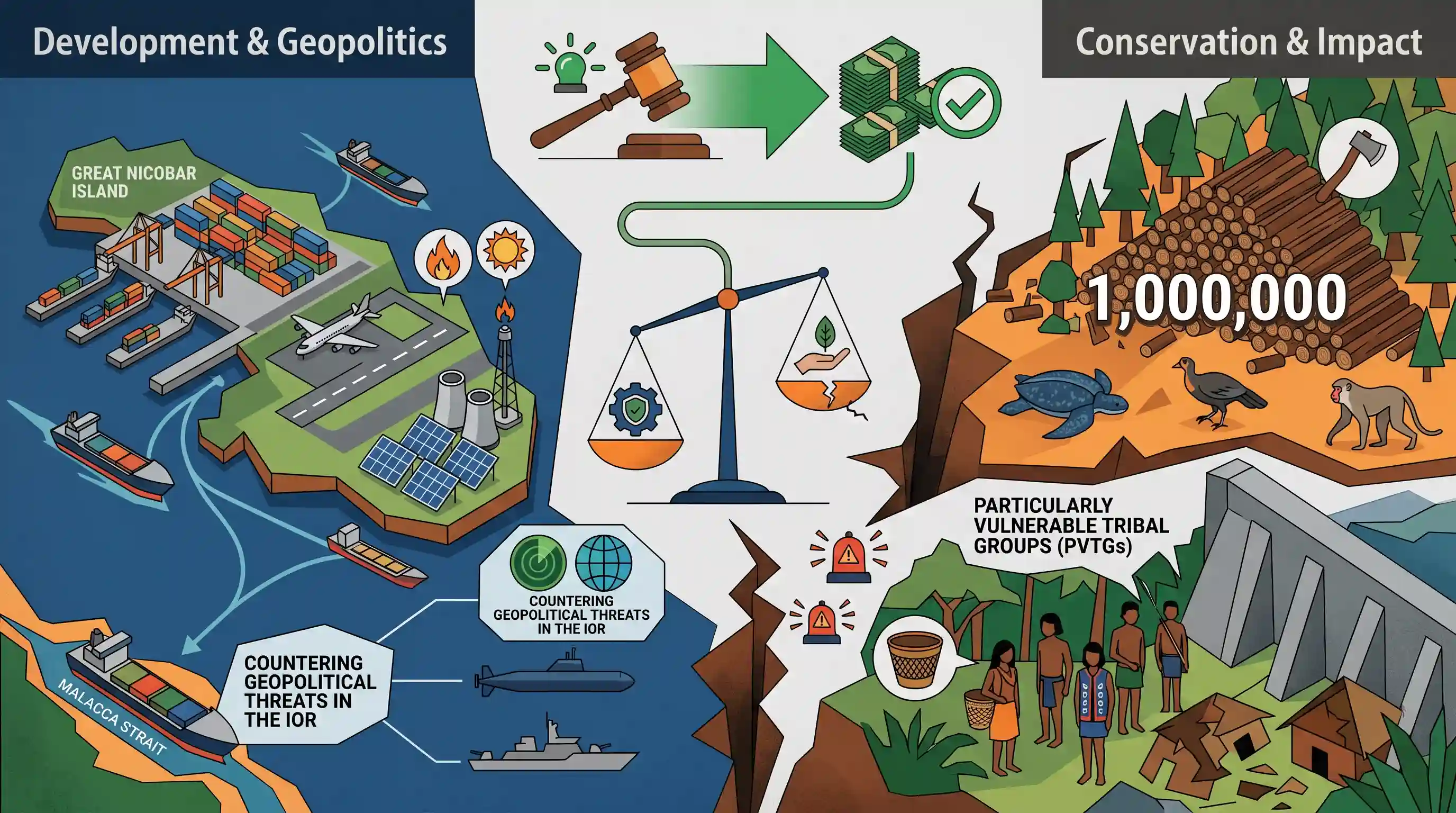
The National Green Tribunal (NGT) has given the green light to the ₹81,000-crore Great Nicobar project, setting the stage for the creation of a major strategic hub near the vital Malacca Strait. While the government emphasizes the project's necessity for maritime security and countering geopolitical threats in the Indian Ocean Region, environmentalists raise alarms over its ecological fallout. The development will require cutting down approximately one million trees, posing an existential threat to the region's rich biodiversity and the indigenous Particularly Vulnerable Tribal Groups (PVTGs) such as the Shompen.
Key Points
- The NGT has cleared the controversial ₹81,000-crore holistic development project for Great Nicobar Island.
- The massive infrastructure plan includes an international container transhipment terminal, a greenfield international airport, a power plant, and a township.
- Ecological concerns are severe as the project necessitates the felling of nearly one million trees, threatening endemic biodiversity and the habitats of vulnerable tribal groups like the Shompen and Nicobarese.
- Strategically, the island is positioned near the Malacca Strait, a crucial choke point for global trade and energy supply chains.
- The development is viewed as a necessary geostrategic move to enhance India's maritime security and counter China's growing naval presence in the Indian Ocean Region.
Important Terms
Great Nicobar Development Project

A ₹81,000-crore mega-infrastructure plan involving an international transshipment port at Galathea Bay, a dual-use airport, a power plant, and a greenfield city to boost India's maritime and strategic footprint.
UPSC context
GS-I (Geography), GS-III (Environment & Internal Security). Tests knowledge of strategic infrastructure and its trade-offs with biodiversity and tribal rights.
National Green Tribunal (NGT)
A statutory judicial body established under the NGT Act (2010) for the expedited disposal of environmental disputes, ensuring the enforcement of legal rights related to conservation and natural resources.
UPSC context
GS-II (Statutory Bodies) and GS-III (Environment). Tests understanding of environmental governance, judicial mechanisms, and the 'Polluter Pays' principle.
Environmental Impact Assessment (EIA)
A statutory process under the Environment (Protection) Act, 1986, used to evaluate and mitigate the potential environmental, social, and economic impacts of proposed developmental projects before granting clearance.
UPSC context
GS-III (Environment). Tests knowledge of the regulatory framework for sustainable development, public consultation stages, and recent legislative amendments.
Particularly Vulnerable Tribal Groups (PVTGs)
A sub-classification of Scheduled Tribes characterized by stagnant/declining populations, extremely low literacy, pre-agricultural technology, and subsistence economies, identified for focused protection and targeted welfare interventions.
UPSC context
GS-II (Social Justice & Vulnerable Sections). Tests awareness of tribal welfare criteria (Dhebar Commission) and constitutional safeguards for marginalized communities.
Shompen Tribe
A nomadic hunter-gatherer PVTG indigenous to the Great Nicobar Island's tropical rainforests, currently threatened by habitat fragmentation and displacement due to large-scale infrastructure development.
UPSC context
GS-I (Society) and GS-II (Tribal Rights). Frequently featured in questions regarding the impact of modernization on isolated indigenous cultures.
Malacca Strait
A critical 900-km maritime chokepoint between the Indian and Pacific Oceans; its proximity to Great Nicobar allows India to monitor global trade and counter regional geopolitical threats.
UPSC context
GS-II (International Relations) and GS-III (Security). Tests understanding of the 'Malacca Dilemma' and India's 'Act East' policy strategic positioning.
Prelims Trap
"Great Nicobar Island and its endemic biodiversity are located within the Indo-Burma biodiversity hotspot."
A classic UPSC geography trap. While the Andaman Islands are part of the Indo-Burma hotspot, the Nicobar Islands (including Great Nicobar) are part of the Sundaland biodiversity hotspot.
Static Concepts Connected
What are the criteria for classifying a community as a PVTG?
- Technology: A pre-agricultural level of technology (e.g., hunting, gathering).
- Population: A stagnant or declining population growth rate.
- Literacy: Extremely low levels of literacy compared to other tribal groups.
- Economy: A subsistence level of economy and severe economic backwardness.
What is the jurisdiction of the National Green Tribunal (NGT)?
- Statutory status: It is a statutory body established under the NGT Act 2010 to handle cases related to environmental protection and conservation.
- Covered Acts: It deals with civil cases under 7 major environmental laws, including the Water, Air, Environment Protection, and Forest Conservation Acts.
- Exemptions: Crucially, the Wildlife (Protection) Act, 1972 and the Forest Rights Act, 2006 are kept outside the NGT's jurisdiction.
Cross-Topic Patterns
Malacca Dilemma & Maritime Infrastructure
The Galathea Bay transhipment terminal directly addresses China's "Malacca Dilemma" by positioning Indian naval and commercial assets at the mouth of this critical global chokepoint, bridging infrastructure with maritime security.
Nesting Sites vs Mega-Infrastructure
Similar to the Olive Ridley mass nesting at Gahirmatha (Odisha), Galathea Bay's denotification risks the primary Northern Indian Ocean nesting site for the endangered Giant Leatherback turtle.

Expect a map-based Prelims question ordering the A&N islands N-to-S, linking Great Nicobar to Sundaland and the Malacca Strait.
Linked PYQs · 4
Linked PYQs · 4
- 2024MainsGS3
What role do environmental NGOs and activists play in influencing Environmental Impact Assessment (EIA) outcomes for major projects in India? Cite four examples with all important details.
- 2014MainsGS3
Environmental Impact Assessment studies are increasingly undertaken before a project is cleared by the Government. Discuss the environmental impacts of coal-fired thermal plants located at coal pitheads.
- 2009PrelimsGS1
In which one of the following places is the Shompen tribe found?
- 2017PrelimsGS1
Which of the following is geographically closest to Great Nicobar?
