Germany ramps up defense capabilities amid NATO spending revision
Source:Indian Express ↗
Why It Matters
Germany's rearmament marks a historic shift in global geopolitics. For India, a stronger, self-reliant Europe alters the global balance of power, contributing to multipolarity and potentially opening new avenues for strategic and defense partnerships beyond the traditional US-Russia paradigm.
Summary
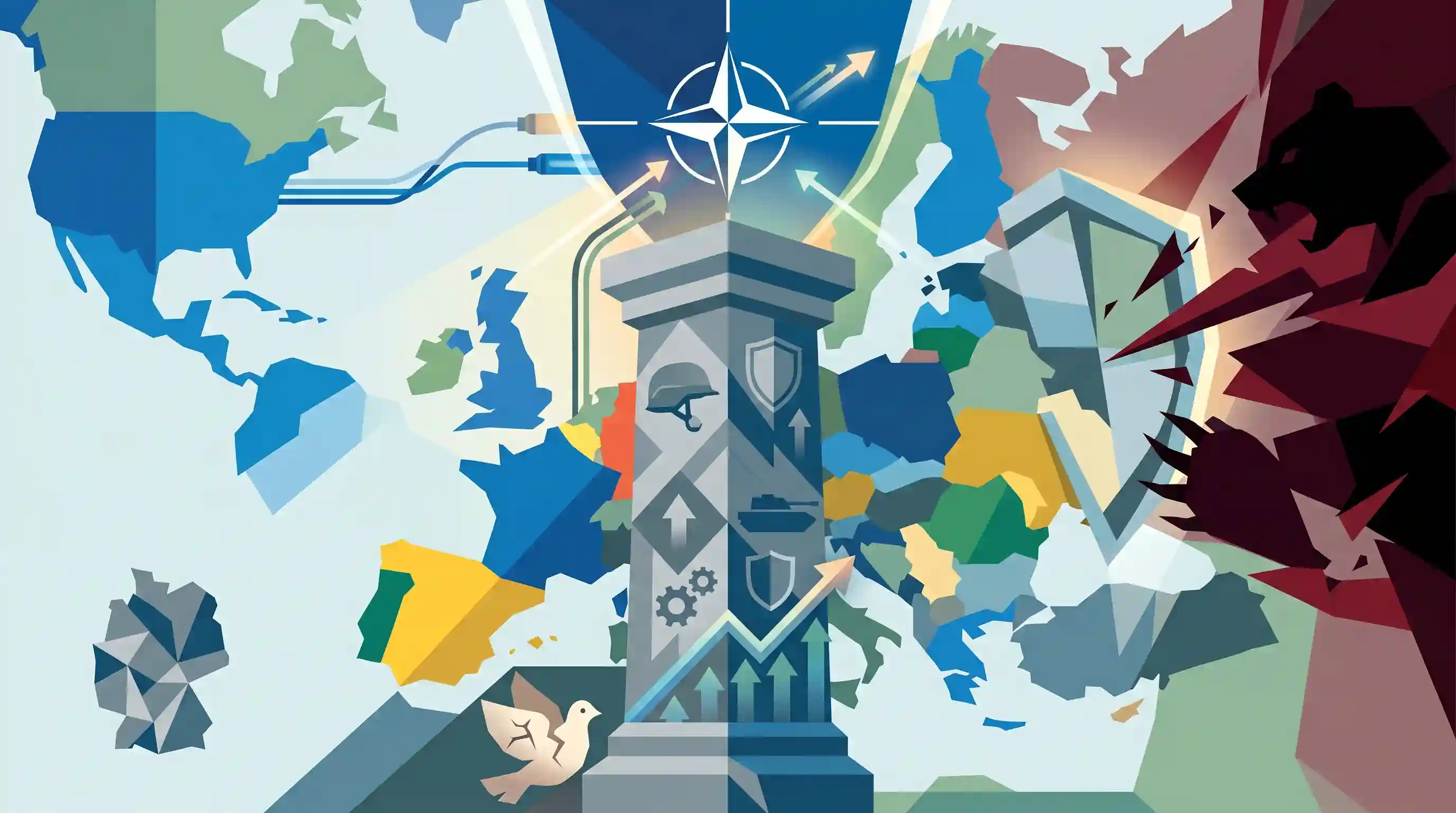
The article discusses Germany's significant shift in its defense and security policy, moving away from its post-WWII pacifism to become the "backbone of European security." This transformation is driven by NATO's upward revision of defence-spending goals and the geopolitical necessity of countering Russian aggression. By ramping up its military capabilities and defense budget, Germany aims to anchor the European defense architecture, compensating for potential shifts in US engagement and reinforcing the NATO alliance.
Key Points
- NATO is re-evaluating its defense spending targets, pushing member states to treat the traditional 2% of GDP baseline as a minimum floor rather than a ceiling in response to modern security threats.
- Triggered by the Russia-Ukraine war, Germany is undergoing a historic defense policy shift (Zeitenwende), discarding decades of post-WWII military restraint.
- Amidst uncertainties regarding future US security commitments to Europe, the continent is actively seeking greater strategic autonomy and self-reliance.
- Germany, Europe's largest economy, is strategically positioning itself to lead the European defense framework by heavily investing in its armed forces to serve as the primary conventional deterrent.
Important Terms
Zeitenwende

German for 'turning point,' it denotes the historic shift in Germany's foreign policy from post-WWII pacifism to active military rearmament following the 2022 Russian invasion of Ukraine.
UPSC context
GS II (International Relations): Impact of major powers' foreign policy shifts on global security architecture and India's strategic environment.
NATO (North Atlantic Treaty Organization)
An intergovernmental military alliance of 32 countries established in 1949 for collective defense. It is currently expanding its defense spending targets to 5% of GDP by 2035.
UPSC context
GS II (International Relations): Key global grouping shaping contemporary security paradigms and influencing India's defense and diplomatic choices.
Bundeswehr
The unified federal armed forces of Germany. Under new defense guidelines, it aims to become the 'strongest conventional army in Europe' to anchor continental security.
UPSC context
GS II (International Relations): Bilateral defense cooperation and the emergence of new security providers in the European theater.
Collective Defence
A foundational principle (NATO Article 5) stating that an attack on one member is an attack on all, necessitating a collective military response.
UPSC context
GS II (International Relations): Understanding the legal and operational foundations of international military alliances and collective security.
Strategic Autonomy
The capacity of a state or international organization (like the EU) to act independently in the field of security and defense with reduced reliance on external allies.
UPSC context
GS II (International Relations): Evolving geopolitical strategies of regional blocs and their implications for India's pursuit of multipolarity.
European Union (EU)
A political and economic union of 27 European member states that acts as Germany's 'framework for action' in developing shared defense and security policies.
UPSC context
GS II (International Relations): Regional groupings and institutional frameworks influencing India's trade and strategic ties with Europe.
Prelims Trap
Zeitenwende is a new NATO doctrine mandating a 2% GDP defense spending floor for all European Union members.
Zeitenwende is specifically Germany's historic domestic shift in foreign and defense policy, not an official NATO doctrine or European Union treaty.
Static Concepts Connected
What is NATO's Article 5 and how does it relate to collective defense?
- Collective Defense: An armed attack against one NATO member is considered an armed attack against them all.
- Past Invocation: It has only been invoked once in the alliance's history, following the 9/11 terrorist attacks on the United States.
- Geographic Scope: Under Article 6, the treaty geographically protects member territories in Europe, North America, and islands north of the Tropic of Cancer.
What is the genesis of NATO's 2% Defence Investment Guideline?
- Wales Summit 2014: The target was formally agreed upon at the 2014 Wales Summit following Russia's annexation of Crimea, urging members to halt defense budget cuts.
- Guideline vs Rule: Members committed to aim to move towards the 2% GDP guideline within a decade (by 2024). It is now shifting from a ceiling to a minimum floor.
Cross-Topic Patterns
Strategic Autonomy mirrors India's multi-alignment
Europe's push to reduce structural reliance on the US mirrors India's own strategic autonomy. This alignment creates fertile ground for Indo-German and Indo-French defense co-development.
EU re-arming limits Russian defense exports
As Germany and NATO bulk up conventional deterrence against Russia, India's own defense diversification away from Moscow accelerates, avoiding CAATSA risks and supply-chain bottlenecks.

Expect a Prelims match-the-following on defense terms (Zeitenwende, Strategic Compass) or a Mains Q on Europe's strategic autonomy in 2026.
Linked PYQs · 2
Linked PYQs · 2
- 2023MainsGS2
‘The expansion and strengthening of NATO and a stronger US-Europe strategic partnership works well for India.’ What is your opinion about this statement ? Give reasons and examples to support your answer.
- 2025PrelimsGS1
Consider the following countries : I. Austria II. Bulgaria III. Croatia IV. Serbia V. Sweden VI. North Macedonia How many of the above are members of the North Atlantic Treaty Organization?
