India Fertility Rate Decline Demands Demographic Policy Review
Source:Indian Express ↗
हे का महत्त्वाचे आहे
Understanding fertility transitions and replacement levels is vital for analyzing India's demographic dividend, population aging, and formulation of long-term socio-economic policies.
सारांश
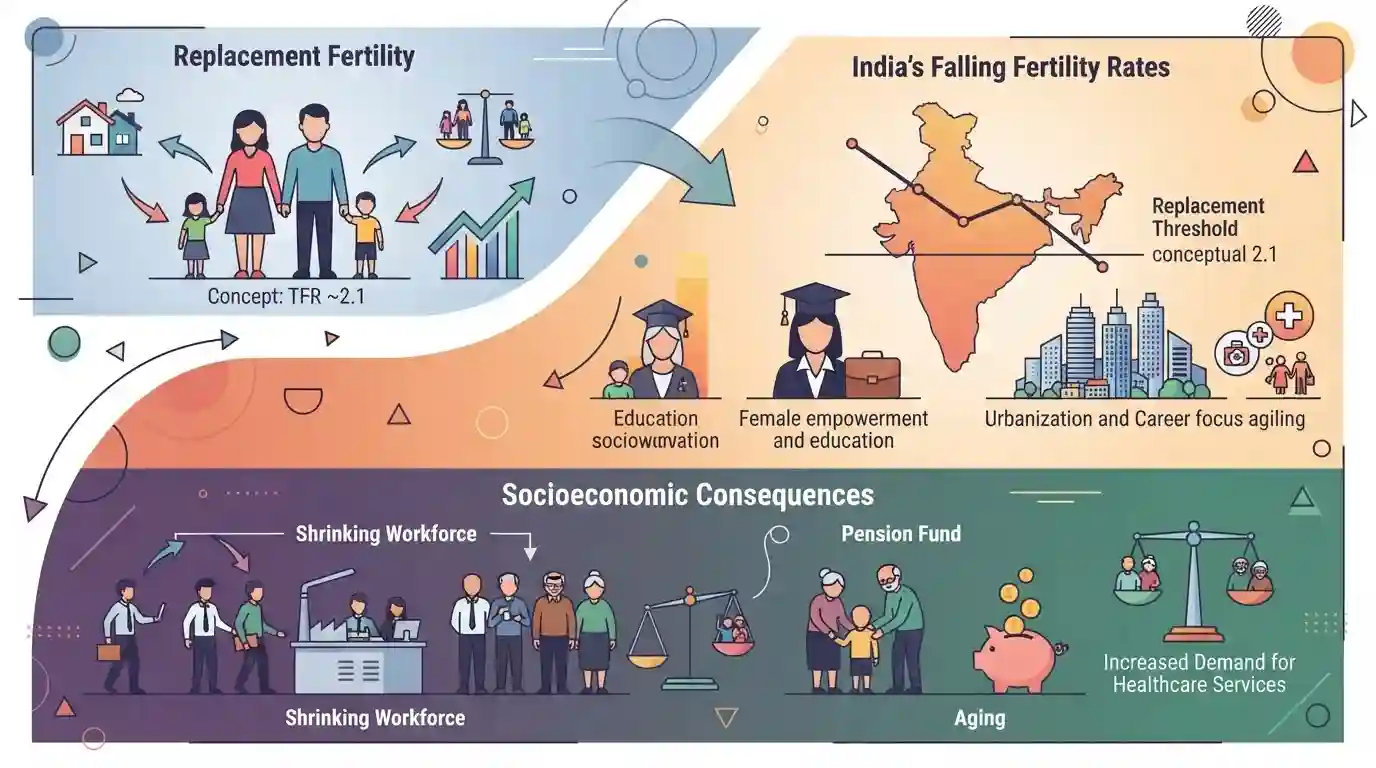
The article discusses the concept of replacement fertility and analyzes the implications of India's falling fertility rates. It examines what replacement fertility means demographically (traditionally a TFR of 2.1), why India's numbers are shifting below this threshold, and the socioeconomic consequences of a shrinking and aging population.
मुख्य मुद्दे
- India's Total Fertility Rate (TFR) is falling below the replacement level in many states, reflecting a broader demographic transition.
- Replacement fertility refers to the average number of children per woman needed to keep population stable without immigration, typically around 2.1 in developed nations, but can vary based on mortality rates.
- Falling fertility leads to population aging, shrinking workforce, and future pressure on social security systems, challenging traditional economic models reliant on population growth.
- Policymakers need to balance population stabilization policies with long-term planning for an aging demographic and changing labor market dynamics.
पूर्वपरीक्षा सापळा
replacement fertility is universally and strictly fixed at 2.1 children per woman across all countries and eras
Aspirants often assume replacement fertility is universally fixed at exactly 2.1 globally, ignoring that higher infant and child mortality rates in developing contexts can push the threshold above 2.1.
संबंधित स्थिर संकल्पना
What are the key demographic indicators used in India's National Family Health Survey (NFHS)?
- TFR Definition: Total Fertility Rate (TFR) is the average number of children that would be born to a woman over her lifetime if she were to experience the exact current age-specific fertility rates.
- Replacement Level: Replacement Level Fertility is approximately 2.1 children per woman, ensuring each generation exactly replaces itself without net migration.
- Sex Ratio: Sex Ratio at Birth (SRB) measures the number of female births per 1,000 male births, tracking sex-selective practices.
- Unmet Need: Unmet Need for Family Planning tracks married women who want to stop or delay childbearing but are not using contraception.
आंतर-विषय नमुने
Demographic Dividend vs Finance Commission Horizontal Devolution
Interstate demographic divergence creates asymmetrical fiscal pressures, testing the 15th/16th Finance Commission devolution formulas that reward population control versus elderly care burdens.
Sub-Replacement Fertility and Parliamentary Delimitation Politics
Falling TFR in southern states interacts with internal migration from northern states, shifting political representation via delimitation and altering labor markets.

Expect a multi-statement Prelims question pairing TFR definition with regional demographic divergence (North vs South).
संबंधित PYQ · 4
संबंधित PYQ · 4
- 2025MainsGS1
Discuss the distribution and density of population in the Ganga River Basin with special reference to land, soil and water resources.
- 2021MainsGS1
Discuss the main objectives of Population Education and point out the measures to achieve them in India in detail.
- 2013MainsGS1
Critically examine the effect of globalization on the aged population in India.
- 2024PrelimsGS1
The total fertility rate in an economy is defined as:
