AI in Classrooms and Outdated Assessment Methods in India
Source:Indian Express ↗
Why It Matters
Highlights the critical lag between adopting technology in pedagogy and updating assessment methods, arguing that without examination reform, India cannot effectively build a skilled, future-ready workforce for the 21st century.
Summary
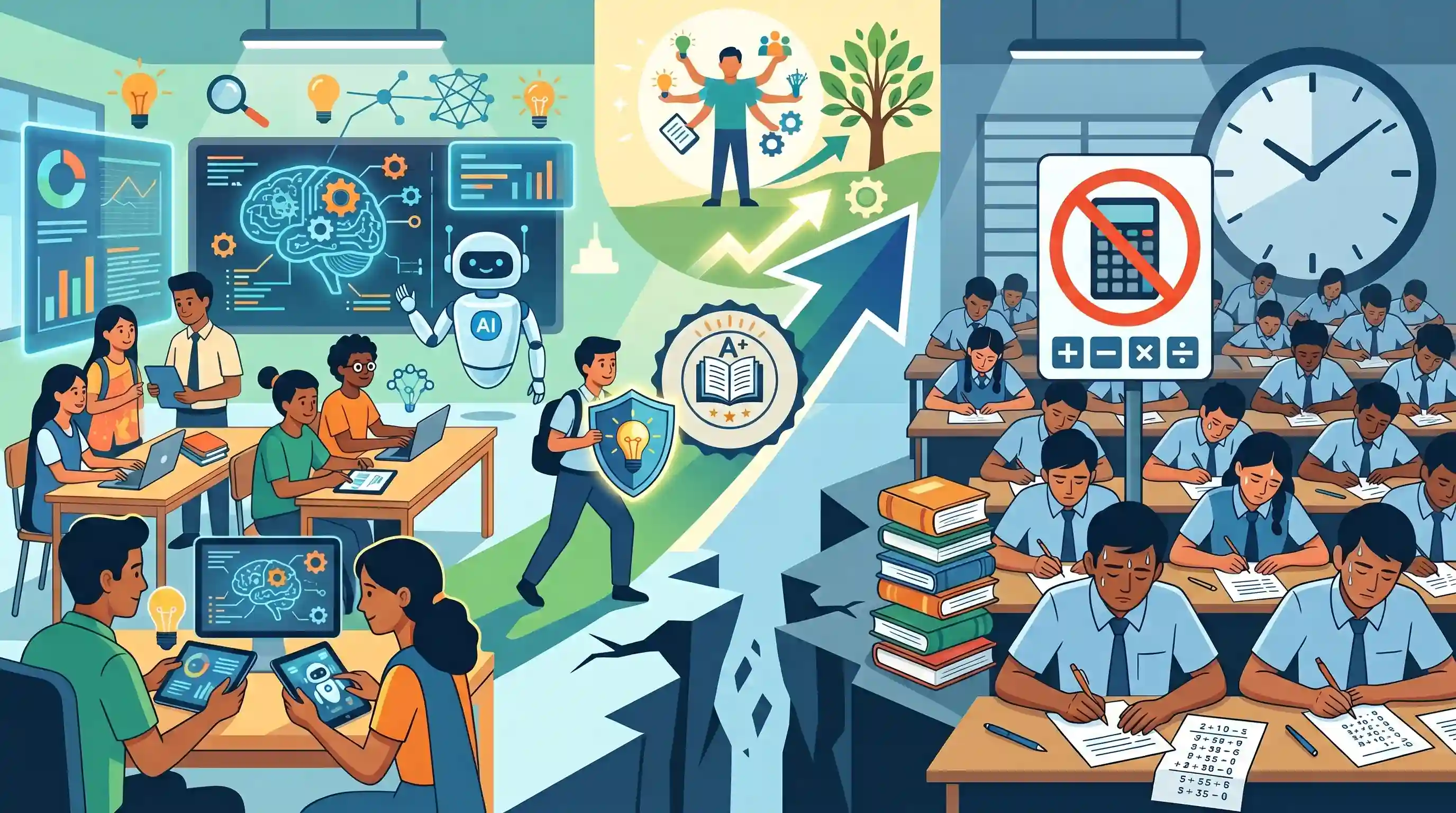
The article critiques the fundamental disconnect in India's education system, which embraces modern technologies like Artificial Intelligence in classrooms but retains outdated, rote-based assessment methods in exam halls. By continuing to ban basic tools like calculators, Indian exams test endurance and manual arithmetic rather than critical thinking and analytical skills. The author argues that true Human Resource Development and the vision of the National Education Policy 2020 will only be achieved when examination patterns are fundamentally reformed to evaluate higher-order cognitive abilities, preparing students for an AI-driven future where routine tasks are automated.
Key Points
- Highlights a paradox in Indian education: introducing AI in classrooms while maintaining archaic examination systems that ban calculators and test endurance and rote memorization.
- Argues that Indian exams disproportionately reward manual arithmetic speed and memory recall rather than the critical thinking and problem-solving skills needed in an AI-driven future.
- Stresses that as AI takes over routine cognitive tasks, human capital development must pivot toward higher-order thinking, making current evaluation paradigms obsolete.
- Suggests that true educational reform, as envisioned by NEP 2020, cannot be realized unless assessment methods are completely revamped to align with modern pedagogy.
Important Terms
National Education Policy (NEP) 2020

India's first 21st-century education framework replacing the 1986 policy. It introduces a 5+3+3+4 structure and emphasizes multidisciplinary learning, critical thinking, and a shift from rote learning.
UPSC context
GS Paper 2 (Social Justice - Education); foundational for questions on human capital and school/higher education reforms.
Human Resource Development (HRD)
The process of enhancing a nation's workforce through education, skilling, and health to drive economic growth and socio-economic progress.
UPSC context
GS Paper 3 (Economy) and GS Paper 2 (Education); crucial for discussions on demographic dividend and employability.
Artificial Intelligence (AI)
Technology that enables machines to simulate human cognitive functions like learning and problem-solving. In education, it aids personalized learning and automation of routine tasks.
UPSC context
GS Paper 3 (Science & Tech); focuses on technological advancements, ethics, and digital transformation in governance.
Rote Learning
A learning method based on memorizing information through repetition without deep conceptual understanding, often criticized for failing to foster analytical skills.
UPSC context
GS Paper 2 (Education); relevant to exam reform and the disconnect between academic and practical learning.
Higher-Order Thinking Skills (HOTS)
Advanced cognitive processes—including analysis, evaluation, and synthesis—that enable learners to apply knowledge creatively to solve complex, real-world problems.
UPSC context
GS Paper 2 (Education); key for assessment reform and shifting from recall-based to competency-based testing.
Prelims Trap
PARAKH was established under NEP 2020 to draft the new national curriculum framework for schools.
False. PARAKH is a national standard-setting body for student assessment and evaluation, while the curriculum drafting is the mandate of NCERT via the National Curriculum Framework (NCF).
Static Concepts Connected
What is the mandate of PARAKH under NEP 2020?
- Standard Setting: Formulates norms, standards, and guidelines for student assessment and evaluation across all recognized school boards in India.
- Competency Shift: Guides the transition of assessments towards competency-based learning, deliberately moving education away from rote memorization.
- Nodal Body: Functions as a constituent unit of NCERT tasked with conducting periodic assessments like the National Achievement Survey (NAS).
How does NEP 2020 reform examination and evaluation?
- Formative Assessment: Mandates a shift from high-stakes summative exams to regular formative assessments evaluating higher-order skills like critical thinking.
- Board Reforms: Redesigns Board exams to test core capacities and conceptual understanding rather than months of memorization.
- Holistic Report Card: Introduces a 360-degree multidimensional progress card reflecting cognitive, affective, and psychomotor domains, integrating self and peer assessment.
Cross-Topic Patterns
AI & India's Demographic Dividend
The paradox of rote-learning directly threatens India's demographic dividend. Without shifting to cognitive skill assessments, graduates face structural unemployment as AI automates routine tasks (GS2 Education + GS3 Economy).
Frontier Tech vs. Foundational Numeracy
Contrasts the high-end push for AI/semiconductor hubs (GS3 Tech) with ASER reports highlighting poor foundational numeracy (GS2), exposing a severe structural bottleneck in India's human capital funnel.

Mains GS2 2026: Expect a question linking NEP 2020's assessment reforms (PARAKH) to India's readiness for the AI-driven global job market.
Linked PYQs · 3
Linked PYQs · 3
- 2020MainsGS2
National Education Policy 2020 is in conformity with the Sustainable Development Goal-4 (2030). It intends to restructure and reorient education system in India. Critically examine the statement.
- 2023MainsGS2
The crucial aspect of development process has been the inadequate attention paid to Human Resource Development in India. Suggest measures that can address this inadequacy.
- 2023MainsGS3
Introduce the concept of Artificial Intelligence (AI). How does Al help clinical diagnosis? Do you perceive any threat to privacy of the individual in the use of Al in healthcare?
