Exclusion of Soyabean Farmers from Commodity Futures Market
Source:Indian Express ↗
Why It Matters
Agricultural commodity derivatives are critical for price discovery and risk management. UPSC aspirants must understand how suspending futures trading to control retail inflation negatively impacts farmers' ability to hedge against price volatility, creating a structural barrier to income stabilization.
Summary
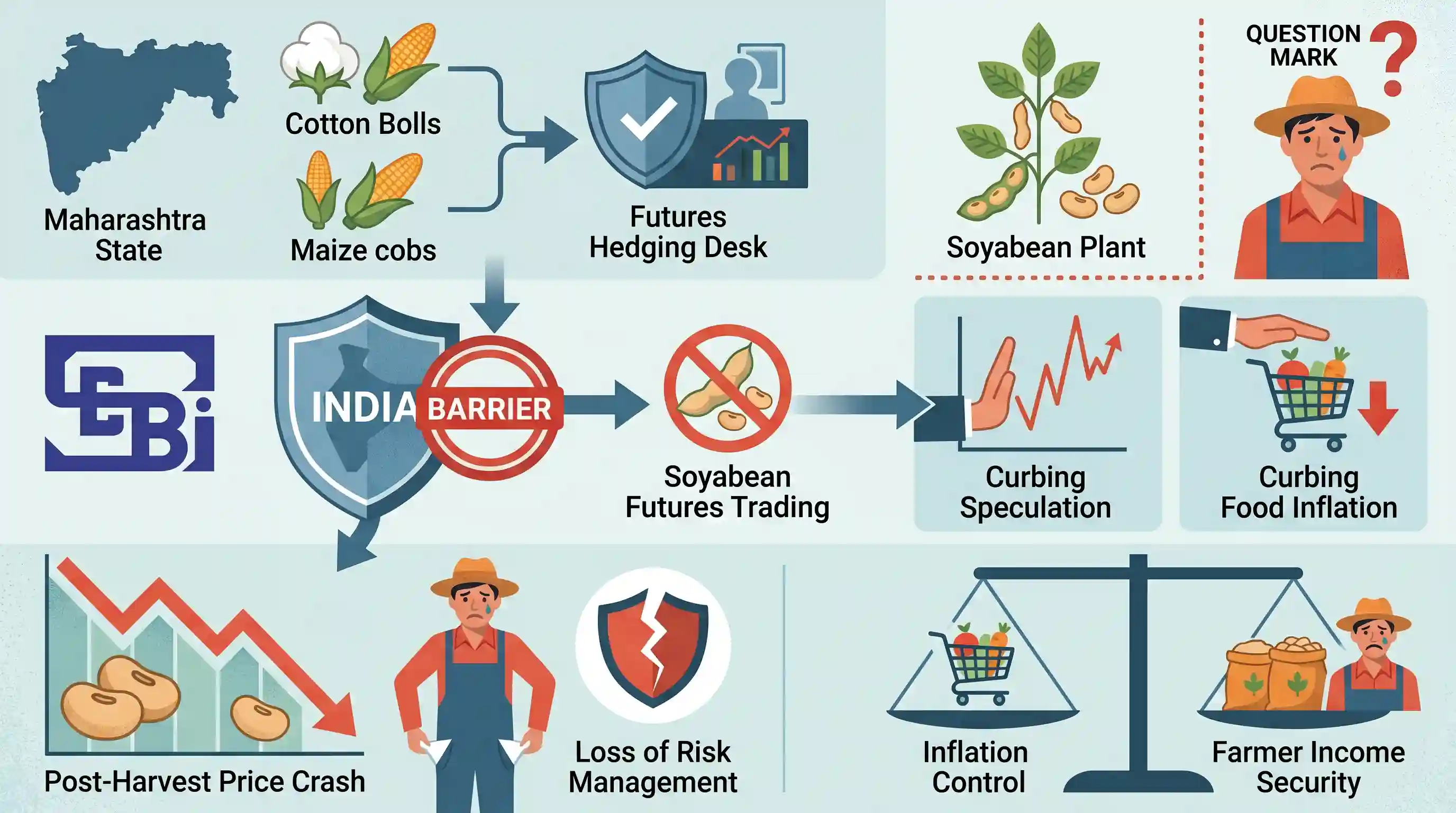
As hedging desks are introduced for cotton and maize farmers in Maharashtra to facilitate futures trading, soyabean farmers are questioning their exclusion. SEBI has historically suspended futures trading in essential agricultural commodities like soyabean to curb speculation and retail inflation. However, this policy deprives farmers of vital risk management tools and price discovery mechanisms, leaving them exposed to post-harvest price crashes and highlighting the conflict between inflation control and farmer income security.
Key Points
- Hedging desks are being set up for cotton and maize farmers in Maharashtra, enabling them to use futures markets to lock in prices and manage risk.
- Soyabean farmers are currently excluded from this facility, leading to frustration as they remain exposed to spot market price volatility.
- The Securities and Exchange Board of India (SEBI) had previously suspended futures trading in several key agricultural commodities—including soyabean, mustard, chana, and wheat—to curb speculation and control retail food inflation.
- Without access to commodity derivatives and futures contracts, soyabean farmers lack a reliable forward-looking price discovery mechanism, leaving them vulnerable to price crashes at harvest time.
- The exclusion highlights the persistent policy tension between controlling consumer food inflation and providing farmers with financial tools to secure their incomes.
Important Terms
SEBI (Securities and Exchange Board of India)

Statutory regulator for India's securities and commodity markets; it oversees exchanges and can suspend trading to curb speculation or inflation.
UPSC context
GS III: Indian Economy; tests regulatory mechanisms and the trade-off between inflation control and farmer income security.
NCDEX (National Commodity & Derivatives Exchange)
India's primary technology-driven commodity exchange focused on agricultural products, facilitating the trading of futures and options for crops like cotton and maize.
UPSC context
GS III: Agricultural Marketing; evaluates market infrastructure and electronic trading platforms for primary produce.
Farmer Producer Organisations (FPOs)
Collectives of small and marginal farmers formed to leverage economies of scale in procurement, processing, and marketing of agricultural produce.
UPSC context
GS II/III: Governance and Agriculture; tests institutional interventions for farmer empowerment and doubling farm income.
Hedging
A risk management strategy where farmers or traders take an offsetting position in the futures market to protect against price volatility.
UPSC context
GS III: Indian Economy/Agriculture; assesses knowledge of financial tools for stabilizing agricultural income against market shocks.
Price Discovery
The process by which the market determines the fair price of a commodity based on real-time supply and demand data.
UPSC context
GS III: Agriculture; tests understanding of market efficiency and the importance of information transparency in trade.
Futures Contract
A standardized legal agreement to buy or sell a specific commodity at a predetermined price at a specified date in the future.
UPSC context
GS III: Economy; examines derivatives trading and its role in modernizing agricultural value chains.
Prelims Trap
"The Forward Markets Commission (FMC) regulates agricultural commodity futures in India."
The FMC was merged with SEBI in 2015. SEBI now regulates all commodity derivatives, including agricultural futures, and holds the power to suspend trading.
Static Concepts Connected
What is the difference between Hedging and Speculation in commodity futures?
- Hedging: Used by actual producers (like farmers/FPOs) or buyers to lock in prices in advance, minimizing risk from future post-harvest price crashes.
- Speculation: Used by traders seeking profit from price movements without any physical interest or ownership in the underlying agricultural commodity.
- SEBI intervention: SEBI suspends futures trading when speculators artificially drive up prices of essential commodities, which can spill over into retail food inflation.
How does price discovery in futures differ from the Minimum Support Price (MSP)?
- Futures Market: Provides 'forward-looking' price discovery based on expected future supply and demand, helping farmers make informed cropping decisions before sowing.
- MSP: Acts as a retrospective, fixed government safety net guaranteeing a floor price, but lacks real-time market demand signals.
Cross-Topic Patterns
APMC bypass via NCDEX futures
Farmer Producer Organisations (FPOs) bypassing traditional APMC mandis by using NCDEX futures for hedging represents the growing financialization of agricultural supply chains.
Inflation targeting vs. Farmer incomes
The suspension of agricultural futures highlights a classic macro-policy conflict: state interventions to shield consumers from food inflation actively deprive farmers of advanced price realization tools.

Expect a 2026 GS3 Prelims question testing SEBI's jurisdiction over agricultural commodity derivatives and its power to suspend trading.
Linked PYQs · 3
Linked PYQs · 3
- 2025MainsGS3
Elaborate the scope and significance of supply chain management of agricultural commodities in India.
- 2024MainsGS3
Elucidate the importance of buffer stocks for stabilizing agricultural prices in India. What are the challenges associated with the storage of buffer stock? Discuss.
- 2018MainsGS3
What do you mean by Minimum Support Price (MSP)? How will MSP rescue the farmers from the low income trap?
