Climate Finance Shortfall Threatens Global Health Systems Adaptation
Source:The Hindu ↗
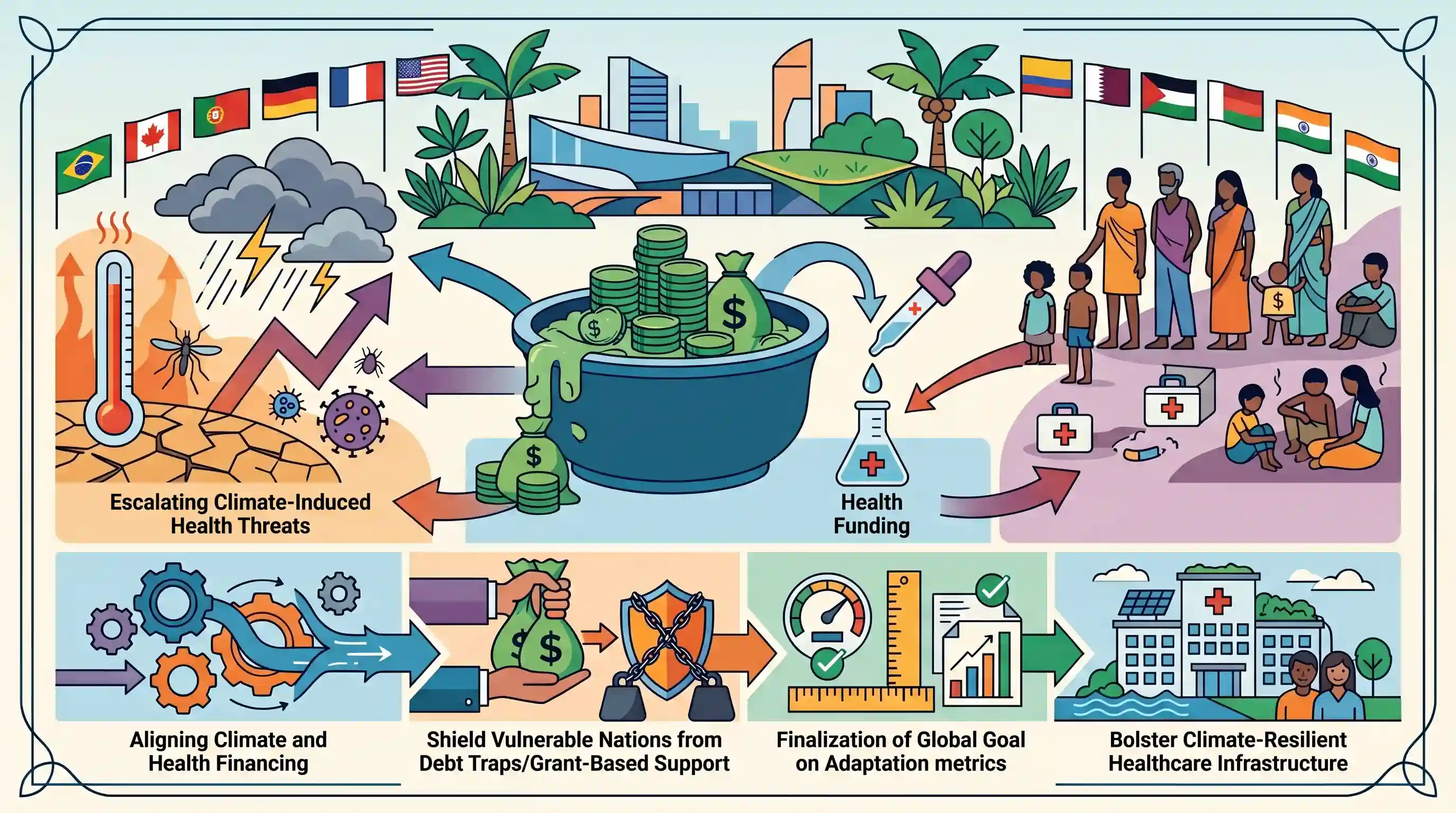
Why It Matters
The article is highly relevant for GS3 (Environment) and GS2 (Global Health & IR) as it connects climate change directly to public health vulnerabilities. It exposes the critical gaps in multilateral climate finance and highlights the diplomatic and economic struggle of developing nations seeking grant-based adaptation funding (like the Green Climate Fund). This informs topics on National Adaptation Plans (NAPs) and global negotiations at UNFCCC COPs.
Summary
As the COP30 UN Climate Summit commences in Belém, Brazil, a report by the think tank adelphi has highlighted an alarming shortfall in multilateral climate finance for global health systems. Despite widespread recognition of escalating climate-induced health threats, only 0.5% of multilateral climate funding has been directed towards health adaptation since 2004. Regions with extreme vulnerability, like South Asia and Sub-Saharan Africa, remain severely underfunded. The report advocates for an alignment of climate and health financing, emphasizing the need for targeted, grant-based support and the finalization of the Global Goal on Adaptation metrics to shield vulnerable nations from debt traps while bolstering climate-resilient healthcare infrastructure.
Key Points
- A report by 'adelphi' reveals that merely 0.5% ($173 million) of multilateral climate finance since 2004 has gone toward health systems adaptation, starkly trailing the $2.54 billion identified in national needs.
- While 87% of National Adaptation Plans (NAPs) submitted to the UNFCCC incorporate health objectives, less than 0.1% of their financial requirements have been met.
- Despite South Asia being projected to bear 18% of future climate-related health impacts, the region has not received a single country-specific health adaptation project from multilateral funds.
- The Green Climate Fund is the largest single contributor, accounting for over 70% of health-adaptation funding, but distribution is skewed heavily towards East Asia and the Pacific.
- At the COP30 summit (dubbed the "Adaptation COP") in Belém, Brazil, the presidency is expected to launch the Belém Health Action Plan to center health in adaptation negotiations.
- Experts emphasize the need for grant-based climate finance to support resilient health systems without plunging vulnerable, developing countries into further debt.
Important Terms
UNFCCC

The 1992 treaty established to stabilize greenhouse gas concentrations; it serves as the parent treaty for the Paris Agreement and Kyoto Protocol.
UPSC context
GS Paper 2/3: Core framework for international climate governance and the principle of Common but Differentiated Responsibilities.
Global Goal on Adaptation
A collective commitment under the Paris Agreement to enhance adaptive capacity, strengthen resilience, and reduce vulnerability to climate change globally.
UPSC context
GS Paper 3: Crucial for evaluating global progress on climate resilience and mobilizing adaptation finance for developing nations.
Green Climate Fund
A UNFCCC financial mechanism established to assist developing countries in both mitigation and adaptation practices, aiming for equitable funding distribution.
UPSC context
GS Paper 3: Tests knowledge of international climate finance architecture and resource transfers to vulnerable nations.
National Adaptation Plans (NAPs)
A UNFCCC-established process allowing nations to identify medium- and long-term adaptation needs and integrate them into national development planning.
UPSC context
GS Paper 3: Key for domestic policy questions on vulnerability reduction and India's national climate strategies.
Belém Health Action Plan
A COP30 framework dedicated to health adaptation, focusing on climate-proofing health systems, disease surveillance, and equitable medical infrastructure.
UPSC context
GS Paper 3: Significant for the 'Climate-Health Nexus' and new international commitments arising from the Brazil-led summit.
adelphi
A leading global think tank specializing in climate, environment, and development policy research, often cited in multilateral reports.
UPSC context
GS Paper 3: Source of data on the adaptation finance gap and global climate policy trends.
Center for Participatory Research and Development (CPRD)
A research organization focusing on climate justice, loss and damage, and the specific vulnerabilities of Least Developed Countries in South Asia.
UPSC context
GS Paper 2: Important for understanding regional South Asian perspectives and civil society's role in climate negotiations.
Prelims Trap
"South Asia receives the highest share of multilateral health-adaptation finance due to its vulnerability."
UPSC often uses logical-sounding but factually inverse statements. Despite high vulnerability, South Asia has received almost zero country-specific health adaptation multilateral funding.
Static Concepts Connected
What are the primary multilateral climate funds under the UNFCCC?
- Green Climate Fund (GCF): Established in 2010 (Cancun), it is the world's largest dedicated climate fund supporting developing countries in mitigation and adaptation.
- Global Environment Facility (GEF): Established in 1991, it acts as an operating entity of the UNFCCC financial mechanism alongside the GCF.
- SCCF & LDCF: Administered by the GEF, these funds specifically target adaptation needs and tech transfer for vulnerable nations.
What is the National Adaptation Plan (NAP) process under the UNFCCC?
- Origin: Established under the Cancun Adaptation Framework (2010) to help developing countries build climate resilience.
- Objective: Enables countries to identify medium- and long-term adaptation needs, integrating them into national planning.
- Nature: Unlike Nationally Determined Contributions (NDCs) which are heavily mitigation-focused, NAPs are country-driven, continuous adaptation strategies.
Cross-Topic Patterns
Climate Finance & Sovereign Debt
The demand for grant-based adaptation finance highlights the intersection of GS3 climate goals with GS2 macroeconomic realities, where climate-loans exacerbate developing nations' debt distress.
Adaptation metrics + Public Health
The shift from pure emission mitigation metrics to qualitative adaptation frameworks (like NAPs) links global UNFCCC negotiations directly to domestic healthcare and disaster infrastructure resilience.

Expect a 2026 Prelims question testing the mandate of the Green Climate Fund against the UNFCCC Global Goal on Adaptation metrics.
Linked PYQs · 3
Linked PYQs · 3
- 2025MainsGS3
Write a review on India's climate commitments under the Paris Agreement (2015) and mention how these have been further strengthened in COP26 (2021). In this direction, how has the first Nationally Determined Contribution intended by India been updated in 2022?
- 2021MainsGS3
Describe the major outcomes of the 26th session of the Conference of the Parties (COP) to the United Nations Framework Convention on Climate Change (UNFCCC). What are the commitments made by India in this conference?
- 2017MainsGS3
'Climate change' is a global problem. How India will be affected by climate change? How Himalayan and coastal states of India will be affected by climate change?
