Punjab Floods Trigger Centre State Friction Over Illegal Sand Mining
Source:Indian Express ↗
Why It Matters
The article is significant for UPSC aspirants as it bridges environmental issues (the impact of illegal sand mining on river ecosystems) with disaster management (causes of floods) and polity (Centre-State friction during crisis management). It provides a real-world example of how environmental degradation exacerbates natural disasters and highlights the need for cooperative federalism in disaster response.
Summary
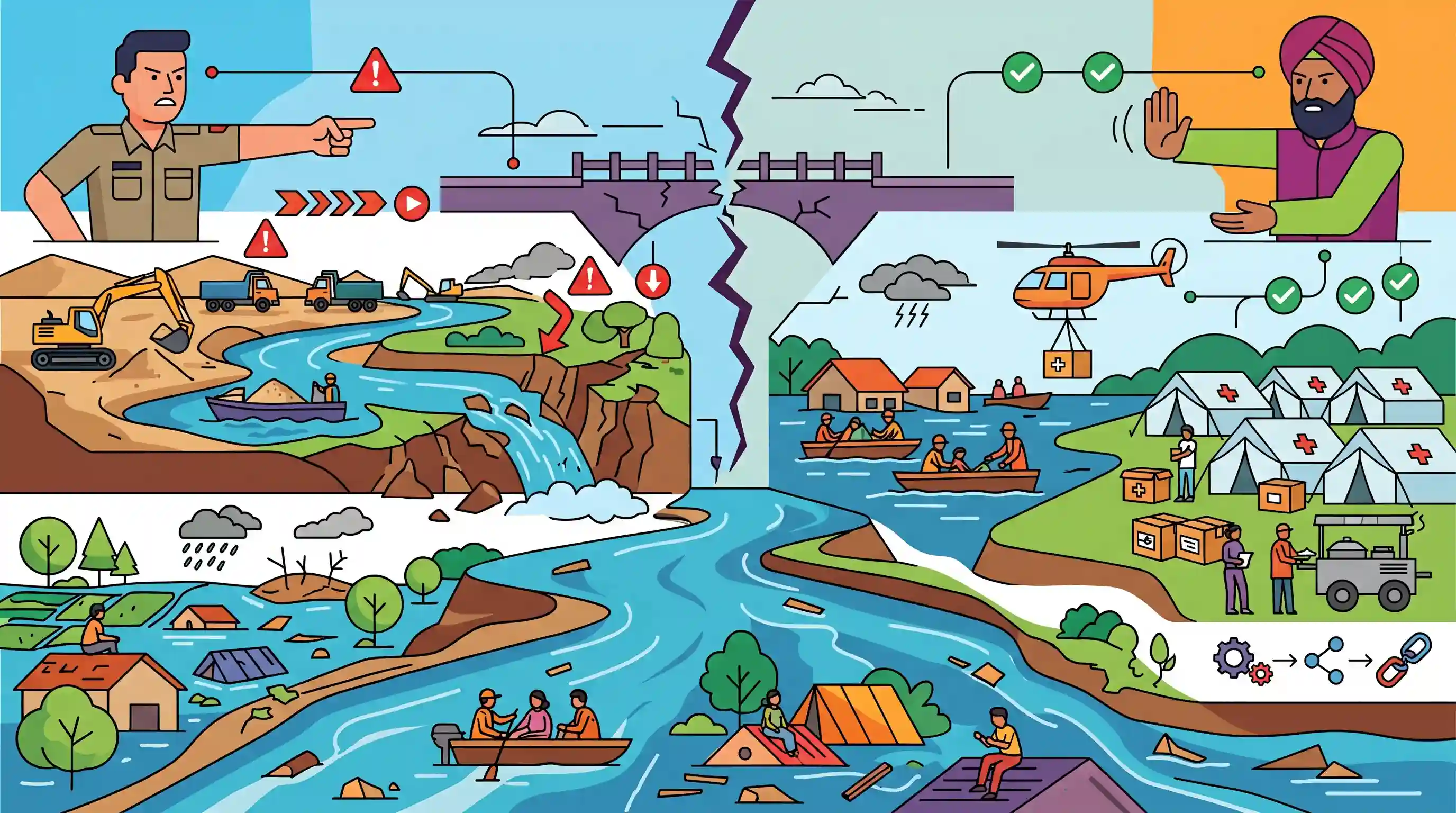
A political and administrative row has erupted between the Central government and the Punjab state government over the causes of recent floods in Punjab. The Centre alleged that illegal sand mining, which compromises river embankments and natural water flows, is primarily responsible for the flooding. In response, the Punjab government rebuked the Centre, urging it to assume responsibility for disaster management and relief rather than shifting the blame. This incident highlights the critical environmental impacts of unscientific sand mining and reflects ongoing challenges in Centre-State coordination during disaster response.
Key Points
- The Central government has attributed the recent floods in Punjab to rampant illegal sand mining in the state.
- Illegal sand mining severely degrades riverine ecosystems by weakening river embankments, altering natural water flow, and reducing the carrying capacity of rivers, thereby exacerbating flood risks.
- The Punjab state government strongly rejected the Centre's allegations, accusing the Union government of evading its own responsibilities in disaster management and relief.
- This dispute underscores the friction in Centre-State relations and the frequent politicization of disaster management and accountability during natural calamities.
Important Terms
Illegal Sand Mining

Extraction of riverbed sand without legal permits, which destabilizes river ecosystems, worsens erosion, and increases the frequency and severity of floods.
UPSC context
GS3 (Environment & Disaster Management); tests environmental degradation's impact on disaster vulnerability.
Minor Minerals
A legal classification under the MMDR Act, 1957, including sand and gravel, for which state governments hold exclusive regulatory and rule-making authority.
UPSC context
GS3 (Resources/Geography); tests knowledge of mineral laws and the division of powers.
Sustainable Sand Management Guidelines (SSMG)
MoEFCC frameworks (2016, 2020) mandating scientific mining, replenishment studies, and surveillance technologies like drones to curb illegal extraction and protect river ecology.
UPSC context
GS3 (Environmental Governance); tests awareness of policy interventions for sustainable resource extraction.
River Embankments
Man-made levees constructed along riverbanks to contain water; unscientific mining causes riverbed deepening and bank erosion, weakening these structures and leading to breaches.
UPSC context
GS3 (Disaster Management/Geography); tests knowledge of flood-control infrastructure and its failure mechanisms.
Disaster Management Act, 2005
The 2005 legislation establishing the NDMA and SDMAs, creating a legal mandate for a proactive, multi-tier approach to disaster preparedness and response.
UPSC context
GS3 (Disaster Management) & GS2 (Governance); tests understanding of the institutional framework for crisis handling.
Centre-State Relations
The constitutional division of powers where coordination between the Union and States is essential for managing resources like sand and responding to emergencies.
UPSC context
GS2 (Polity); tests dynamics of cooperative federalism and administrative accountability during regional crises.
Prelims Trap
"The Central government has the statutory authority to frame rules preventing illegal sand mining."
Sand is legally a "minor mineral." Under Section 23C of the MMDR Act, State governments—not the Centre—hold exclusive statutory power to frame rules preventing its illegal mining and transportation.
Static Concepts Connected
How is sand regulated as a minor mineral under the MMDR Act, 1957?
- Central Notification: The Central Government holds the exclusive power to notify which minerals are classified as 'minor minerals' under Section 3(e) of the Act.
- State Regulation: State governments possess the statutory authority to frame rules for granting leases, regulating extraction, and preventing illegal mining of minor minerals.
- Environmental Clearance: Following the Supreme Court's 2012 Deepak Kumar judgment, mandatory prior Environmental Clearance (EC) is required for all sand mining, regardless of lease size.
How does unscientific sand mining exacerbate flood hazards?
- Riverbed Incision: Excessive extraction deeply lowers the riverbed, increasing downstream water flow velocity which violently erodes bridges and infrastructure.
- Embankment Destabilization: Mining near the banks undercuts natural protective levees, making them highly prone to collapse during sudden, high-discharge monsoon surges.
- Loss of Buffers: Removing sand diminishes the river's natural floodplain sponge effect, reducing groundwater recharge and accelerating immediate surface runoff.
Cross-Topic Patterns
Politicization of Disaster Management
Blame games over floods mirror recurring Centre-State friction over NDRF allocations and the Disaster Management Act, repeatedly testing India's cooperative federalism during natural crises.
Judicial bridging of environmental gaps
Because States control minor minerals, environmental oversight often defaults to the judiciary, echoing NGT bans on monsoon sand mining and SC mandates for ecological clearances.

Expect a 2026 prelims multi-statement question blending the statutory classification of minor minerals with mandatory environmental clearance.
Linked PYQs · 3
Linked PYQs · 3
- 2019MainsGS3
Coastal sand mining, whether legal or illegal, poses one of the biggest threats to our environment. Analyze the impact of sand mining along the Indian coasts, citing specific examples.
- 2024MainsGS3
Flooding in urban areas is an emerging climate-induced disaster. Discuss the causes of this disaster. Mention the features of two such major floods in the last two decades in India. Describe the policies and frameworks in India that aim at tackling such floods.
- 2024MainsGS2
What changes has the Union Government recently introduced in the domain of Centre-State relations ? Suggest measures to be adopted to build the trust between the Centre and the States and for strengthening federalism.
