Slum clean cooking fuel distribution and winter pollution mitigation
Source:The Hindu ↗
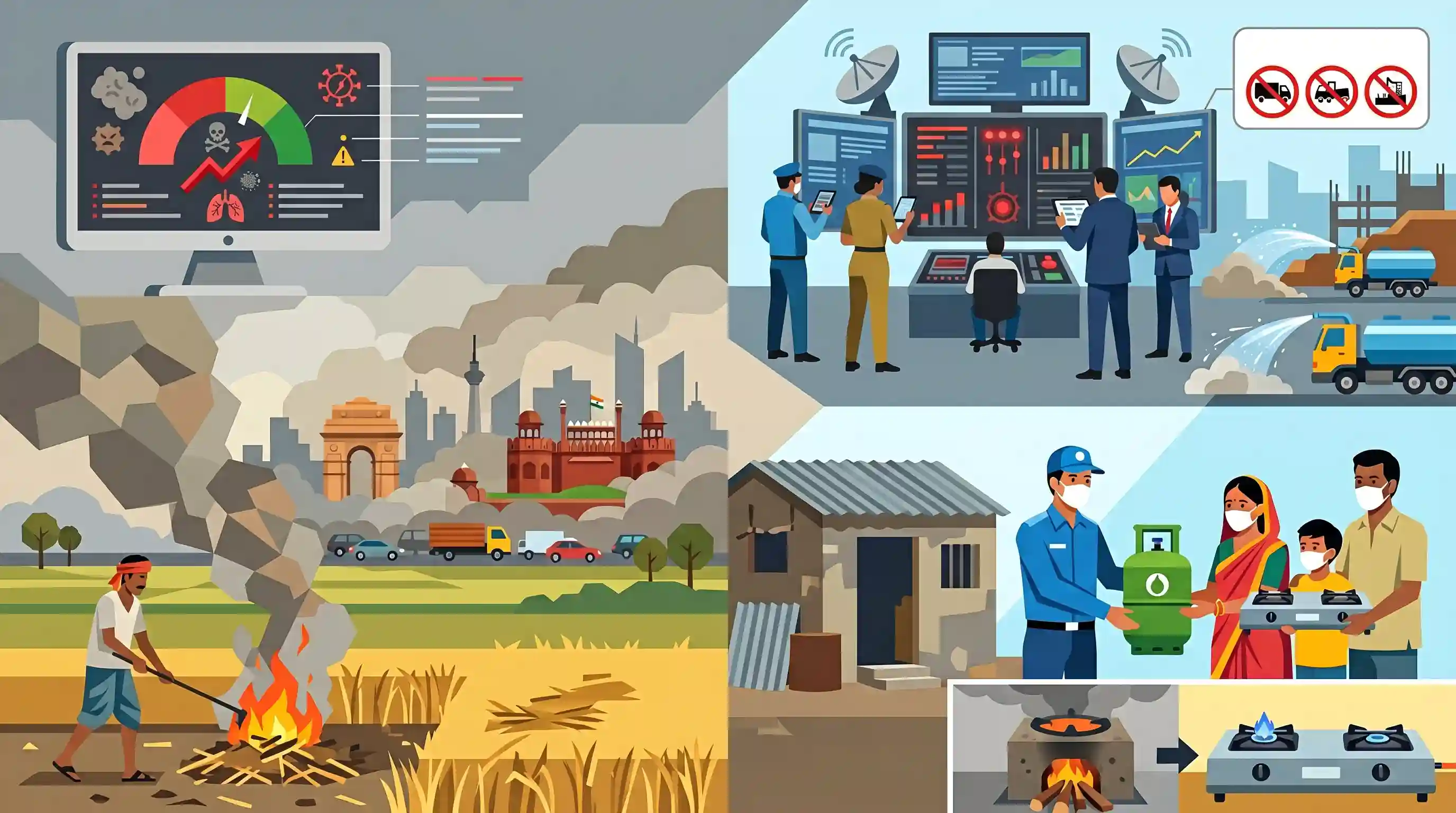
Why It Matters
Delhi's recurrent winter air pollution crisis is a standard UPSC theme encompassing environmental governance, statutory bodies (CPCB/DPCC), air quality monitoring mechanisms (AQI, GRAP), and the transition to clean cooking fuels (Ujjwala Yojana) as a mitigation strategy.
Summary
As Delhi's air quality continues to persist in the 'very poor' category due to winter meteorological conditions, stubble burning, and local emissions, the Delhi government has announced it will provide free LPG connections to slum dwellers under the Ujjwala Yojana. By targeting families using traditional solid fuels, the initiative aims to reduce local indoor and outdoor emissions. Authorities like the DPCC and CPCB are closely monitoring the Air Quality Index (AQI), intensifying dust mitigation efforts, and preparing to enforce Graded Response Action Plan (GRAP) Stage 3 if pollution levels cross critical thresholds.
Key Points
- The Delhi government announced the extension of the 'Ujjwala Yojana' to provide free LPG connections to slum dwellers using traditional stoves to curb local air pollution.
- The Delhi Urban Shelter Improvement Board (DUSIB) will conduct a survey to identify eligible families for the gas connections.
- Delhi's air quality remains in the 'very poor' category (AQI above 300) due to meteorological factors like lower wind speed and dropping temperatures.
- Stubble burning in neighboring states is a significant contributor to Delhi's PM2.5 levels, alongside local dust and vehicular emissions.
- Authorities are monitoring air quality trends closely and may enforce Graded Response Action Plan (GRAP) Stage 3 if pollution thresholds are crossed.
Important Terms
Pradhan Mantri Ujjwala Yojana (PMUY)

A flagship welfare scheme providing deposit-free LPG connections to women from BPL households to promote clean cooking fuel and reduce indoor air pollution.
UPSC context
GS Paper II (Policies & Interventions) and III (Pollution); tests knowledge of welfare schemes, health, and indoor emissions.
Graded Response Action Plan (GRAP)
A statutory emergency framework for Delhi-NCR that mandates stage-wise restrictive measures (Stage I to IV) based on the severity of Air Quality Index levels.
UPSC context
GS Paper III (Environmental Degradation); critical for understanding urban pollution management and proactive administrative responses to environmental crises.
Air Quality Early Warning System (AQEWS)
A scientific forecasting model developed by IITM and IMD to predict extreme pollution events in Delhi 3-10 days in advance using satellite data.
UPSC context
GS Paper III (Science & Technology and Environment); focuses on technology-led disaster management and evidence-based policy making.
Central Pollution Control Board (CPCB)
A statutory organization under MoEFCC established in 1974; it coordinates State Boards and sets national standards for air and water quality.
UPSC context
GS Paper II (Statutory Bodies) and GS Paper III (Conservation); the apex technical authority for pollution control in India.
Delhi Pollution Control Committee (DPCC)
A statutory authority established in 1991 to perform the functions of a State Pollution Control Board for the Union Territory of Delhi.
UPSC context
GS Paper II (Governance); essential for understanding the administrative division of environmental enforcement between central and UT authorities.
Delhi Urban Shelter Improvement Board (DUSIB)
A statutory body under the Delhi Government responsible for civic amenities, night shelters, and rehabilitation of slum and JJ (Jhuggi Jhopri) dwellers.
UPSC context
GS Paper II (Welfare for Vulnerable Sections); highlights urban poverty alleviation, housing rights, and state-level social welfare implementation.
Prelims Trap
Carbon dioxide (CO2) is one of the eight pollutants measured under the National Air Quality Index (AQI).
A classic UPSC trap. AQI measures Carbon Monoxide (CO), but NOT Carbon Dioxide (CO2) or greenhouse gases like Methane.
Static Concepts Connected
What are the parameters and pollutants of the National Air Quality Index (AQI)?
- 8 Pollutants: PM10, PM2.5, NO2, SO2, CO, Ozone (O3), Ammonia (NH3), and Lead (Pb).
- 6 Categories: Ranges from Good (0-50) to Severe (401-500). 'Very Poor' falls between 301 and 400.
- Crucial exclusions: Does not measure greenhouse gases like Carbon Dioxide (CO2) or Methane (CH4).
How does the Graded Response Action Plan (GRAP) function in Delhi-NCR?
- Statutory backing: Implemented by the Commission for Air Quality Management (CAQM) in NCR, a statutory body that replaced the EPCA.
- Stage-based action: Divided into four stages based on AQI levels: Poor, Very Poor, Severe (AQI > 400), and Severe+.
- Emergency measures: Measures include halting construction activities, restricting BS-III/IV vehicles, and enforcing work-from-home rules at higher stages.
Cross-Topic Patterns
Clean Energy + Women's Health
PMUY links environmental policy with social justice by reducing the disproportionate burden of indoor air pollution (biomass burning) on women's respiratory health.
Agriculture + Urban Air Quality
Winter pollution highlights the cross-border impact of agriculture, linking paddy stubble burning driven by cropping patterns in Punjab to urban microclimate crises.

Expect a multi-statement question in Prelims 2026 linking AQI pollutants, CAQM's statutory powers, and PMUY's impact on indoor emissions.
Linked PYQs · 4
Linked PYQs · 4
- 2020MainsGS3
What are the key features of the National Clean Air Programme (NCAP) initiated by the Government of India?
- 2022PrelimsGS1
In the context of WHO Air Quality Guidelines, consider the following statements: 1. The 24-hour mean of PM2.5 should not exceed 15 µg/m³ and annual mean of PM2.5 should not exceed 5 µg/m³. 2. In a year, the highest levels of ozone pollution occur during the periods of inclement weather. 3. PM10 can penetrate the lung barrier and enter the bloodstream. 4. Excessive ozone in the air can trigger asthma. Which of the statements given above are correct?
- 2025PrelimsGS1
Artificial way of causing rainfall to reduce air pollution makes use of
- 2016PrelimsGS1
In the cities of our country, which among the following atmospheric gases are normally considered in calculating the value of Air Quality Index? 1. Carbon dioxide 2. Carbon monoxide 3. Nitrogen dioxide 4. Sulfur dioxide 5. Methane Select the correct answer using the code given below.
