Institutional Trust and Private Investment Slump in India
Source:Indian Express ↗
Why It Matters
This article provides a critical analytical framework for understanding the limitations of supply-side economics (tax cuts/subsidies) when institutional trust is low. It bridges GS3 (Economy - Private Investment/Capex Cycle) and GS2 (Governance - Independence of Regulatory Institutions), offering excellent arguments for Mains essays or answers on why India's private investment hasn't revived despite government efforts.
Summary
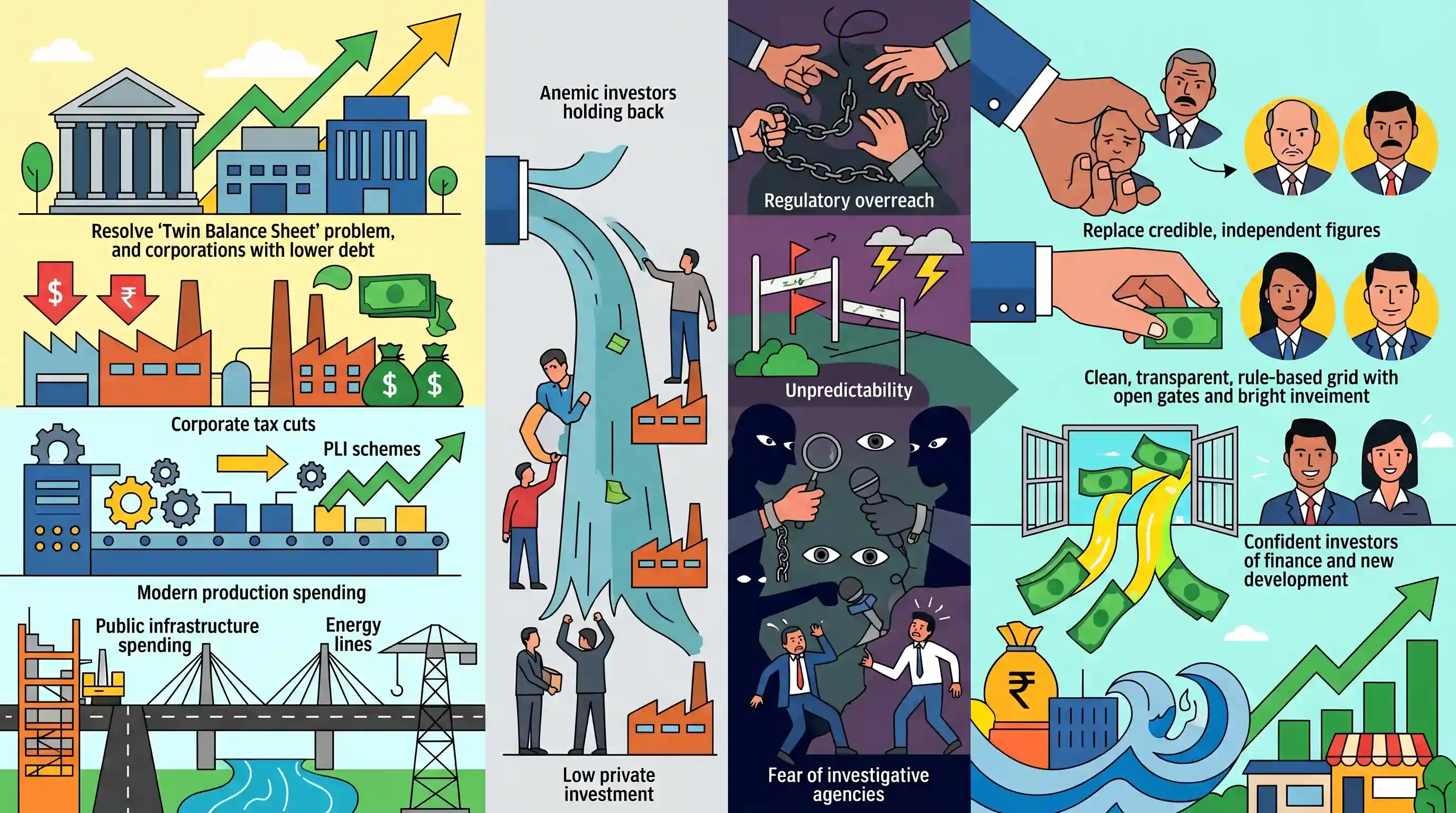
Former Chief Economic Advisor Arvind Subramanian argues that despite resolving the 'Twin Balance Sheet' problem, offering massive corporate tax cuts, implementing PLI schemes, and ramping up public infrastructure spending, private investment in India remains stubbornly low. He posits that the root cause is a 'software' problem rather than a 'hardware' one: a profound lack of trust and confidence among private actors due to regulatory overreach, unpredictability, and fear of investigative agencies. To reverse this slump and signal a genuine shift toward a rule-based, market-friendly environment, the government must structurally 'change the people in charge,' replacing key economic and regulatory officials with credible, independent figures to restore investor confidence.
Key Points
- The Paradox of Private Investment: Private sector capital formation has stagnated at a two-decade low despite aggressive supply-side interventions, including the 2019 corporate tax cuts, PLI schemes, and a massive push in public infrastructure spending.
- The Missing 'Software': The government has mistakenly relied on 'hardware' solutions (subsidies, tax cuts, hard infrastructure) to boost investment. The real bottleneck is the 'software'—the regulatory environment, a perceived lack of a level playing field, arbitrary policy shifts, and fear of investigative agencies (often termed tax terrorism).
- Post-Twin Balance Sheet Era: Indian corporates and banks have largely repaired their balance sheets. Firms now have the financial capacity to invest, proving that the current slump is driven by a lack of confidence and trust rather than a lack of capital.
- The Solution (Institutional Credibility): Merely promising a better business environment is insufficient to restore trust. The author argues that the government must 'change the people in charge' by appointing independent, credible leaders to key economic and regulatory institutions, thereby signaling a genuine, binding commitment to a rule-based market economy.
Important Terms
Production Linked Incentive (PLI) scheme

A central government initiative providing financial incentives (4-6%) to domestic and foreign manufacturers based on incremental sales of products made in India across 14 key sectors.
UPSC context
GS Paper III: Industrial Policy; essential for questions on 'Make in India' and manufacturing-led growth models.
Enforcement Directorate (ED)
A specialized financial investigation agency under the Ministry of Finance responsible for enforcing the Foreign Exchange Management Act (FEMA) and the Prevention of Money Laundering Act (PMLA).
UPSC context
GS Paper II/III: Regulatory bodies and Internal Security; frequently analyzed regarding federalism and investigative independence.
Twin Balance Sheet Problem
A situation where highly indebted private companies and banks burdened with Non-Performing Assets (NPAs) simultaneously face financial distress, hindering credit flow and investment.
UPSC context
GS Paper III: Indian Economy; a fundamental concept for understanding banking sector reforms and investment cycles.
Central Bureau of Investigation (CBI)
India's premier investigating agency under the Ministry of Personnel, Public Grievances and Pensions, tasked with probing high-profile corruption, economic offenses, and inter-state crimes.
UPSC context
GS Paper II: Statutory and regulatory bodies; relevant for debates on institutional autonomy and administrative transparency.
Reserve Bank of India (RBI)
India's central bank and regulatory body responsible for managing monetary policy, controlling inflation, and supervising the banking and financial system.
UPSC context
GS Paper III: Monetary Policy; core to topics like inflation targeting, exchange rate management, and financial stability.
Income Tax Department
The government agency under the Department of Revenue (Ministry of Finance) responsible for the administration and collection of direct taxes like Income Tax and Corporate Tax.
UPSC context
GS Paper III: Mobilization of Resources; focuses on taxation policy, fiscal health, and ease of doing business.
Prelims Trap
High public capital expenditure always guarantees a proportionate crowding-in of private investment.
UPSC often implies public capex automatically crowds-in private investment. However, despite massive recent government infrastructure spending, India's private capital formation remains sluggish due to regulatory mistrust.
Static Concepts Connected
What is the 'Twin Balance Sheet' (TBS) syndrome in the Indian economy?
- Corporate stress: An over-leveraged corporate sector unable to repay debt due to stalled projects, aggressive expansion, or economic slowdowns.
- Bank NPAs: The resulting accumulation of Non-Performing Assets (NPAs) in the banking sector, particularly in Public Sector Banks, impairing fresh credit.
- Vicious cycle: Banks stop lending due to high NPAs and debt-ridden corporates stop investing, leading to stagnant capital formation and sluggish GDP growth.
What drives Gross Fixed Capital Formation (GFCF) and why is it crucial?
- GFCF definition: GFCF measures the net increase in physical assets (such as machinery, equipment, and infrastructure) within the economy over a specific period.
- Key contributors: It comprises capital investments made by the household sector, the private corporate sector, and the public (government) sector.
- Economic indicator: It serves as a primary metric for investment activity; a stagnant private GFCF signifies sluggish industrial expansion and potential future growth bottlenecks.
Cross-Topic Patterns
Regulatory overreach vs. Economic Growth
The 'fear of investigative agencies' bridges GS2 (Governance/Institutions) and GS3 (Economy), showing how institutional autonomy and regulatory 'software' directly dictate corporate capital formation and ease of doing business.
Twin Balance Sheet to PLI limits
While resolving NPAs and pushing PLI fixed financial capacity, it shows that structural trust deficits can still cripple investment, linking banking sector repair with institutional governance.

Expect a GS3 Mains question asking why record public capex and PLI schemes have failed to crowd-in private investment (GFCF) in India.
Linked PYQs · 4
Linked PYQs · 4
- 2020MainsGS3
Explain the meaning of investment in an economy in terms of capital formation. Discuss the factors to be considered while designing a concession agreement between a public entity and a private entity.
- 2021MainsGS3
“Investment in infrastructure is essential for more rapid and inclusive economic growth.” Discuss in the light of India's experience.
- 2015MainsGS2
For achieving the desired objectives, it is necessary to ensure that the regulatory institutions remain independent and autonomous. Discuss in the light of the experiences in recent past.
- 2018PrelimsGS1
Despite being a high saving economy, capital formation may not result in significant increase in output due to
