Delhi Excise Policy Case Verdict and Central Investigating Agencies
Source:Indian Express ↗
Why It Matters
The controversy surrounding the CBI's handling of the Delhi Excise Policy case is highly relevant for UPSC aspirants. It serves as a stark case study on the ongoing debates regarding the independence of central investigating agencies, the ethical requirement of non-partisanship in public service, and the friction in Centre-State relations caused by allegations of political vendetta.
Summary
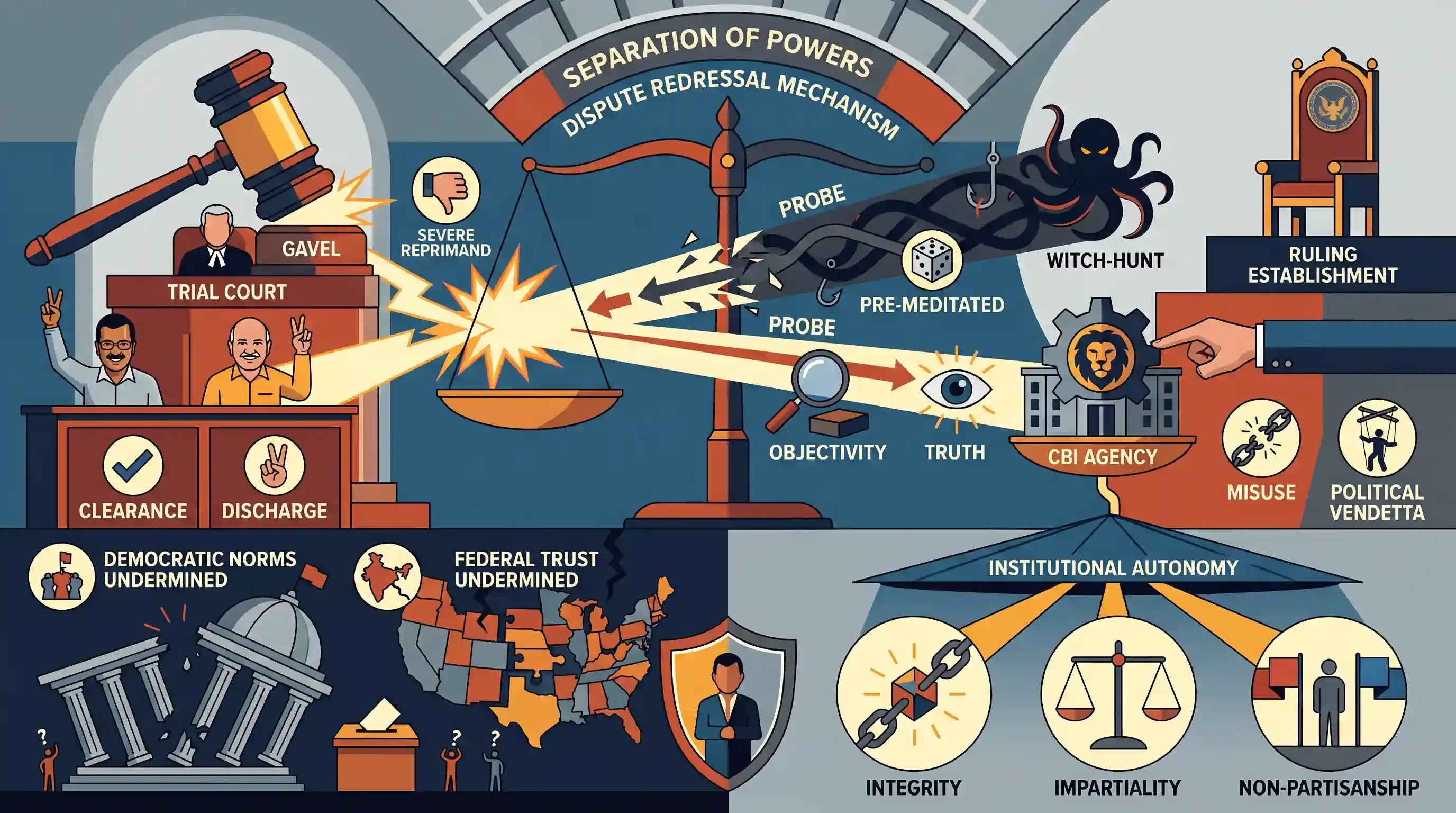
An editorial reflects on a trial court's decision to clear Arvind Kejriwal and Manish Sisodia in the Delhi excise policy case, a ruling that prominently featured severe judicial reprimands of the Central Bureau of Investigation (CBI). The court explicitly criticized the agency's probe as a biased, pre-meditated witch-hunt characterized by malice rather than an objective search for truth. This scathing indictment serves as a broader message to the ruling establishment about the dangers of using premier investigative agencies as instruments of political vendetta. It underscores the urgent need to protect the institutional autonomy and non-partisan character of law enforcement bodies, warning that their continued misuse severely undermines democratic norms and federal trust.
Key Points
- A Delhi trial court recently discharged Arvind Kejriwal and Manish Sisodia in the Delhi Excise Policy case, issuing severe strictures against the CBI.
- The court characterized the CBI\'s actions as a pre-meditated \'witch-hunt\' and noted instances of \'malice in law\', indicating a biased rather than impartial investigation.
- The editorial highlights the ruling as a crucial reminder to the Union government regarding the escalating perception that central agencies are being weaponized against political opponents.
- Such judicial interventions underscore the imperative of maintaining the institutional integrity, operational independence, and non-partisanship of premier investigating agencies.
Important Terms
Central Bureau of Investigation (CBI)

India's premier investigative agency for corruption and serious crimes. It operates under the Ministry of Personnel and derives powers from the Delhi Special Police Establishment (DSPE) Act, 1946.
UPSC context
GS Paper II: Statutory/Regulatory bodies. Tests knowledge of the agency's legal basis, jurisdiction, and challenges to its independence.
Delhi Excise Policy (2021-22)
A scrapped 2021-22 reform aimed at privatizing Delhi's liquor trade. It became the center of major corruption probes involving allegations of kickbacks and procedural lapses.
UPSC context
GS Paper II: Government policies. Tests ability to analyze policy implementation failures and issues of corruption in governance.
Institutional Autonomy
The capacity of state institutions to function without partisan pressure or executive interference, ensuring impartial enforcement of the law as defined by their constitutional or statutory mandates.
UPSC context
GS Paper II: Governance. Vital for discussing accountability, the independence of "watchdog" bodies, and the "caged parrot" debate.
Aam Aadmi Party (AAP)
A national political party governing Delhi and Punjab. It was officially recognized as a 'National Party' by the Election Commission of India in April 2023.
UPSC context
GS Paper II: Political Parties. Tests criteria for national party recognition under the Election Symbols Order, 1968.
Separation of Powers
A constitutional doctrine dividing authority between the legislature, executive, and judiciary to ensure checks and balances and prevent the arbitrary or malicious use of state power.
UPSC context
GS Paper II: Constitution. Tests understanding of judicial review as a critical check on executive overreach and agency misuse.
Federalism
The constitutional distribution of power between central and state governments. In this context, it refers to the strained relations between the Union and the Delhi Government.
UPSC context
GS Paper II: Federalism. Tests understanding of Center-State relations and the unique administrative and legal status of Delhi.
Prelims Trap
The CBI is a statutory body drawing its investigative powers from the Prevention of Corruption Act with absolute pan-India jurisdiction.
CBI is neither a constitutional nor a statutory body. It derives its powers from the Delhi Special Police Establishment (DSPE) Act, 1946, and requires state consent to operate outside UTs.
Static Concepts Connected
How does the CBI acquire jurisdiction to investigate cases across India?
- DSPE Act 1946: The CBI is not a statutory body; it derives its investigative powers from the Delhi Special Police Establishment (DSPE) Act, 1946.
- State Consent: Under Section 6, the CBI requires prior general or case-specific consent from state governments to investigate crimes within their respective territories.
- Constitutional Courts: The Supreme Court and High Courts can order a CBI probe anywhere in the country without the concerned state government's consent.
What distinguishes 'malice in law' from 'malice in fact' in administrative or investigative actions?
- Malice in Law: A wrongful act done intentionally without just cause or lawful excuse. It occurs when legal powers are exercised for unauthorized or collateral purposes, regardless of actual motive.
- Malice in Fact: An act motivated by a specific evil motive, ill will, personal animosity, or vindictive intent against an individual.
- Judicial Scrutiny: Courts routinely strike down administrative actions or discharge accused persons if an agency's exercise of power demonstrates 'malice in law'.
Cross-Topic Patterns
Federal friction and withdrawal of General Consent
The weaponization of central agencies directly connects to the growing trend of opposition-ruled states withdrawing 'general consent' under the DSPE Act, deeply straining cooperative federalism and Centre-State relations.
GS4: Institutional ethics and political subservience
Judicial strictures on the CBI's "witch-hunt" provide a perfect GS4 case study on the erosion of foundational civil service values like impartiality, non-partisanship, and objective integrity.

Expect a 2026 Prelims multi-statement question linking CBI's DSPE Act origins with CVC supervision and the nuances of state consent.
Linked PYQs · 3
Linked PYQs · 3
- 2021MainsGS2
The jurisdiction of the Central Bureau of Investigation (CBI) regarding lodging an FIR and conducting probe within a particular State is being questioned by various States. However, the power of the States to withhold consent to the CBI is not absolute. Explain with special reference to the federal character of India.
- 2021MainsGS4
Should impartial and being non-partisan be considered as indispensable qualities to make a successful civil servant? Discuss with illustrations.
- 2016MainsGS4
Why should impartiality and non-partisanship be considered as foundational values in public services, especially in the present day socio-political context ? Illustrate your answer with examples.
