Arun Shourie Book Critiques Savarkar Ideology and Pervasiveness
Source:Indian Express ↗
Why It Matters
V.D. Savarkar is a pivotal and polarizing figure in India's freedom struggle and political history. His ideology of Hindutva profoundly shapes contemporary Indian politics. Understanding the critiques of his ideology and its modern pervasiveness is crucial for UPSC aspirants studying the evolution of Indian nationalism, communalism, and the nature of Indian secularism.
Summary
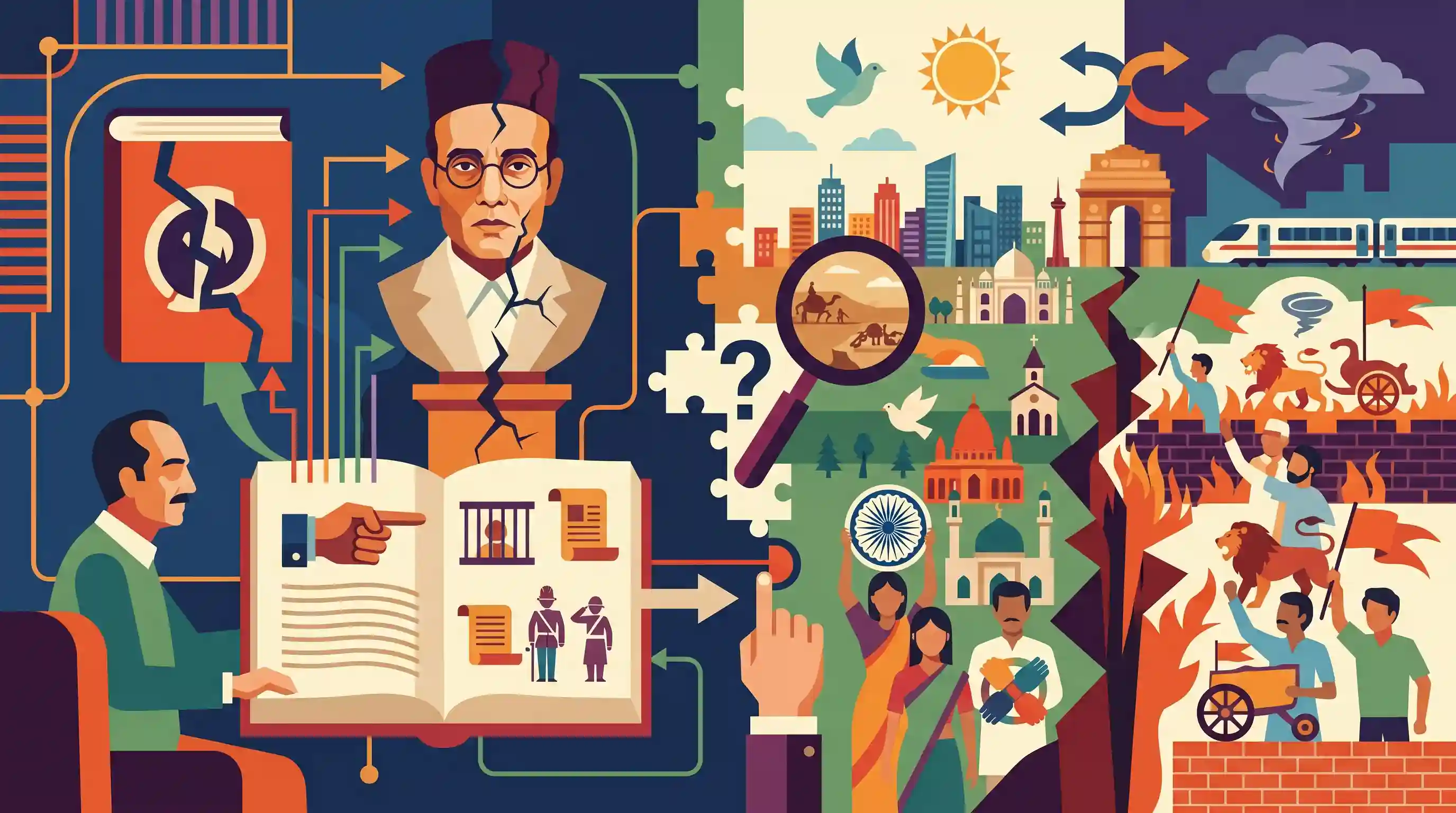
Arun Shourie’s latest book, 'A New Icon', offers a sharp critique of V.D. Savarkar, presenting a strong indictment of the Hindutva leader's historical role and ideas. However, reviews point out a significant gap in the narrative: the book falls short in dissecting the contemporary socio-political factors that make Savarkar’s ideology so resonant and pervasive in modern India. The ongoing debate around Savarkar remains central to understanding the shifting ideological currents in Indian politics, particularly concerning the competing visions of nationalism, secularism, and communalism.
Key Points
- Arun Shourie's new book, 'A New Icon', provides a critical assessment and sharp indictment of Hindutva ideologue V.D. Savarkar.
- The book is criticized for failing to adequately diagnose the underlying reasons for the current widespread acceptance and pervasiveness of Savarkar's ideology in modern India.
- The ongoing discourse around Savarkar underscores the deeper ideological contestations regarding nationalism, secularism, and communalism in contemporary Indian politics.
Prelims Trap
V.D. Savarkar actively supported and participated in the 1942 Quit India Movement.
Savarkar, as President of the Hindu Mahasabha, officially boycotted the Quit India Movement. He directed members serving in government positions to remain at their posts.
Static Concepts Connected
What was the trajectory of the Abhinav Bharat Society?
- Origins: Founded by the Savarkar brothers in 1899 as Mitra Mela, it functioned as a revolutionary secret society in Maharashtra.
- Ideological Inspiration: It formally became Abhinav Bharat in 1904, heavily inspired by Giuseppe Mazzini's 'Young Italy' movement.
- Revolutionary Activities: It aimed to overthrow British rule through armed rebellion, notably linked to the 1909 assassination of A.M.T. Jackson by Anant Laxman Kanhere.
How did Savarkar define Indian nationhood in his 1923 text 'Hindutva'?
- Territorial & Sacred: He defined a Hindu as someone who considers India as both their fatherland (Pitrubhu) and their holy land (Punyabhu).
- Cultural Nationalism: He framed Hindutva as a broader cultural, historical, and political identity, distinguishing it from mere religious theology or personal faith.
Cross-Topic Patterns
Savarkar's anti-caste social reform pragmatism
While famous for political Hindutva, his Ratnagiri phase (Patit-Pavan Mandir, inter-dining) reflects significant anti-untouchability efforts, adding nuance to the broader social reform movements of the 1930s.
Historiography of the 1857 revolt
Savarkar’s 1909 book permanently altered Indian nationalist historiography, directly challenging British colonial narratives of a mere 'Sepoy Mutiny' by framing it as a unified independence struggle.

Expect multi-statement Prelims questions contrasting Gandhi and Savarkar’s specific stances on the Quit India Movement and untouchability.
Linked PYQs · 3
Linked PYQs · 3
- 2017MainsGS1
Distinguish between religiousness/religiosity and communalism giving one example of how the former has got transformed into the latter in independent India.
- 2022MainsGS1
Are tolerance, assimilation and pluralism the key elements in the making of an Indian form of secularism? Justify your answer.
- 2008PrelimsGS1
During the Indian Freedom Struggle, who of the following raised an army called ‘Free Indian Legion’?
