Kanchan Prakash revives traditional Bajjika paintings of Bihar
Source:etvbharat ↗
Why It Matters
BPSC Prelims frequently tests candidates on Bihar's regional arts, crafts, and cultural heritage (e.g., Madhubani painting, Sujini embroidery). The recent global recognition and revival of Bajjika painting make it highly relevant for upcoming exams.
Summary
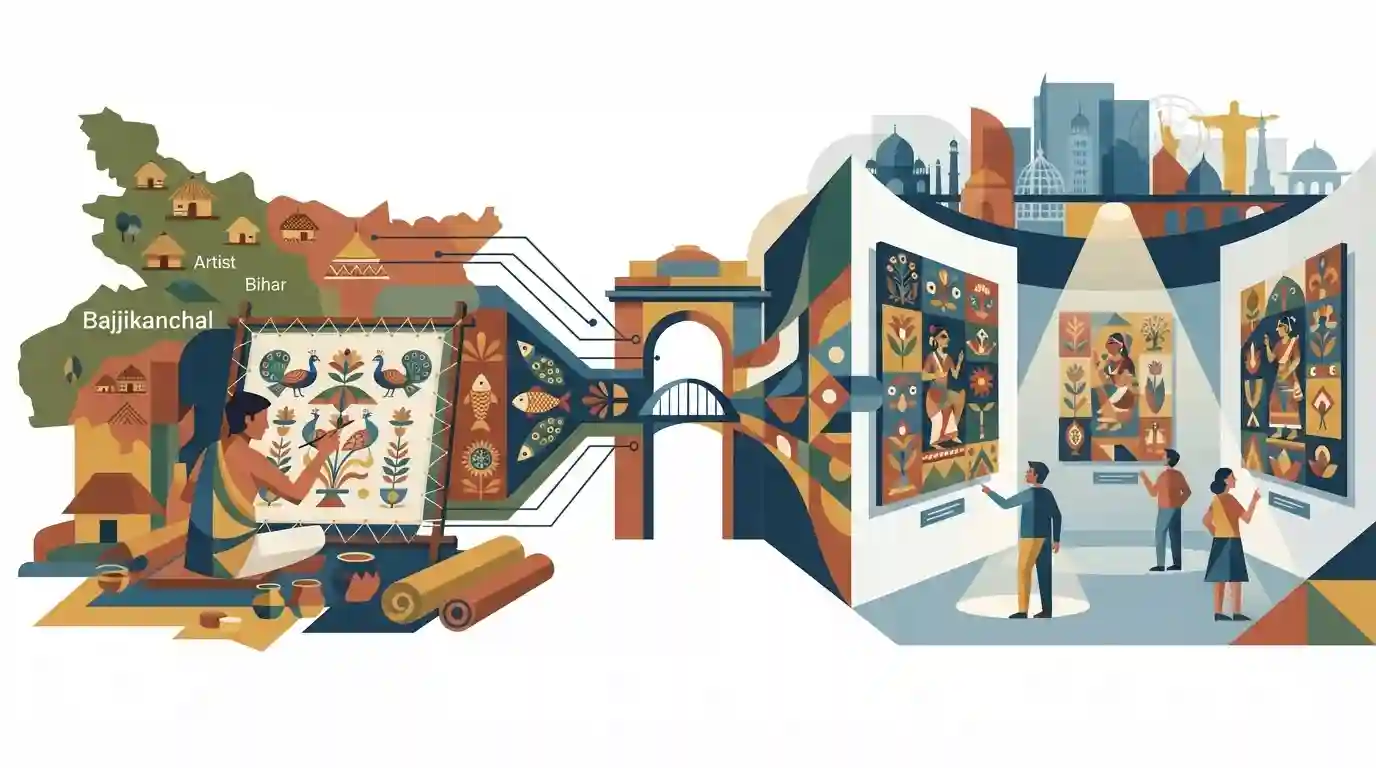
Artist Kanchan Prakash has successfully revived Bihar's traditional Bajjika painting, transporting the indigenous art form from regional fringes to the walls of museums globally. Originating in the Bajjikanchal region, this cultural heritage is gaining mainstream recognition akin to Bihar's famous Madhubani art.
Key Points
- Bajjika painting is a traditional folk art originating from the Bajjikanchal region of Bihar, which includes districts like Muzaffarpur, Vaishali, and Sitamarhi.
- Artist Kanchan Prakash has played a pivotal role in reviving this indigenous art form by transitioning it from rural mud walls to canvas, enabling its exhibition in museums globally.
- Bajjika art is historically practiced by women during auspicious ceremonies, akin to other celebrated regional art forms like Madhubani painting and Sujini embroidery.
- The art typically uses natural dyes and auspicious motifs, representing the rich cultural heritage and socio-religious traditions of Bihar.
Prelims Trap
Bajjika paintings prominently use black color to outline motifs, similar to Madhubani art.
While many Indian folk arts use soot for prominent outlines, Bajjika/Baseri art strictly avoids black because the paintings are created exclusively for highly auspicious ceremonies.
Static Concepts Connected
What are the major traditional visual arts and crafts of Bihar?
- Madhubani Painting: Originates in Mithila; uses vibrant colors, geometric patterns, and filled spaces (Kachni/Bharni) to depict mythological themes.
- Manjusha Art: Originates in the Anga region (Bhagalpur); characterized by snake motifs and restricts its palette to three colors (pink, green, yellow).
- Sujini Embroidery: Traditional quilt embroidery depicting daily life and social themes, typically created by women.
- Bajjika (Baseri): From the Vajji region; central bamboo motif (Bans) symbolizes lineage and prosperity, strictly avoiding black pigment.
What was the political structure of the ancient Vajji Mahajanapada?
- Geographical extent: Located in North Bihar with its capital at Vaishali, covering the modern Bajjikanchal region.
- Clan confederacy: It was a confederacy of eight clans (Ashtakula), most notably the Licchavis, Videhans, and Jnatrikas.
- Gana-Sangha polity: Operated as a Gana-Sangha (oligarchic republic), contrasting sharply with neighboring monarchies like Magadha.
Cross-Topic Patterns
Women-led ceremonial folk arts
Like Madhubani and Warli, Bajjika is deeply tied to female practitioners and socio-religious rituals, highlighting a broader trend of women-led, mud-wall ceremonial arts transitioning to commercial canvas.
Dialect conservation + Visual arts
The Bihar government established an academy for the Bajjika dialect in 2022. UPSC often tests cultural heritage where intangible language conservation overlaps with tangible visual arts of the same region.

Expect a Prelims 'pairs' question matching lesser-known regional arts (Bajjika, Manjusha, Sujini) to their specific Bihar sub-regions.
Linked PYQs · 2
Linked PYQs · 2
- 2024-IBPSC_PRELIMSGS1
World famous painting is found in which district of Bihar?
- 2023BPSC_PRELIMSGS1
In the context of Indian handicrafts, what is ‘Sujini’ in Bihar?
