Role of Artificial Intelligence in India Weather Forecasting
Source:The Hindu ↗
Why It Matters
Understanding the application of frontier technologies like AI in governance and disaster management is highly relevant for GS-3. It showcases how India is modernizing its scientific infrastructure to tackle climate-induced extreme weather.
Summary
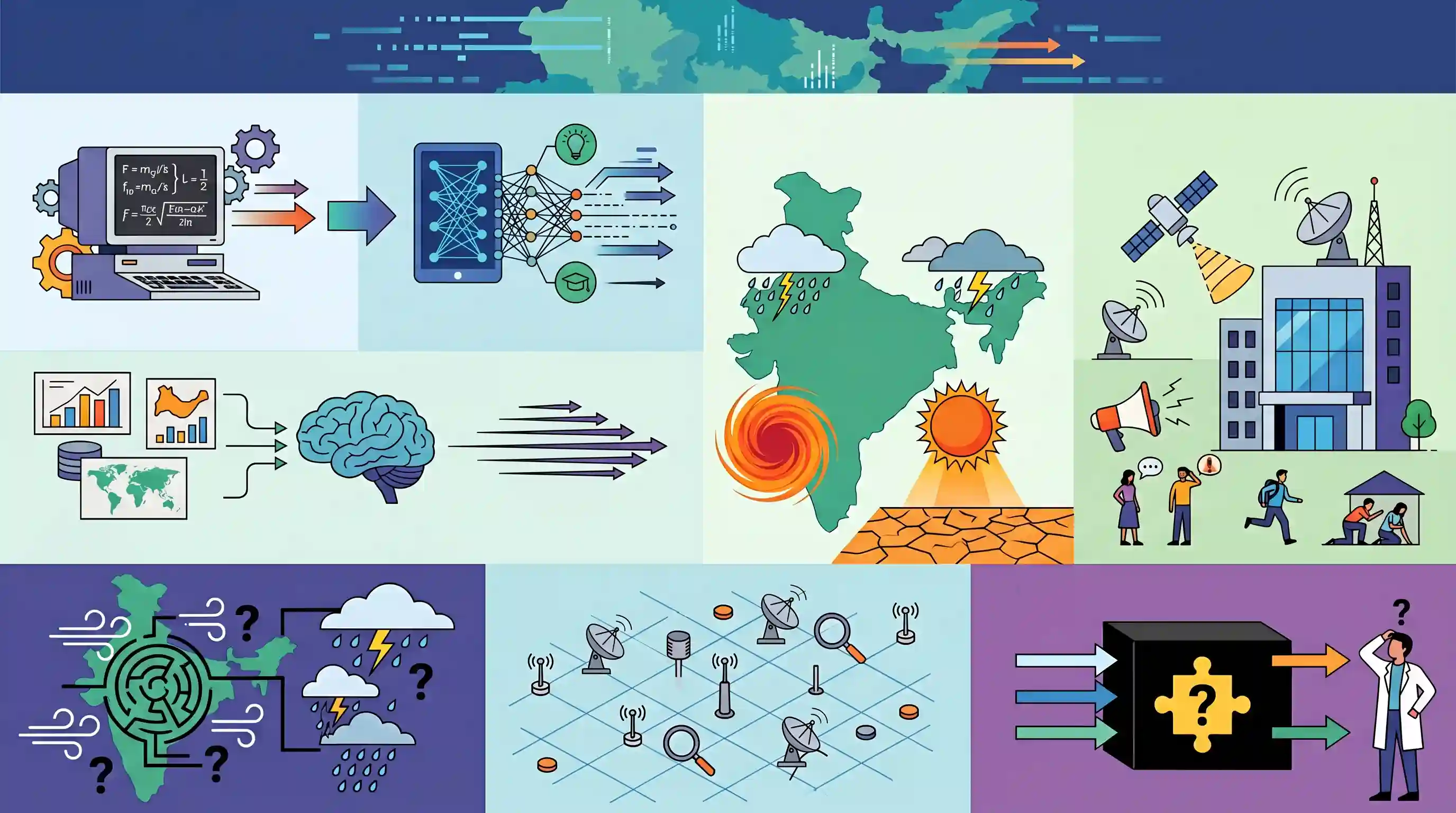
The integration of Artificial Intelligence (AI) in India's weather forecasting systems marks a significant technological shift aimed at better predicting extreme weather events. While traditional Numerical Weather Prediction (NWP) models rely on heavy computational physics, AI models learn from historical weather data to generate rapid forecasts. This enhancement is crucial for the India Meteorological Department (IMD) to issue timely early warnings for cyclones, heatwaves, and erratic rainfall. However, challenges remain, such as the complexity of the Indian monsoon, the need for localized high-quality data, and the lack of physical explainability inherent to AI algorithms.
Key Points
- India is increasingly integrating Artificial Intelligence (AI) and Machine Learning (ML) into its meteorological framework to forecast extreme weather events more efficiently.
- AI models offer faster prediction capabilities compared to traditional Numerical Weather Prediction (NWP) models, as they analyze vast historical datasets rather than computing complex physical equations in real-time.
- Faster and more accurate localized forecasting (nowcasting) via AI significantly strengthens Early Warning Systems (EWS), helping authorities mitigate the impact of cyclones, heatwaves, and flash floods.
- Challenges in adopting AI for Indian weather include the complex and non-linear nature of the tropical monsoon, regional data sparsity (e.g., in the Himalayas), and the 'black-box' nature of AI which makes physical interpretation difficult.
Important Terms
India Meteorological Department (IMD)

Established in 1875, it is India's principal agency for meteorological observations, weather forecasting, and seismology. It operates under the Ministry of Earth Sciences and issues alerts for cyclones and heatwaves.
UPSC context
GS Paper I (Geography) and GS III (Disaster Management). Tests knowledge of institutional frameworks for disaster preparedness and weather services.
Ministry of Earth Sciences (MoES)
The nodal ministry established in 2006 to provide a coordinated approach to Earth science research. It oversees agencies like IMD, IITM, and NCMRWF to manage weather, climate, and ocean services.
UPSC context
GS Paper II (Governance) and GS III (S&T). Tests understanding of governmental structures managing national scientific missions and climate resilience.
Mission Mausam
A ₹2,000 crore initiative launched by MoES to modernize India's weather and climate forecasting through advanced AI, high-performance computing, and densified observation networks like Doppler radars.
UPSC context
GS Paper III (S&T and Disaster Management). A high-probability current affairs topic regarding technological interventions for climate adaptation and disaster risk reduction.
Numerical Weather Prediction (NWP)
A traditional forecasting method using mathematical physics and fluid dynamics equations to simulate atmospheric behavior. It requires high-performance supercomputers and forms the baseline for modern weather predictions.
UPSC context
GS Paper III (Science & Technology). Tests conceptual understanding of scientific methodologies versus emerging AI-driven data-centric models in meteorology.
Early Warning Systems (EWS)
Integrated systems that provide timely hazard information to enable communities to act before disasters. The Sendai Framework’s Priority 4 emphasizes these as critical for disaster risk reduction.
UPSC context
GS Paper III (Disaster Management). Directly linked to the Sendai Framework for Disaster Risk Reduction and India's national disaster management goals.
Explainability (AI)
The 'black box' problem where AI outputs lack physical reasoning. In meteorology, it refers to the challenge of understanding why an AI predicted a specific weather event without physical equations.
UPSC context
GS Paper III (Science & Technology). Tests critical analysis of AI ethics and reliability in high-stakes sectors like disaster management.
Nowcasting
Weather forecasting on a very short-term basis (0 to 6 hours), focusing on localized events like cloudbursts or thunderstorms. AI excels at this by processing real-time radar data rapidly.
UPSC context
GS Paper I (Geography) and GS III (Disaster Management). Relevant for understanding localized disaster mitigation and recent advancements in urban flooding management.
Prelims Trap
"AI weather models compute complex physical atmospheric equations faster than traditional NWP models."
AI models bypass physical equations entirely. They rely on data-driven pattern recognition from historical datasets, whereas traditional Numerical Weather Prediction (NWP) relies on physics-based mathematical equations.
Static Concepts Connected
What is Nowcasting in the context of extreme weather management?
- Timeframe: Short-term, localized weather forecasting, typically covering a period of up to 2 to 6 hours into the future.
- Applications: Crucial for predicting and mitigating rapid-onset disasters like urban flash floods, cloudbursts, and severe thunderstorms.
- Observational Tools: Heavily dependent on high-resolution, real-time observational data from Doppler Weather Radars (DWRs) and satellite feeds.
How do traditional Numerical Weather Prediction (NWP) models function?
- Physics-based: They use mathematical equations based on the fundamental laws of physics, fluid dynamics, and thermodynamics to simulate the atmosphere.
- Computational Load: Require immense supercomputing capacity to solve complex deterministic equations in real-time, making them slower but physically explainable.
Cross-Topic Patterns
AI limitations in a warming climate
Because AI trains on historical data, it struggles to predict novel, unprecedented extreme weather events caused by a changing climate baseline, a limitation not inherently shared by physics-based NWP models.
Mission Mausam + Sendai Framework Target G
AI-enhanced nowcasting and Doppler radar upgrades directly fulfill Sendai Framework Target G, which mandates improving access to multi-hazard early warning systems and disaster risk information by 2030.

Expect a 2026 Prelims question contrasting the mechanics of NWP (physics-based) vs. AI (data-driven) models, linked to Mission Mausam.
Linked PYQs · 3
Linked PYQs · 3
- 2023MainsGS3
Introduce the concept of Artificial Intelligence (AI). How does Al help clinical diagnosis? Do you perceive any threat to privacy of the individual in the use of Al in healthcare?
- 2022MainsGS1
Discuss the meaning of colour-coded weather warnings for cyclone prone areas given by India Meteorological Department.
- 2013MainsGS3
How important are vulnerability and risk assessment for pre-disaster management ? As an administrator, what are key areas that you would focus on in a Disaster Management System.
