Supreme Court enforces Article 22 safeguards against arbitrary arrest
Source:Indian Express ↗
Why It Matters
It addresses critical constitutional rights concerning personal liberty, procedural safeguards against arbitrary arrest, and the judiciary's role in enforcing fundamental rights under Articles 21 and 22.
Summary
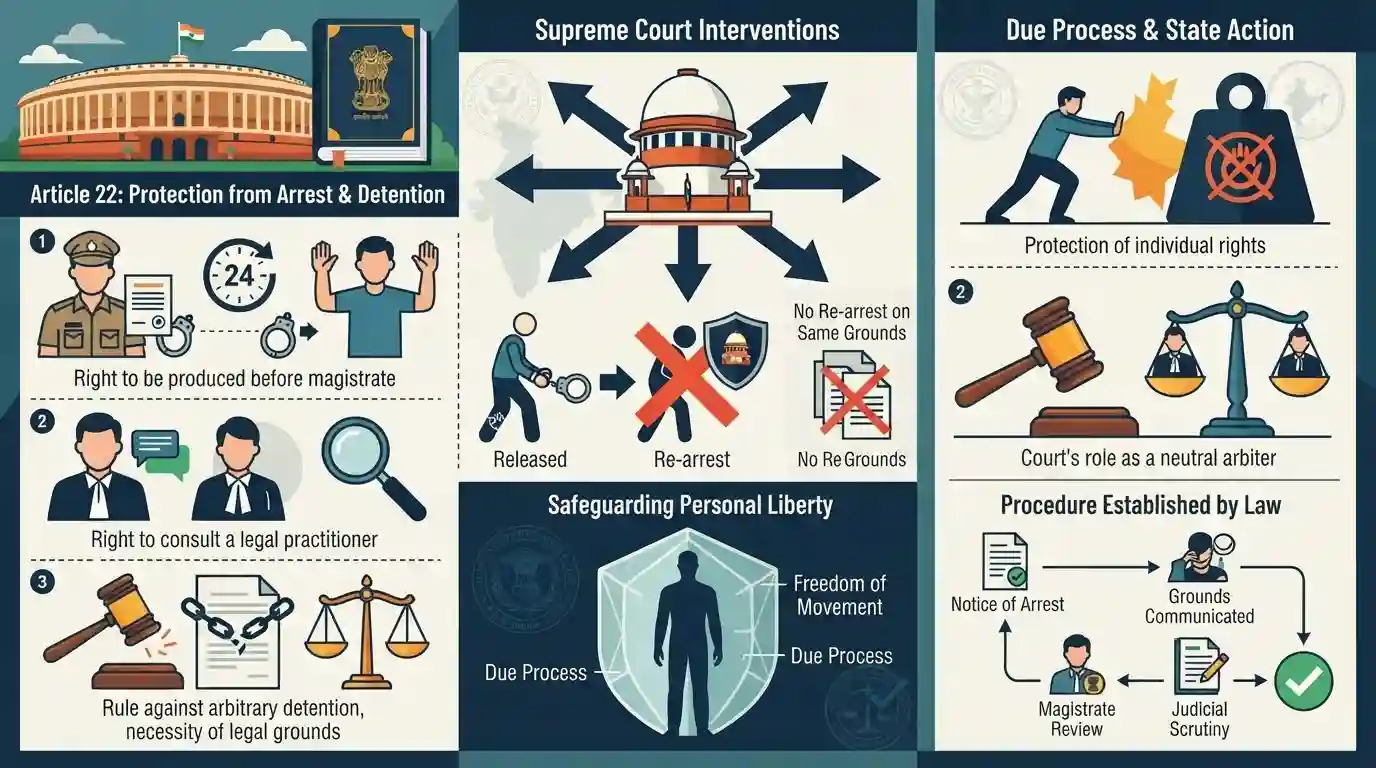
The article discusses the constitutional and legal safeguards provided under Article 22 of the Indian Constitution regarding arrest and detention, emphasizing recent Supreme Court interventions and rules concerning re-arrests and protection of personal liberty against arbitrary state action.
Key Points
- Article 22 of the Indian Constitution provides fundamental safeguards against arbitrary arrest and detention, including the right to be informed of the grounds of arrest and the right to consult a legal practitioner.
- The Supreme Court has consistently reinforced procedural requirements to prevent abuse of state power, checking malpractices like arbitrary or repeated re-arrests without fresh valid grounds.
- Procedural due process under Articles 21 and 22 acts as a vital check against executive overreach and arbitrary custodial measures in the criminal justice system.
Important Terms
Article 22 of the Constitution

A fundamental right providing safeguards against arbitrary arrest and detention, including the right to be informed of grounds of arrest, legal representation, and production before a magistrate within 24 hours.
UPSC context
UPSC GS Paper II: Indian Constitution—Significant Provisions, Fundamental Rights, and protection against state excess.
Article 21 of the Constitution
Guarantees protection of life and personal liberty, establishing that no person shall be deprived of liberty except according to procedure established by law.
UPSC context
UPSC GS Paper II: Right to life, personal liberty, and judicial interpretation expanding due process in India.
Supreme Court of India
The apex judicial institution of India tasked with interpreting the Constitution, safeguarding fundamental rights, and maintaining the rule of law.
UPSC context
UPSC GS Paper II: Judiciary, judicial review, separation of powers, and institutional checks on executive action.
Static Concepts Connected
What are the constitutional exceptions to the safeguards provided under Article 22 of the Indian Constitution?
- Alien Exception: Enemy Aliens: The protections against arrest and detention under Article 22(1) and (2) do not apply to enemy aliens.
- Preventive Laws: Preventive Detention: Persons arrested or detained under any law providing for preventive detention are excluded from standard Article 22(1) and (2) safeguards.
- Advisory Board: Max Detention: Preventive detention cannot exceed 3 months unless an Advisory Board recommends extended detention beyond 3 months.
Cross-Topic Patterns
Preventive Detention vs Personal Liberty Jurisprudence
The evolving Supreme Court interpretation of Article 21 and Article 22 intersects with the expansion of special statutes like UAPA and PMLA, testing executive powers against fundamental liberties.

Expect a statement-based question combining Article 22(2) timelines, preventive vs punitive detention exceptions, and re-arrest rules.
Linked PYQs · 2
Linked PYQs · 2
- 2024MainsGS2
Right to privacy is intrinsic to life and personal liberty and is inherently protected under Article 21 of the constitution. Explain. In this reference discuss the law relating to D.N.A. testing of child in the womb to establish its paternity.
- 2024PrelimsGS1
Under which of the following Articles of the Constitution of India, has the Supreme Court of India placed the Right to Privacy ?
