Artemis II Lunar Flyby Tests Deep-Space Life Support Systems
Source:The Hindu ↗
Why It Matters
The Artemis mission represents the next frontier of global human space exploration. For UPSC aspirants, understanding manned space missions, life support technologies, and international collaborations is critical for the Science & Technology syllabus in GS Paper 3, particularly in comparing global space endeavors with India's own Gaganyaan and Chandrayaan programmes.
Summary
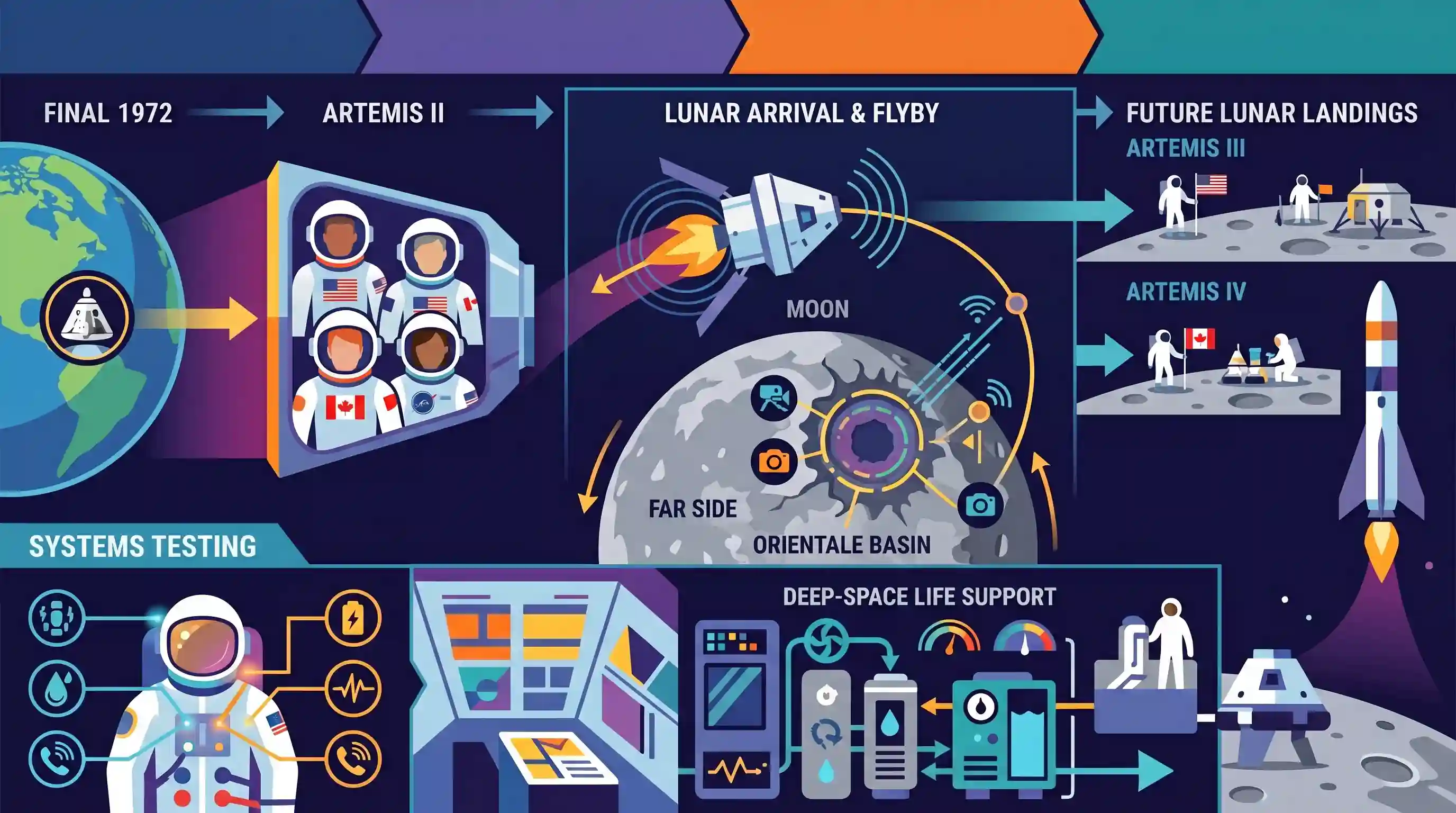
NASA's Artemis II astronauts have successfully approached the Moon, marking the first human lunar flyby since the Apollo missions in 1972. The crew, comprising Victor Glover, Christina Koch, Jeremy Hansen, and Reid Wiseman, entered the Moon's gravitational pull to document its surface, notably the Orientale basin on the far side. Crucial tests of the Orion crew survival system spacesuits and deep-space life-support systems are underway. This mission sets the groundwork for upcoming lunar landings scheduled for Artemis 3 and 4, continuing the renewed era of human space exploration.
Key Points
- NASA's Artemis II crew executed the first human lunar flyby since 1972, entering the moon's gravitational influence.
- The mission involves documenting the Moon's surface, including the Orientale basin located on the far side.
- The crew is testing critical technologies like the Orion crew survival system spacesuits and deep-space life-support mechanisms.
- The Artemis II flyby serves as a precursor to future lunar landing missions, namely Artemis 3 planned for 2027 and Artemis 4 in 2028.
- The crew marks historic diversity milestones, featuring the first woman, the first person of color, and the first non-American to fly around the Moon.
Important Terms
Artemis II Mission

NASA's 2026 mission involving a 10-day crewed lunar flyby. It tested the Orion spacecraft's life-support and navigation systems, marking the first human flight beyond low Earth orbit since 1972.
UPSC context
GS Paper III: Science & Technology. Significant for space exploration milestones and international collaboration in deep-space missions.
Artemis III
Scheduled for late 2027, this mission was restructured in 2026 as a crewed Earth-orbit demonstration. It focuses on testing rendezvous and docking operations with commercial lunar landers like SpaceX’s Starship.
UPSC context
GS Paper III: Science & Technology. Tests public-private partnerships in space (HLS) and critical docking technologies for future landings.
Artemis IV
Targeted for early 2028, this is currently planned as the first Artemis mission to land humans on the lunar South Pole, resuming crewed surface exploration after over 50 years.
UPSC context
GS Paper III: Science & Technology. Concerns lunar resource exploration (Water Ice) and establishing a sustainable human presence on the Moon.
Orion Crew Survival System (OCSS)
A specialized orange pressure suit worn by Orion crew during high-risk flight phases. It provides up to six days of life support during cabin depressurization and includes maritime survival gear.
UPSC context
GS Paper III: Science & Technology. Represents advancements in astronaut safety, life-support systems (ECLSS), and intra-vehicular activity (IVA) technology.
NASA
The U.S. federal agency responsible for the civil space program. It leads the Artemis program and the Artemis Accords, a framework for international cooperation in lunar and Martian exploration.
UPSC context
GS Paper III: Science & Technology. Key actor in global space governance and primary partner for international space station and lunar missions.
Prelims Trap
Artemis II marks the first crewed landing on the lunar South Pole since 1972.
Artemis II is strictly a crewed lunar flyby mission to test systems. The actual crewed landing at the lunar South Pole is scheduled for Artemis III.
Static Concepts Connected
What are the core principles of the Artemis Accords?
- Non-binding nature: It is a set of multilateral, non-binding declarations rooted in the 1967 Outer Space Treaty, not a legally binding treaty.
- Peaceful and transparent: Mandates that all activities be conducted for peaceful purposes, with full transparency and the public release of scientific data.
- Resource utilization: Permits the extraction and utilization of space resources (like lunar water) under the broader framework of international space law.
Why do modern space missions specifically target the Lunar South Pole?
- Water ice reserves: Permanently Shadowed Regions (PSRs) in polar craters act as cold traps, preserving ancient water ice crucial for life support and rocket fuel.
- Continuous solar power: Elevated crater rims near the pole receive near-continuous sunlight, providing a reliable energy source for sustainable lunar outposts.
Cross-Topic Patterns
Artemis Accords + Quad Diplomacy
India's 2023 signing of the Artemis Accords integrates space exploration into its broader strategic tech alignment with the US and Quad, countering the China-Russia International Lunar Research Station (ILRS) initiative.
Chandrayaan + Artemis Synergies
Data from India's Chandrayaan missions (including orbital mapping of the Orientale basin) directly complements the Artemis program's objective of establishing a sustainable human presence on the lunar surface.

Expect a comparative Prelims question contrasting Apollo's equatorial landings with the Artemis and Chandrayaan focus on the South Pole.
Linked PYQs · 3
Linked PYQs · 3
- 2017MainsGS3
India has achieved remarkable successes in unmanned space missions including the Chandrayaan and Mars Orbitter Mission, but has not ventured into manned space missions. What are the main obstacles to launching a manned space mission, both in terms of technology and logistics? Examine critically.
- 2023MainsGS3
What is the main task of India's third moon mission which could not be achieved in its earlier mission? List the countries that have achieved this task. Introduce the subsystems in the spacecraft launched and explain the role of the Virtual Launch Control Centre' at the Vikram Sarabhai Space Centre which contributed to the successful launch from Sriharikota.
- 2025PrelimsGS1
Consider the following space missions : I. Axiom-4 II. SpaDeX III. Gaganyaan How many of the space missions given above encourage and support micro-gravity research?
