Artemis Two Lunar Mission and Deep Space Human Exploration
Source:The Hindu ↗
Why It Matters
Space exploration, particularly manned missions and lunar exploration (like India's Gaganyaan and Chandrayaan), is a core component of the UPSC GS-3 Science and Technology syllabus. The Artemis program sets the current global benchmark for deep-space human flight.
Summary
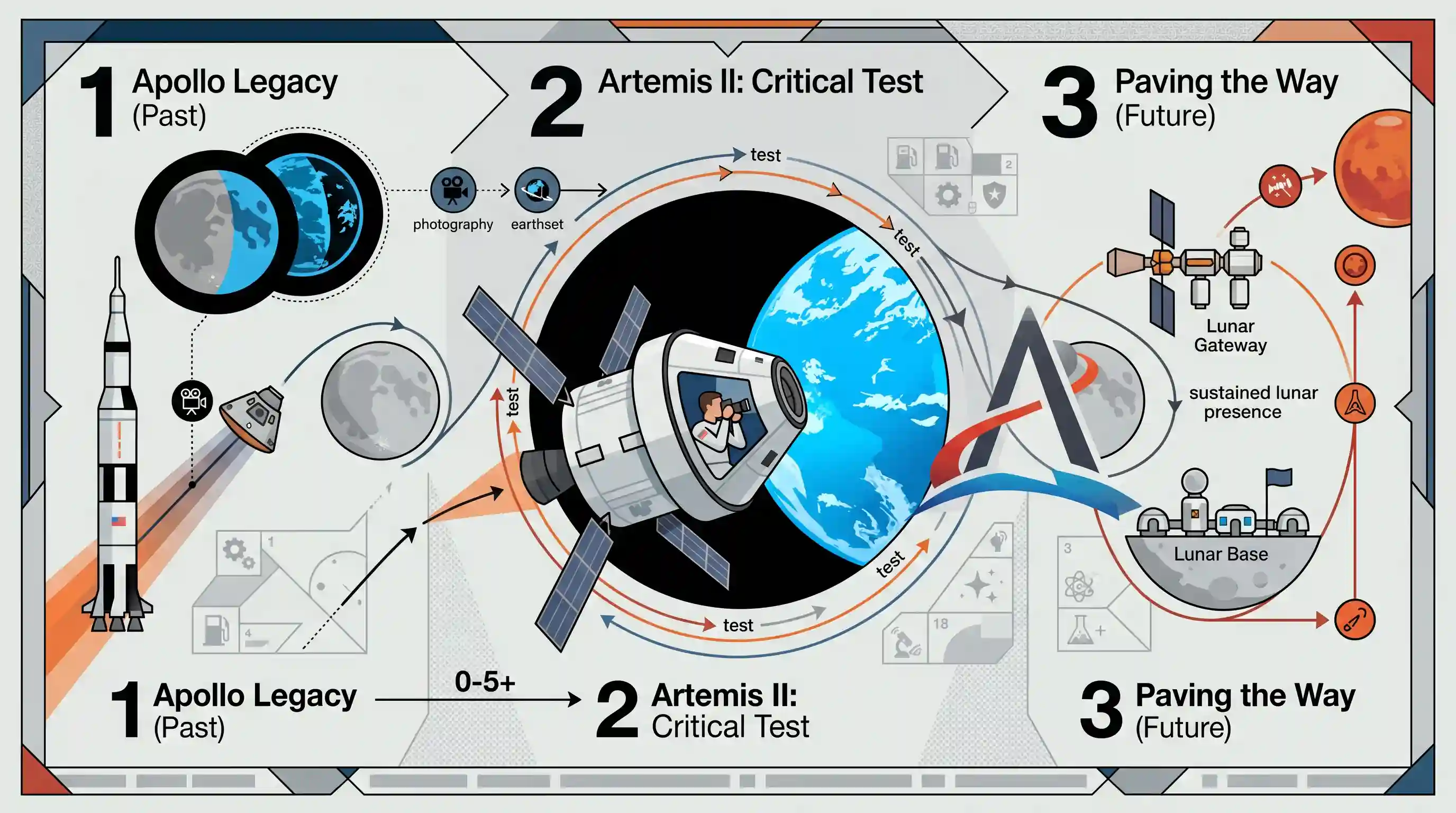
During their journey to the Moon, the crew of NASA's Artemis II mission captured stunning photographs of Earth from the Orion spacecraft. The imagery highlights the brilliant blue of the planet against the stark blackness of space, drawing parallels to the iconic photos taken during the Apollo era. As the first crewed lunar mission in over five decades, Artemis II serves as a critical test of deep-space human exploration systems, paving the way for future sustained lunar presence.
Key Points
- Astronauts aboard the Artemis II mission captured striking new imagery of Earth from the Orion spacecraft as they journeyed toward the Moon.
- The photographs echo the historical 'Blue Marble' and 'Earthrise' images taken during the Apollo missions, emphasizing Earth's fragile beauty against the void of space.
- Artemis II is a crucial milestone for NASA, marking the first time humans have returned to the lunar vicinity in over 50 years.
- The mission tests the life support systems of the Orion spacecraft in deep space, laying the groundwork for future lunar surface landings.
Important Terms
Artemis II

NASA's first crewed mission under the Artemis program, designed to carry four astronauts on a 10-day lunar flyby to test deep-space life-support and navigation systems.
UPSC context
GS III: Space Technology. Tests mission readiness for human lunar landings and deep-space engineering milestones.
Artemis program
A NASA-led international initiative aiming to return humans to the Moon, establish a sustainable lunar presence, and serve as a stepping stone for future Mars missions.
UPSC context
GS III: Science & Tech. Highlights international collaboration (Artemis Accords) and the shift from "exploration" to "habitation."
Orion spacecraft
A specialized deep-space capsule designed to transport crew beyond low Earth orbit, featuring advanced radiation shielding, life support, and a high-speed thermal protection system.
UPSC context
GS III: Space Technology. Tests critical technologies for human survival in deep space and NASA-ESA collaboration.
Apollo program
The 1961–1972 NASA program that achieved the first human Moon landings, primarily driven by Cold War competition and technological demonstration.
UPSC context
GS III: History of Science. Benchmarks modern sustainable exploration (Artemis) against early space-race achievements.
NASA
The U.S. federal agency responsible for civilian aerospace research and space exploration; lead coordinator for global lunar and deep-space initiatives.
UPSC context
GS II/III: International Relations/Space. Key for Indo-US space ties (Artemis Accords) and comparative global space governance.
Prelims Trap
Artemis II is NASA's mission to land the first astronauts on the lunar surface in 50 years.
Artemis II is strictly a crewed lunar flyby to test spacecraft systems. The actual surface landing is scheduled for Artemis III.
Static Concepts Connected
What distinguishes Low Earth Orbit (LEO) from Deep Space missions?
- Low Earth Orbit: Orbits at an altitude up to 2,000 km. India's Gaganyaan targets a 400 km LEO, which is heavily protected by Earth's magnetic field.
- Deep Space: Operations beyond Earth's gravitational dominance (like lunar orbits). They require advanced radiation shielding and autonomous life-support systems, tested by Artemis II.
What is the legal and strategic framework of the Artemis Accords?
- Nature: A non-binding multilateral arrangement initiated by the US, grounded in the 1967 Outer Space Treaty.
- Signatories & Purpose: India signed in 2023. It outlines principles for peaceful civil space exploration, space resource utilization, and transparent operations.
- Deconfliction: Mandates interoperability of systems and the creation of 'safety zones' to avoid harmful interference in lunar activities.
Cross-Topic Patterns
Artemis Accords + Geopolitics of Space
India's 2023 signing of the Artemis Accords aligns it with US-led space norms, acting as a strategic counterweight to the China-Russia International Lunar Research Station (ILRS).
Gaganyaan + Indian Space Vision 2040
NASA's deep-space missions provide a blueprint for ISRO's long-term goals, including the Bharatiya Antariksha Station by 2035 and an Indian crewed lunar landing by 2040.

Expect a comparative question distinguishing Artemis II (flyby) from Artemis III (landing) alongside India's Gaganyaan LEO parameters.
Linked PYQs · 2
Linked PYQs · 2
- 2017MainsGS3
India has achieved remarkable successes in unmanned space missions including the Chandrayaan and Mars Orbitter Mission, but has not ventured into manned space missions. What are the main obstacles to launching a manned space mission, both in terms of technology and logistics? Examine critically.
- 2023MainsGS3
What is the main task of India's third moon mission which could not be achieved in its earlier mission? List the countries that have achieved this task. Introduce the subsystems in the spacecraft launched and explain the role of the Virtual Launch Control Centre' at the Vikram Sarabhai Space Centre which contributed to the successful launch from Sriharikota.
