Artemis II Mission and Strategic Geopolitics of Lunar Exploration
Source:The Hindu ↗
Why It Matters
The commercialization and militarization of space, alongside lunar missions, are recurring themes in UPSC. Understanding the intersection of space technology (GS3) and international relations/geopolitics (GS2) is crucial for both Prelims and Mains, especially in light of India's own successes like Chandrayaan-3 and the Gaganyaan mission.
Summary
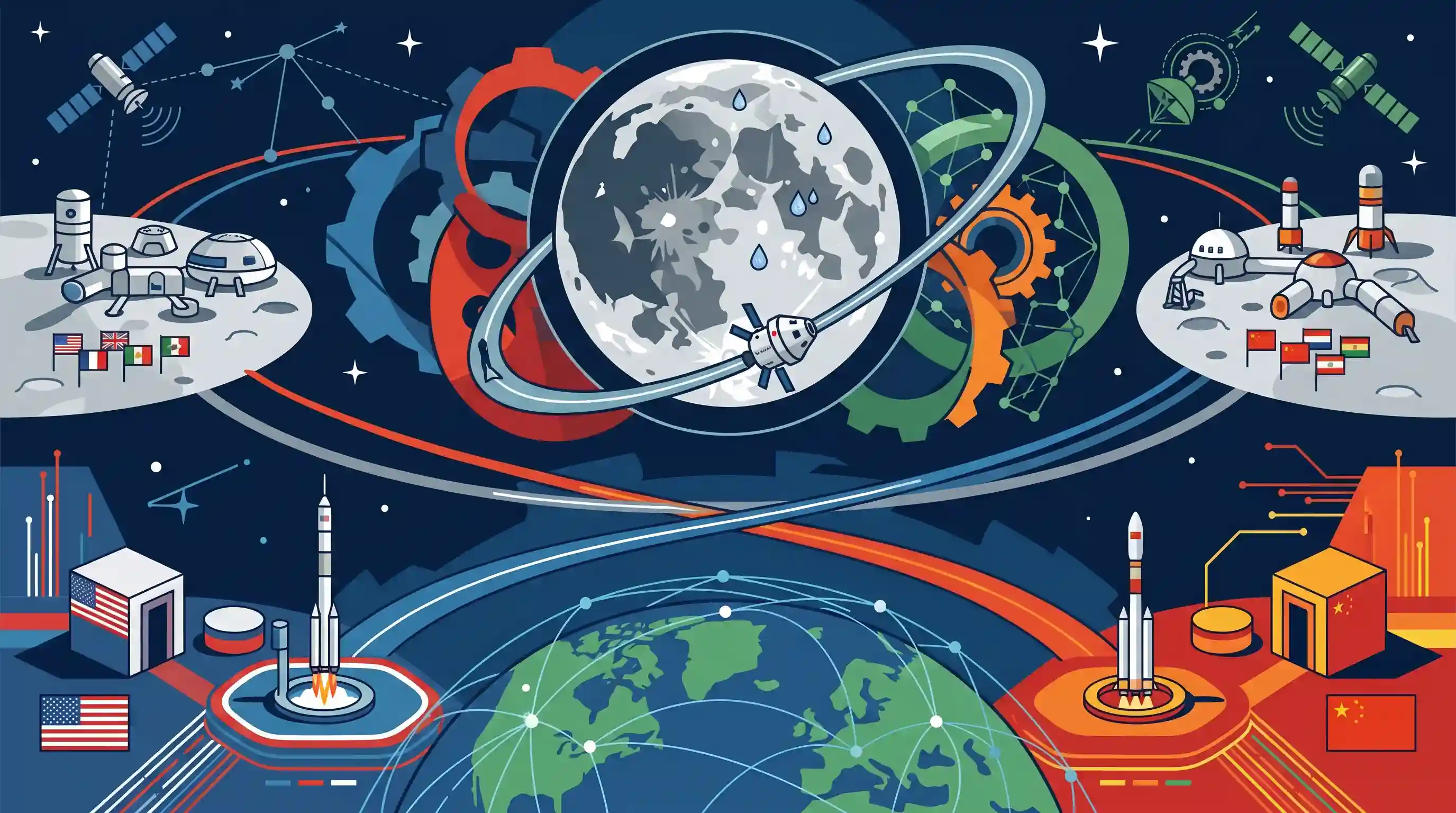
The article examines NASA's Artemis II mission within the broader context of the modern international space race, heavily defined by the strategic rivalry between the United States and China. As a precursor to returning humans to the lunar surface, Artemis II represents a critical step for the US in reasserting its dominance in space. The competition extends beyond mere exploration, focusing on establishing long-term lunar outposts, particularly at the resource-rich lunar south pole, and setting the rules for space governance through coalitions like the Artemis Accords. For the US, maintaining leadership in this arena is vital to countering China's rapid technological advancements and securing future economic and national security interests in outer space.
Key Points
- Artemis II is a crucial crewed lunar flyby mission in NASA's broader program to establish a sustainable human presence on the Moon as a stepping stone to Mars.
- The mission highlights the renewed international space race, predominantly characterized by the strategic and technological competition between the United States and China.
- Both nations are fiercely targeting the lunar south pole to extract critical resources like water ice and to establish long-term bases (Artemis base camp vs. China's ILRS).
- Beyond scientific exploration, at stake for the US is its geopolitical hegemony, national security, and the ability to set international norms in space governance through frameworks like the Artemis Accords.
Important Terms
Artemis Program

A NASA-led initiative to return humans to the Moon, establish a permanent lunar base, and use these experiences to prepare for future crewed missions to Mars.
UPSC context
GS Paper 3 (Space Technology); critical for understanding modern human spaceflight goals and India's collaborative role.
Artemis Accords
A US-led set of non-binding principles for peaceful, transparent, and sustainable international cooperation in lunar and deep-space exploration; India is a signatory.
UPSC context
GS Paper 2 (International Relations); tests awareness of space diplomacy and India’s alignment with global space governance frameworks.
International Lunar Research Station (ILRS)
A planned lunar base project jointly led by China (CNSA) and Russia (Roscosmos) to conduct long-term scientific research and resource utilization on the Moon.
UPSC context
GS Paper 2 (International Relations); significant for analyzing geopolitical competition and the bifurcated "space race" between major powers.
NASA
The United States' civil space agency responsible for aeronautics research and the Artemis missions; it serves as a global leader in space exploration technology.
UPSC context
GS Paper 3 (Space Technology); central to studying international technological standards and global space exploration milestones.
China National Space Administration (CNSA)
China's national space agency that manages the country's civil space programs, including the Chang'e lunar missions and the competitive International Lunar Research Station.
UPSC context
GS Paper 2 (International Relations); reflects China's strategic ascent in space and its challenge to traditional Western dominance.
Prelims Trap
"The Artemis Accords are a legally binding UN framework for lunar exploration."
The Artemis Accords are a set of non-binding principles drafted by the US, not a UN treaty. The UN's actual framework is the 1967 Outer Space Treaty.
Static Concepts Connected
What are the core principles of the 1967 Outer Space Treaty?
- Weapons ban: Prohibits the placement of nuclear weapons or other weapons of mass destruction in Earth's orbit or on celestial bodies.
- No sovereignty: Forbids any nation from claiming sovereignty or national appropriation over outer space, including the Moon.
- Peaceful use: Mandates that all celestial bodies be used exclusively for peaceful purposes, prohibiting military bases.
What is In-Situ Resource Utilization (ISRU) in space exploration?
- Local extraction: Collecting and processing local materials found on celestial bodies to replace supplies otherwise brought from Earth.
- Resource conversion: Harvesting lunar water ice to produce breathable oxygen, drinking water, and hydrogen for rocket fuel.
- Cost reduction: Crucial for sustainable deep space missions, as it drastically reduces the payload mass and launch costs from Earth.
Cross-Topic Patterns
Space race & resource hegemony
The lunar south pole rush mirrors Earth's critical mineral geopolitics, shifting focus from scientific prestige to resource extraction and In-Situ Resource Utilization (ISRU).
India's space multi-alignment
India signing the US-led Artemis Accords in 2023, while maintaining historical ties with Russia's space program, highlights its broader strategic autonomy extending into space governance.

Expect a 2026 Prelims question contrasting the US-led Artemis Accords with the UN Outer Space Treaty, testing India's recent accession.
Linked PYQs · 3
Linked PYQs · 3
- 2023MainsGS3
What is the main task of India's third moon mission which could not be achieved in its earlier mission? List the countries that have achieved this task. Introduce the subsystems in the spacecraft launched and explain the role of the Virtual Launch Control Centre' at the Vikram Sarabhai Space Centre which contributed to the successful launch from Sriharikota.
- 2017MainsGS3
India has achieved remarkable successes in unmanned space missions including the Chandrayaan and Mars Orbitter Mission, but has not ventured into manned space missions. What are the main obstacles to launching a manned space mission, both in terms of technology and logistics? Examine critically.
- 2021MainsGS2
“The USA is facing an existential threat in the form of a China, that is much more challenging than the erstwhile Soviet Union.” Explain.
