Human Spaceflight Engineering and Artemis II Mission
Source:The Hindu ↗
Why It Matters
Human spaceflight represents the pinnacle of space engineering. With ISRO actively preparing for the Gaganyaan mission, understanding the technological hurdles (such as life support and safety systems) and comparing them with international endeavors like NASA's Artemis II is crucial for the GS3 Science & Technology syllabus.
Summary
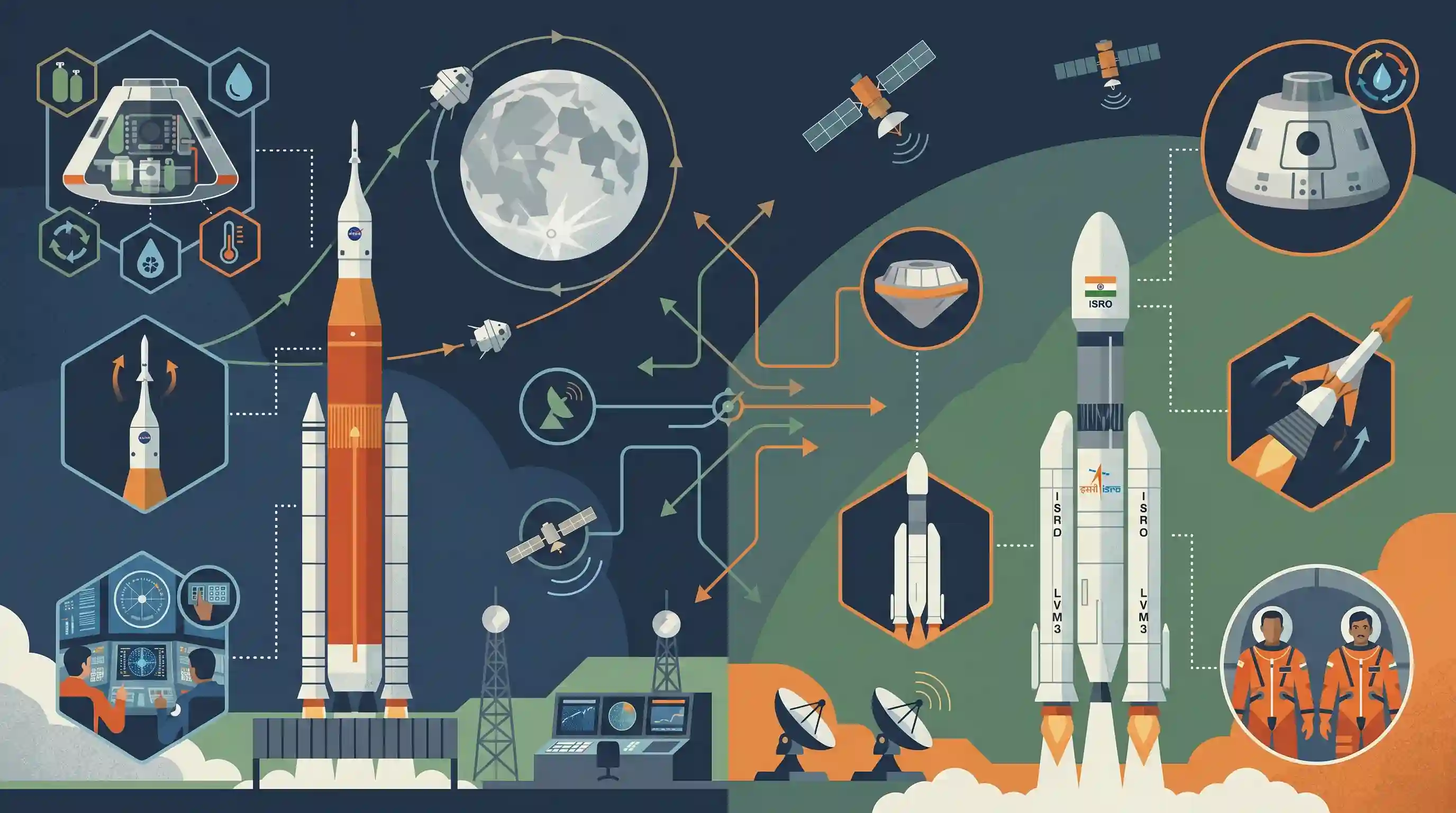
The article highlights the engineering complexities of human spaceflight, bringing focus to NASA's Artemis II mission, which aims to send astronauts around the Moon. This renewed interest in crewed lunar missions spotlights the intricate life support, safety abort systems, and crew module designs required to sustain human life in deep space. Furthermore, the technological advancements demonstrated in Artemis II draw parallels to the progress of ISRO's Gaganyaan mission, India's maiden human spaceflight program, showcasing ISRO's ongoing development of indigenous life-support systems, crew escape mechanisms, and human-rated launch vehicles.
Key Points
- Engineering Human Spaceflight: Emphasizes the critical technologies required to sustain human life in deep space, such as Environmental Control and Life Support Systems (ECLSS), radiation shielding, and thermal control.
- Artemis II Mission: NASA's upcoming crewed mission to orbit the Moon, which will test the Space Launch System (SLS) and the Orion spacecraft's life support systems with a human crew.
- Crew Abort and Safety Systems: Highlights essential safety mechanisms like the Crew Escape System (CES) designed to rapidly separate the crew module and carry astronauts to safety in the event of launch vehicle anomalies.
- ISRO's Gaganyaan Progress: India's parallel development of indigenous human-rated launch vehicles (LVM3), Orbital Modules, and life-support systems for its maiden human spaceflight program.
Important Terms
Gaganyaan Mission

India's maiden human spaceflight mission by ISRO, aiming to send a three-member crew to a 400 km Low Earth Orbit for three days and bring them back safely.
UPSC context
GS Paper III (Science & Technology): Indigenization of technology; testing India's capability for independent human spaceflight and future space station plans.
Artemis Program
A NASA-led international lunar exploration program aiming to land the first woman and next man on the Moon and establish a long-term, sustainable human presence.
UPSC context
GS Paper III (Space): International collaboration in deep-space exploration and scientific advancements beyond Low Earth Orbit.
Artemis II
The first crewed mission under NASA's Artemis program, involving a four-person crew in a 10-day lunar flyby to test the Orion spacecraft’s deep-space life-support systems.
UPSC context
GS Paper III (Space): Crucial transition from uncrewed testing to human deep-space missions; tests human-system integration for lunar landing.
Human-Rated Launch Vehicle (HLVM3)
An indigenous rocket (modified LVM3) certified by ISRO with enhanced reliability and safety features to safely transport human crews into space for the Gaganyaan mission.
UPSC context
GS Paper III (Science & Tech): Evolution of launch vehicle technology and safety standards for crewed versus satellite missions.
Environmental Control and Life Support System (ECLSS)
A complex engineering system that provides oxygen, removes carbon dioxide, and regulates temperature and pressure to maintain a habitable environment for astronauts during spaceflight.
UPSC context
GS Paper III (Space): Critical life-sustaining technology required for long-duration human missions and permanent space habitats.
Crew Escape System (CES)
A safety mechanism designed to quickly pull the astronaut crew module away from the launch vehicle in the event of a life-threatening emergency during ascent.
UPSC context
GS Paper III (Science & Tech): High-stakes safety engineering and abort protocols essential for human-rating space missions.
Prelims Trap
"Artemis II aims to land the first astronauts on the lunar surface since the Apollo era."
Artemis II is a crewed lunar flyby, not a landing mission. Artemis III is the mission actually designated to land humans on the Moon.
Static Concepts Connected
What differentiates a human-rated launch vehicle (HLVM3) from a standard rocket?
- System Redundancy: Incorporates multiple backup hardware and software subsystems to ensure mission success and safety even if a primary component fails.
- Crew Escape System: Equipped with quick-acting solid motors designed to instantly eject and pull the crew module to a safe distance during launch pad or ascent anomalies.
- Stringent Margins: Built and tested with significantly higher structural and safety margins compared to standard uncrewed satellite launch vehicles.
What are the core functions of an Environmental Control and Life Support System (ECLSS)?
- Atmosphere Management: Maintains safe cabin pressure, supplies breathable oxygen, and actively scrubs carbon dioxide and other toxic trace gases from the air.
- Thermal Control: Regulates extreme temperature fluctuations experienced in the vacuum of space, ensuring a habitable environment for the crew and sensitive electronics.
- Water Recovery: Collects, recycles, and purifies moisture (including sweat and urine) into potable water, which is critical for minimizing payload on long-duration missions.
Cross-Topic Patterns
Artemis Accords and Space Diplomacy
India's signing of the Artemis Accords bridges ISRO's indigenous Gaganyaan goals with US-India strategic partnerships, encompassing joint ISS missions, NISAR, and lunar exploration norms.
Gaganyaan vs Samudrayaan Life Support
UPSC often links extreme-environment missions. Gaganyaan's ECLSS mirrors the indigenous life-support and pressure-hull challenges of Samudrayaan's MATSYA 6000 submersible, both testing India's deep-tech autonomy.

Expect a 2026 multi-statement question contrasting Gaganyaan's LEO (400km) limits with Artemis deep-space engineering and the Artemis Accords.
Linked PYQs · 3
Linked PYQs · 3
- 2017MainsGS3
India has achieved remarkable successes in unmanned space missions including the Chandrayaan and Mars Orbitter Mission, but has not ventured into manned space missions. What are the main obstacles to launching a manned space mission, both in terms of technology and logistics? Examine critically.
- 2016MainsGS3
Discuss India's achievements in the field of Space Science and Technology. How the application of this technology has helped India in its socio-economic development?
- 2025PrelimsGS1
Consider the following space missions : I. Axiom-4 II. SpaDeX III. Gaganyaan How many of the space missions given above encourage and support micro-gravity research?
