GST Arrest Powers and Tax Authority Enforcement Limits
Source:Indian Express ↗
આ શા માટે મહત્વનું છે
It touches upon the core intersection of fiscal federalism, state revenue collection, tax compliance, and the protection of fundamental liberties against arbitrary administrative enforcement.
સારાંશ
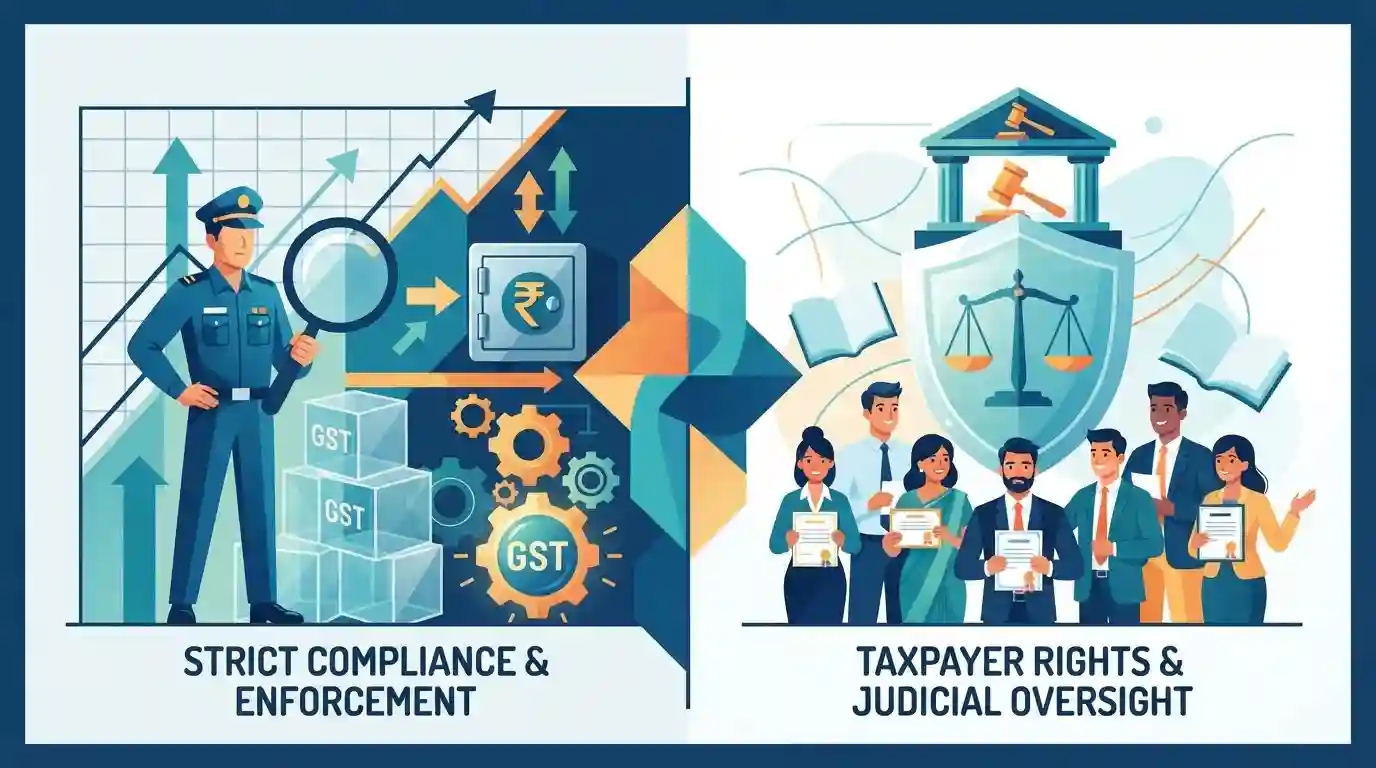
This article explores the legal and policy dimensions surrounding the arrest powers granted to tax authorities under the Goods and Services Tax (GST) regime, highlighting the delicate balance between ensuring strict compliance and protecting taxpayer rights against executive overreach.
મુખ્ય મુદ્દા
- The exercise of arrest powers by tax authorities under the GST regime has been a subject of significant legal and administrative debate.
- Balancing effective tax compliance and enforcement against harassment of taxpayers and overreach of executive power is a core challenge.
- Judicial scrutiny plays a vital role in checking arbitrary administrative actions and safeguarding individual liberty under the tax laws.
- Streamlining procedures and maintaining transparency are crucial for ensuring the ease of doing business while protecting government revenue.
મહત્વપૂર્ણ શબ્દો
Goods and Services Tax Act

The statutory framework governing the indirect tax regime in India, which includes provisions for tax levy, collection, assessment, offences, and penal actions such as arrest and prosecution.
UPSC context
UPSC GS Paper III (Indian Economy - Tax Reforms). Tests understanding of tax compliance, statutory powers, and economic legislation.
GST Council
A constitutional federal body comprising the Union Finance Minister and state finance ministers, responsible for making key recommendations on tax rates, exemptions, and administrative procedures under the GST regime.
UPSC context
UPSC GS Paper II (Indian Polity - Cooperative Federalism & Constitutional Bodies). Tests the functioning and decision-making powers of cooperative federal institutions.
Supreme Court of India
The apex judicial authority in India responsible for interpreting constitutional validity, administrative actions, and statutory provisions relating to tax laws and fundamental rights.
UPSC context
UPSC GS Paper II (Indian Polity - Judiciary & Judicial Review). Tests judicial oversight on executive overreach and statutory powers.
High Courts
Constitutional courts at the state level that exercise writ jurisdiction under Article 226 to review executive actions, statutory arrests, and tax administration disputes.
UPSC context
UPSC GS Paper II (Indian Polity - Judicial System & Writs). Tests the scope of judicial review and writ jurisdiction over executive tax authorities.
સંલગ્ન સ્થિર ખ્યાલો
What are the key legal safeguards and prerequisites governing arrest powers under Section 69 of the CGST Act, 2017?
- Competent Authority: Authorized by Commissioner based on recorded reasons to believe a person committed offenses under Section 132 (e.g., fake invoices).
- No Pre-assessment Needed: A completed tax assessment or adjudication is not a mandatory legal prerequisite prior to exercising arrest powers.
- Constitutional Safeguards: Arrested persons must be informed of grounds of arrest and produced before a Judicial Magistrate within 24 hours (CrPC applicability).
આંતર-વિષય પેટર્ન
GST Arrest Powers vs. PMLA Enforcement
Tax evasion and fake invoice syndicates blur the line between fiscal administration and organized economic offenses, often bringing PMLA (Prevention of Money Laundering Act) provisions into play alongside GST enforcement.
Fiscal Power vs. Constitutional Liberties
The tension between arbitrary executive discretion and fundamental rights under Article 21 highlights the perennial friction between fiscal federalism and citizen liberties.

Expect a statement-based prelims question on whether a completed tax assessment is a mandatory legal prerequisite for exercising GST arrest powers.
સંલગ્ન PYQ · 2
સંલગ્ન PYQ · 2
- 2019MainsGS3
Enumerate the indirect taxes which have been subsumed in the Goods and Services Tax (GST) in India. Also, comment on the revenue implications of the GST introduced in India since July 2017.
- 2013MainsGS3
Discuss the rationale for introducing Goods and Services Tax (GST) in India. Bring out critically the reasons for the delay in roll out for its regime.
