GST Regime Arrest Powers and Tax Authority Enforcement
Source:Indian Express ↗
Why It Matters
Understanding the balance between stringent tax enforcement mechanisms (like arrest powers) and the promotion of ease of doing business is crucial for fiscal governance and investor confidence in India's GST framework.
Summary
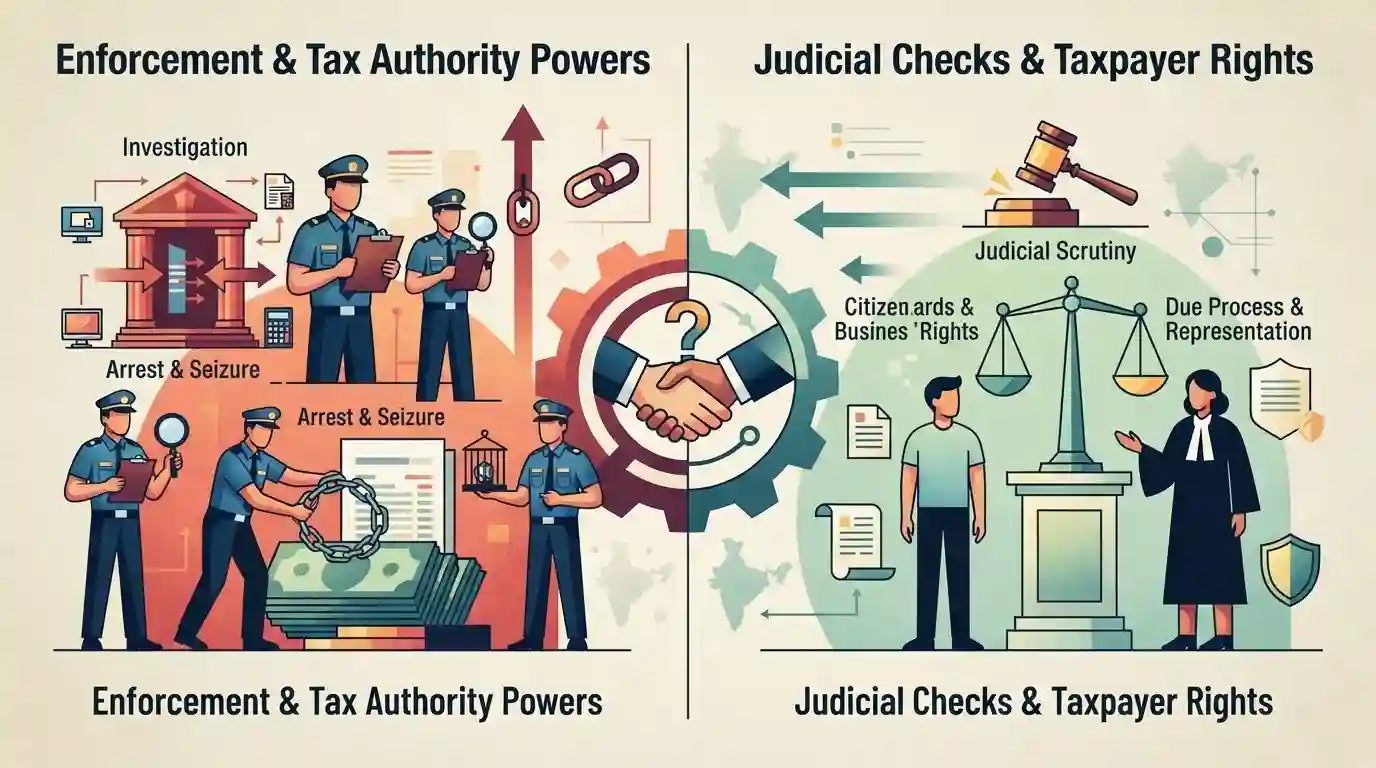
The article discusses the enforcement and arrest powers wielded by tax authorities under the Goods and Services Tax (GST) regime. It highlights the legal framework, the ongoing debates surrounding potential overreach versus compliance enforcement, and the judicial checks required to safeguard taxpayer rights while curbing tax evasion.
Key Points
- Tax authorities' arrest powers under the GST regime have sparked judicial and administrative debates regarding the balance between enforcement and the ease of doing business.
- Concerns are raised over potential overreach, arbitrary enforcement, and safeguards required to protect honest taxpayers from harassment.
- Judicial scrutiny emphasizes that arrest powers must be exercised with extreme caution and only when necessary, rather than as an automatic tool for tax recovery.
Important Terms
Central Goods and Services Tax Act

A key legislation under the indirect taxation framework that governs the intra-state supply of goods and services, empowering designated tax officers with search, seizure, and arrest powers to curb evasion.
UPSC context
UPSC Civil Services Exam - GS Paper III (Indian Economy & Taxation). Essential for testing legal frameworks regulating tax compliance and enforcement.
GST Council
A constitutional body established under Article 279A comprising Union and State representatives to make recommendations on tax rates, thresholds, and administrative rules under the GST regime.
UPSC context
UPSC Civil Services Exam - GS Paper II/III (Polity/Federalism & Economy). Evaluates cooperative federalism and fiscal governance in India.
Static Concepts Connected
What are the key statutory provisions governing arrest and cognizable offences under the CGST Act, 2017?
- Power of Arrest: Section 69 empowers the Commissioner to authorize an officer to arrest if there are 'reasons to believe' specific offences under Section 132 have been committed.
- Cognizable Threshold: Offences involving tax evasion, fraudulent ITC, or wrongful refunds exceeding ₹5 crore are classified as cognizable and non-bailable.
- Magistrate Safeguard: Mandates production of the arrested person before a Judicial or Metropolitan Magistrate within 24 hours pursuant to CrPC procedures.
Cross-Topic Patterns
GST Enforcement vs. PMLA Arrest Standards
GST enforcement intersects with constitutional federalism and executive discretion, mirroring debates under the Prevention of Money Laundering Act (PMLA) regarding arrest powers and bail thresholds.

Expect a statement-based prelims question combining Section 69 CGST Act criteria (cognizable offences, ₹5 crore threshold) with CrPC safeguards.
Linked PYQs · 2
Linked PYQs · 2
- 2019MainsGS3
Enumerate the indirect taxes which have been subsumed in the Goods and Services Tax (GST) in India. Also, comment on the revenue implications of the GST introduced in India since July 2017.
- 2013MainsGS3
Discuss the rationale for introducing Goods and Services Tax (GST) in India. Bring out critically the reasons for the delay in roll out for its regime.
