Arrests Rise Following Esplanade Protest Violence in Kolkata
Source:the-statesman ↗
কেন এটি গুরুত্বপূর্ণ
Demonstrates the practical challenges of balancing fundamental rights (peaceful protest under Article 19) with the State's duty to maintain public order, which is a State Subject under the Seventh Schedule. The actions of the state police also raise discussions on human rights during criminal proceedings.
সারসংক্ষেপ
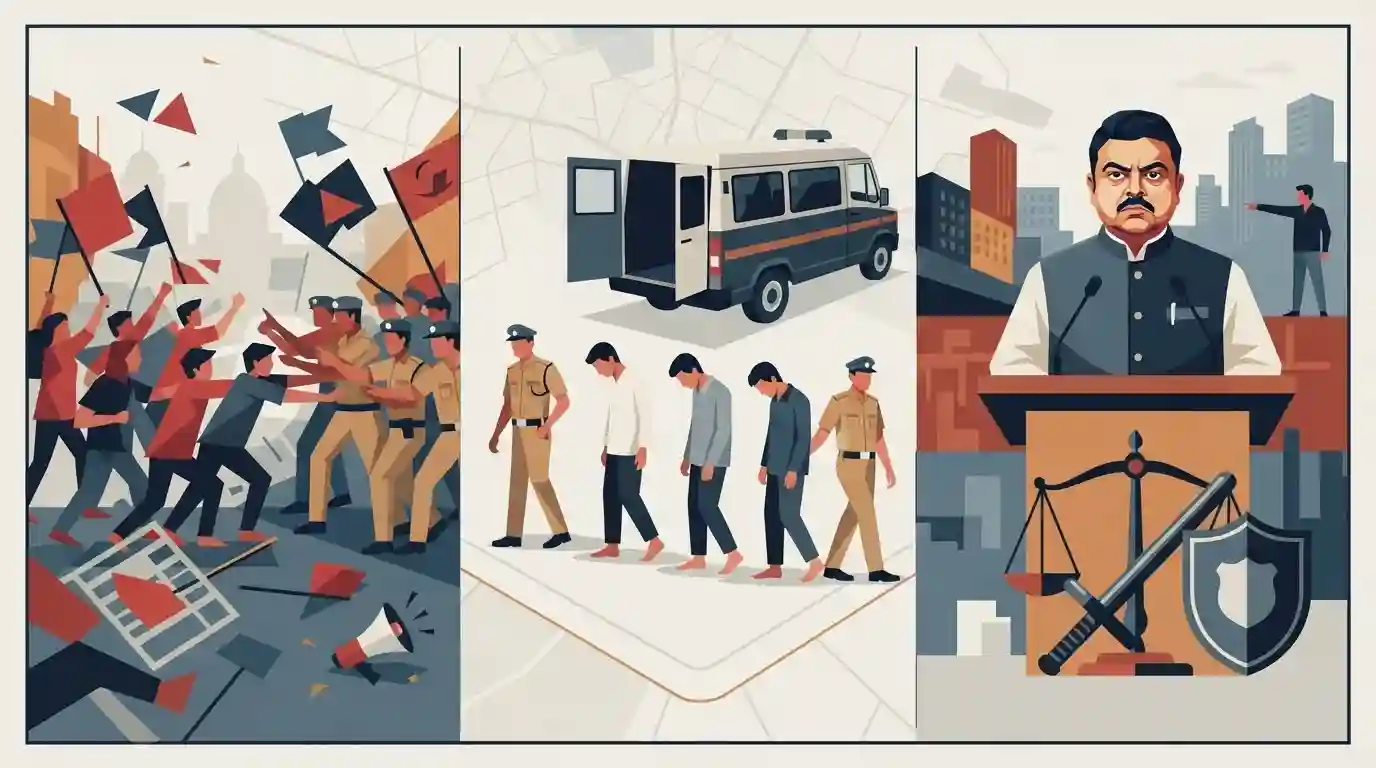
A protest in Kolkata's Esplanade over the NEET paper leak turned violent, resulting in clashes with police and the arrest of 16 individuals. The agitation involved Left student outfits and the Cockroach Janta Party (CJP). In the aftermath, police took five of the accused barefoot to the crime scene for a recreation. Chief Minister Suvendu Adhikari stated that strict measures would be enforced against those involved in the violence.
মূল বিষয়
- 16 individuals were arrested in connection with violence during a protest over the NEET paper leak at Kolkata's Esplanade.
- The protest, initially organized by Left student groups, escalated after members of the Cockroach Janta Party (CJP) joined, leading to clashes that injured police personnel and journalists.
- Five of the accused were brought barefoot to the crime scene by Kolkata Police for a recreation of the events.
- Chief Minister Suvendu Adhikari warned that strict action would be taken against the perpetrators under anti-goon laws.
গুরুত্বপূর্ণ শব্দ
Cockroach Janta Party (CJP)

A satirical, youth-driven political movement founded in 2026. Sparked by perceived insults against unemployed youth, it mobilized widespread internet-backed protests demanding education reform and transparency following the 2026 NEET exam leaks.
UPSC context
GS Paper 2 (Civil Society). Illustrates how modern internet-driven satire channels youth discontent into influential informal political mobilization.
National Eligibility-cum-Entrance Test (NEET)
An all-India entrance exam for undergraduate medical courses. Massive 2026 protests over alleged paper leaks and systemic irregularities sparked violent clashes and highlighted deep flaws in centralized examination integrity.
UPSC context
GS Paper 2 (Education). Tests the accountability, transparency, and structural dynamics of centralized testing agencies like the NTA.
West Bengal Public Safety and Control of Anti-Social Activities Act, 2026
A recently enacted state law, commonly called the 'anti-goonda law', allowing the preventive detention of individuals for up to 12 months to maintain public order. It was invoked against Esplanade violence suspects.
UPSC context
GS Paper 2 (Preventive Detention). Evaluates state powers over law enforcement versus fundamental individual liberties.
Right to Protest (Article 19)
Derived from constitutional guarantees of free speech (Article 19(1)(a)) and peaceful assembly (Article 19(1)(b)). This democratic right remains subject to reasonable restrictions under Article 19(2) and (3) for maintaining public order.
UPSC context
GS Paper 2 (Fundamental Rights). Crucial for questions on balancing democratic dissent with state security and public order.
Public Order (State List)
Under the Seventh Schedule of the Constitution, 'Public Order' and 'Police' are State List subjects (List II). State governments bear exclusive responsibility for maintaining peace, enacting local security laws, and controlling police.
UPSC context
GS Paper 2 (Federalism). Highlights state jurisdiction over managing violent protests, public safety, and law enforcement without central interference.
প্রিলিমস ফাঁদ
The Right to Protest is explicitly enumerated as a distinct, standalone Fundamental Right under Article 19(1) of the Indian Constitution.
The Constitution does not explicitly use the phrase "Right to Protest". It is a judicially derived implied right under Article 19(1)(a), (b), and (c).
সংযুক্ত স্থির ধারণা
What are the constitutional safeguards against misuse of Preventive Detention in India?
- Article 22 protection: Article 22(4) mandates that no preventive detention can exceed three months unless an Advisory Board finds sufficient cause for extension.
- Shared legislative competence: Parliament has exclusive power for defense/foreign affairs detention, while both Parliament and State legislatures share concurrent power for public order detention.
- Right to representation: The detenu must be afforded the earliest opportunity of making a representation against the detention order, as per Article 22(5).
How does the Supreme Court protect custodial dignity under Article 21?
- D.K. Basu guidelines: Laid down strict procedures for arrest, interrogation, and detention to prevent custodial torture and protect prisoner rights.
- Anti-handcuffing rulings: In Prem Shankar Shukla case, the court ruled public parading and routine handcuffing are sadistic and violate Article 21 human dignity.
- No rights forfeiture: In Sunil Batra case, the court held that convict status does not strip a citizen of fundamental rights like human dignity.
আন্তঃবিষয় প্যাটার্ন
Public Order vs. Cooperative Federalism
State public safety laws often overlap with federal investigation mandates (e.g., NIA), testing the boundaries of state police autonomy under the Seventh Schedule.
Custodial Rights & Extradition Diplomacy
Domestic police overreaches and non-ratification of the UN Convention Against Torture often complicate India's bilateral extradition efforts in Western courts.

Mains 2026 may evaluate the tension between state-level anti-social detention laws and Article 21 custodial dignity safeguards.
সংযুক্ত PYQ · 2
সংযুক্ত PYQ · 2
- 2017WBCS_PRELIMSGS1
'Law and Order' is included in the
- 2024WBCS_PRELIMSGS1
Which Fundamental Rights cannot be suspended during a National Emergency under Article 359?
