Army Bharat Ranbhoomi Darshan expedition from Dwarka for jointmanship
Source:The Hindu ↗
Why It Matters
It highlights civil-military engagement, border perception management, and inter-agency jointmanship (Army-Navy-BSF)—key themes for UPSC GS-3 internal security and border management questions.
Summary
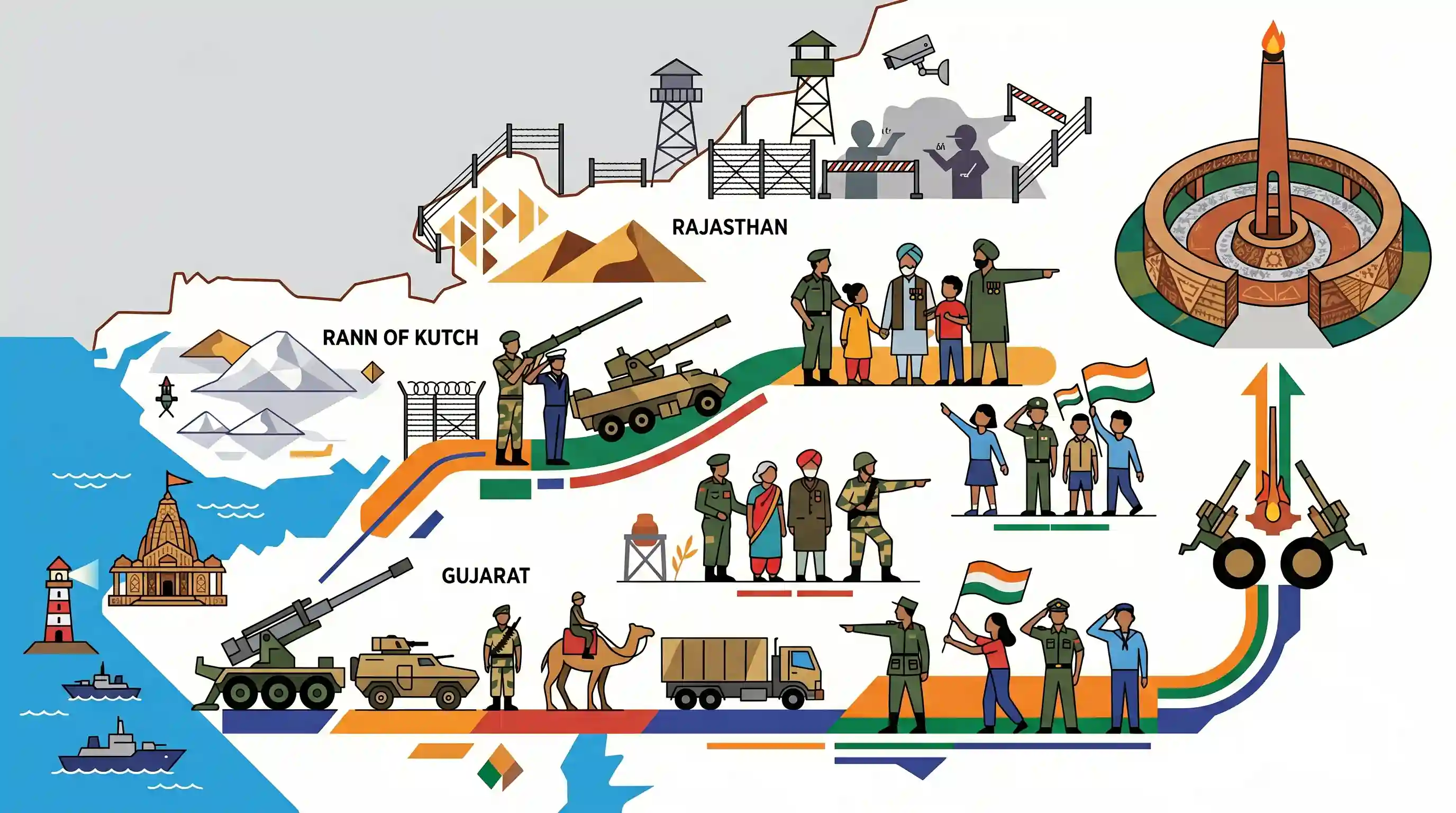
The Indian Army's Regiment of Artillery, in collaboration with the Indian Navy and the Border Security Force (BSF), has launched the 'Bharat Ranbhoomi Darshan' expedition from Dwarka, Gujarat. The 3,400-km journey along the western frontiers of Gujarat and Rajasthan aims to promote jointmanship among the armed forces, engage with border communities and veterans, and foster patriotism among the youth. Culminating at the National War Memorial in New Delhi, the expedition also underscores the strategic maritime importance of coastal cities like Dwarka and honors India's military heritage.
Key Points
- The 'Bharat Ranbhoomi Darshan' expedition was flagged off from Dwarka to honor the Indian Army's Regiment of Artillery.
- The expedition demonstrates jointmanship among the armed forces, being a collaborative effort by the Army, Navy, and BSF.
- Participants will cover over 3,400 km along India's western frontier (Gujarat and Rajasthan), interacting with border communities, veterans, and youth.
- Dwarka was selected to highlight India's deep civilizational roots and the strategic maritime importance safeguarded by the Indian Navy.
- The journey will culminate at the National War Memorial in New Delhi, focusing on spreading awareness about India's military heritage and strengthening national pride.
Important Terms
Bharat Ranbhoomi Darshan expedition

A 3,400-km multi-agency expedition along India's western frontier (Gujarat and Rajasthan) to promote military heritage, jointmanship among forces, and foster patriotism among border communities and youth.
UPSC context
GS Paper III (Internal Security); tests awareness of border outreach, civil-military relations, and joint security operations.
Jointmanship
The integration and coordinated application of military power across the Army, Navy, and Air Force to achieve synergy and unified command in operations.
UPSC context
GS Paper III (Security); critical for discussing defense reforms, the Chief of Defence Staff (CDS), and theaterization.
Border Security Force (BSF)
India's primary border-guarding organization for the frontiers with Pakistan and Bangladesh; it is one of the seven Central Armed Police Forces (CAPFs) under the Ministry of Home Affairs.
UPSC context
GS Paper III (Security forces and their mandates); essential for border management and internal security topics.
Regiment of Artillery
A premier combat support arm of the Indian Army that provide massive firepower through guns, mortars, rockets, and missiles during battlefield operations.
UPSC context
GS Paper III (Security forces); relevant to understanding Indian Army structure and modernization of artillery systems.
National War Memorial
A national monument in New Delhi dedicated to Indian Armed Forces personnel who died in the line of duty during conflicts post-Independence.
UPSC context
GS Paper I (Art & Culture/Heritage); tests knowledge of national commemorative symbols and modern military history.
National Cadet Corps (NCC)
A tri-service youth organization in India that provides basic military training and develops character, discipline, and the spirit of selfless service among students.
UPSC context
GS Paper III (Internal Security); relevant for youth engagement in nation-building and secondary security tiers.
Prelims Trap
The Bharat Ranbhoomi Darshan expedition is entirely a Ministry of Defence initiative.
While the Army and Navy are under the Ministry of Defence, the BSF is a CAPF under the Ministry of Home Affairs. It is a cross-ministry collaboration.
Static Concepts Connected
What is the peacetime and wartime mandate of the Border Security Force (BSF)?
- Primary Peacetime Mandate: Guarding India's land borders with Pakistan and Bangladesh during peacetime to prevent transnational crimes and unauthorized entry.
- Administrative Control: Operates under the administrative control of the Ministry of Home Affairs (MHA) as one of India's Central Armed Police Forces (CAPFs).
- Wartime Role: Defending vital installations, maintaining law and order in border areas, and fighting alongside the Indian Army in designated sectors.
How is India's Coastal Security Architecture structured?
- Tier 1 (Marine Police): Patrols shallow territorial waters up to 12 nautical miles from the coastline.
- Tier 2 (Coast Guard): Secures the maritime zones between 12 and 200 nautical miles, known as the Exclusive Economic Zone (EEZ).
- Tier 3 (Indian Navy): Responsible for overall maritime security, including defending deep-water areas beyond the EEZ and coordinating the entire security grid.
Cross-Topic Patterns
Border Tourism & Vibrant Villages
Engaging border communities to build trust and gather localized intelligence mirrors the objectives of the Vibrant Villages Programme, which aims to check out-migration and utilize locals as a security buffer.
Jointmanship as a Theaterisation Precursor
Collaborative expeditions involving the Army, Navy, and CAPFs serve as soft-power precursors to India's impending Theaterisation drive, fostering the interoperability needed for Integrated Theater Commands.

Expect a 2026 Prelims question contrasting the peacetime vs wartime mandates of MHA-controlled CAPFs and MoD-controlled Armed Forces.
Linked PYQs · 3
Linked PYQs · 3
- 2020MainsGS3
For effective border area management, discuss the steps required to be taken to deny local support to militants and also suggest ways to manage favourable perception among locals.
- 2020MainsGS3
Analyze internal security threats and transborder crimes along Myanmar, Bangladesh and Pakistan borders including Line of Control (LoC). Also discuss the role played by various security forces in this regard.
- 2022MainsGS3
What are the maritime security challenges in India ? Discuss the organisational, technical and procedural initiatives taken to improve the maritime security.
