Adultery Criminalization under Military Law and SC
Source:Indian Express ↗
ఇది ఎందుకు ముఖ్యం
It touches upon the constitutional balance between fundamental rights and the special legislative exceptions carved out for maintaining discipline in the armed forces.
సారాంశం
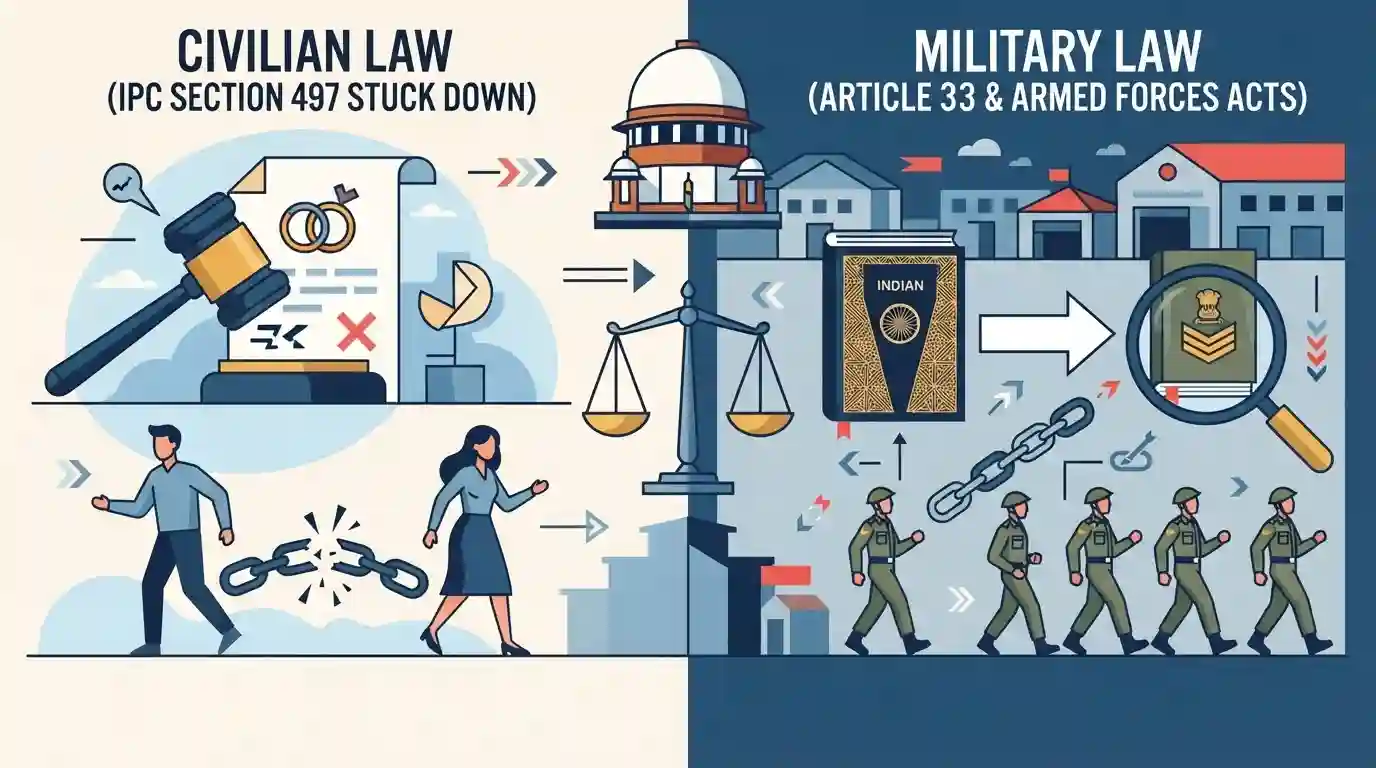
The article discusses the legal debates and Supreme Court proceedings surrounding the criminalization of adultery under military law, contrasting it with the striking down of Section 497 of the IPC for civilians. It highlights the interplay between fundamental rights, military discipline, and the scope of Article 33 of the Constitution.
ముఖ్య అంశాలు
- The Supreme Court examined issues relating to whether adultery can continue to be treated as a criminal offence under military law (Army Act) despite being struck down as unconstitutional for civilians (Joseph Shine case, 2018).
- Article 33 of the Indian Constitution empowers Parliament to restrict or abrogate fundamental rights of members of the armed forces to ensure proper discharge of duties and maintenance of discipline.
- Balancing individual constitutional rights of armed forces personnel with the unique operational and disciplinary requirements of military service remains a key legal and governance challenge.
ముఖ్యమైన పదాలు
Article 33 of the Constitution

Empowers Parliament to restrict or abrogate Fundamental Rights of armed forces personnel to ensure proper discharge of duties and maintenance of discipline.
UPSC context
GS Paper II (Polity): Tests understanding of Fundamental Rights exceptions, exceptions for armed forces, and checks on judicial review.
Army Act
Statute governing the discipline, governance, and trial of personnel in the Indian Army, including provisions for court-martial proceedings for misconduct.
UPSC context
GS Paper II (Polity/Security): Tests understanding of specialized military laws and internal security governance mechanisms.
Section 497 IPC
Former penal provision under the Indian Penal Code that criminalized adultery, which was struck down by the Supreme Court in 2018 as unconstitutional.
UPSC context
GS Paper II (Polity): Important for questions on gender justice, equality, and landmark Supreme Court rulings.
ప్రిలిమ్స్ ఉచ్చు
Decriminalization of an offence under the IPC automatically renders identical court-martial provisions under the Army Act unconstitutional.
Aspirants often assume that judgments decriminalizing offences for civilians automatically repeal equivalent penal provisions under military acts. Article 33 and separate military enactments create distinct standards.
అనుసంధానమైన స్థిర భావనలు
What are the constitutional provisions governing fundamental rights of the armed forces in India?
- Article 33:: Empowers Parliament to restrict or abrogate fundamental rights for members of armed forces, police, and intelligence agencies to ensure discipline.
- Parliamentary Authority:: Exclusively vested in Parliament by the Constitution; state legislatures have no competence to enact laws under Article 33.
- Judicial Test:: Restrictions must have a direct and rational nexus with the maintenance of proper discharge of duties and discipline.
అంతర-అంశ నమూనాలు
Military Discipline vs. Fundamental Rights
While Article 33 allows restricting fundamental rights of armed forces, judicial review under Article 32 and 226 ensures these restrictions are proportional and rationally connected to military discipline.
Civilian vs. Military Penal Regimes
The divergence between civilian penal codes and military enactments illustrates how specialized service conditions create distinct legal regimes under constitutional governance.

Article 33's scope and Parliament's exclusive power to restrict armed forces' fundamental rights frequently recur in statements-based questions.
అనుసంధాన PYQలు · 3
అనుసంధాన PYQలు · 3
- 2025MainsGS2
Indian Constitution has conferred the amending power on the ordinary legislative institutions with a few procedural hurdles. In view of this statement, examine the procedural and substantive limitations on the amending power of the Parliament to change the Constitution.
- 2022MainsGS2
“Right of movement and residence throughout the territory of India are freely available to the Indian citizens, but these rights are not absolute.” Comment.
- 2024PrelimsGS1
Under which of the following Articles of the Constitution of India, has the Supreme Court of India placed the Right to Privacy ?
