Supreme Court Review of Adultery Under Army Act
Source:Indian Express ↗
ఇది ఎందుకు ముఖ్యం
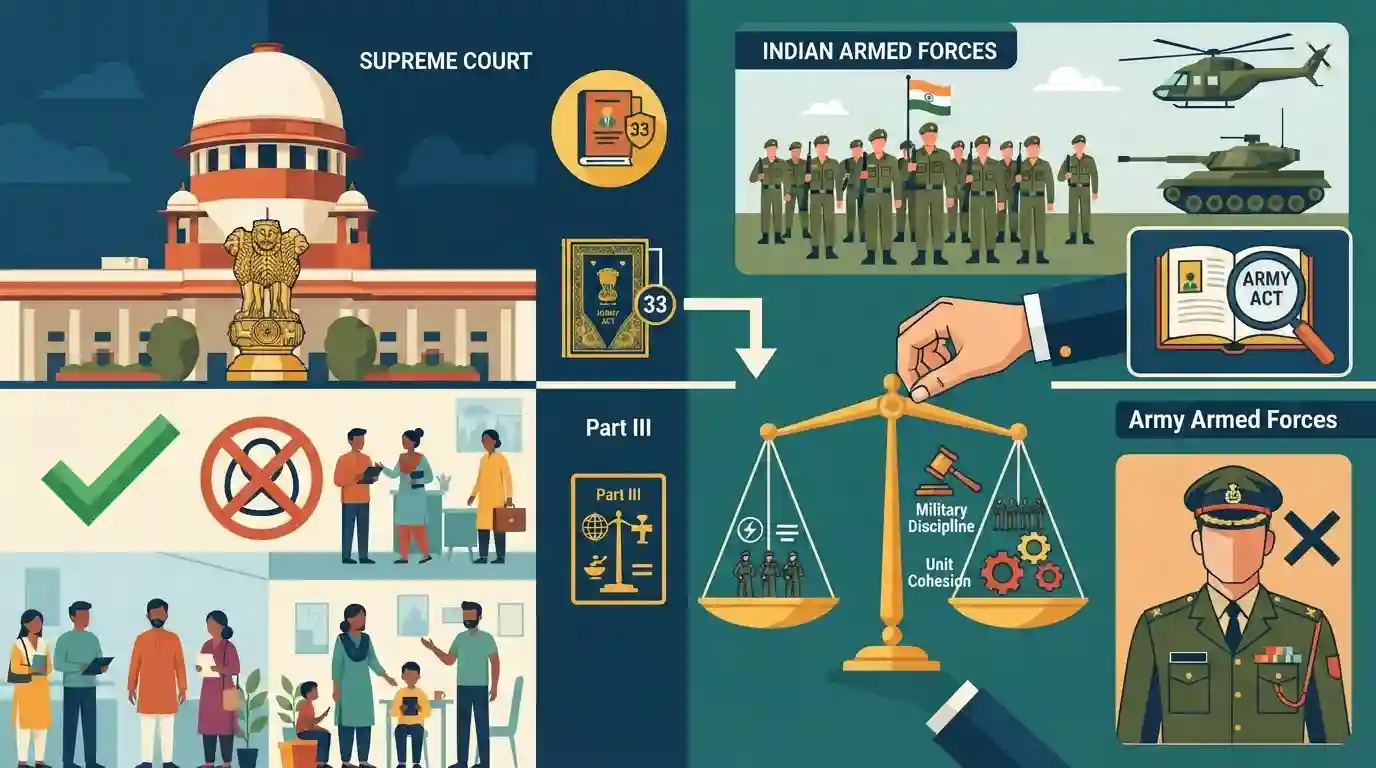
It directly addresses the constitutional limits on fundamental rights for armed forces personnel under Article 33, highlighting the tension between individual liberty/equality and institutional discipline in the military.
సారాంశం
An analysis of the Supreme Court's examination of adultery as a criminal offense under the Army Act, notwithstanding its decriminalization for civilians. The article explores the delicate balance between upholding fundamental rights for armed forces personnel under Article 33 and maintaining strict military discipline and unit cohesion.
ముఖ్య అంశాలు
- The Supreme Court is examining whether adultery can remain a criminal offence under the Army Act, 1950, despite being struck down as unconstitutional for civilians in the Joseph Shine (2018) judgment.
- Article 33 of the Constitution empowers Parliament to restrict Fundamental Rights of armed forces personnel to ensure the proper discharge of their duties and maintenance of discipline.
- Petitioners argue that criminalising adultery uniquely in the military violates equality and privacy rights, while the government maintains that military discipline and unit cohesion require special conduct rules.
ముఖ్యమైన పదాలు
Joseph Shine judgment

A 2018 Supreme Court landmark judgment that struck down Section 497 of the IPC, decriminalizing adultery for civilians on grounds of equality, privacy, and individual autonomy.
UPSC context
GS Paper II (Polity & Constitution — Judiciary, Fundamental Rights). Tests understanding of constitutional morality, right to privacy, and progressive judicial review.
Army Act
A statutory law governing the organization and discipline of the Indian Army, providing a special framework of offenses and penalties to maintain military efficiency and unit cohesion.
UPSC context
GS Paper II / III (Internal Security & Armed Forces Discipline). Tests the balance between fundamental rights under Article 33 and armed forces discipline.
IPC Section 497
The erstwhile penal provision under the Indian Penal Code that criminalized adultery, specifically penalizing sexual intercourse with another man's wife without his consent while treating women as victims or property.
UPSC context
GS Paper II (Constitutional Law / Criminal Law Reform). Evaluates historical colonial penal provisions vis-à-vis gender equality and non-discrimination.
అనుసంధానమైన స్థిర భావనలు
What is the scope and constitutional basis of Article 33 of the Indian Constitution?
- Parliamentary Competence: Empowers Parliament to restrict or abrogate Fundamental Rights for members of Armed Forces, police forces, and intelligence agencies to ensure proper discharge of duties.
- Non-Justiciable Exception: Restrictions under Article 33 cannot be challenged on the ground of violating Part III of the Constitution.
- Strict Applicability: Applies exclusively to forces charged with the maintenance of public order and national security; cannot be extended arbitrarily to civilian administrative staff.
అంతర-అంశ నమూనాలు
Article 33 vs Fundamental Rights
Article 33's restriction of fundamental rights for armed forces personnel intersects with the broader debate on civil liberties versus national security.
Military Exceptionalism and Penal Codes
The divergence between civilian penal codes and special armed forces statutes mirrors ongoing debates around AFSPA and military exceptionalism.

Expect a statement-based question combining Article 33 powers, Joseph Shine precedent, and the distinct classification of armed forces.
అనుసంధాన PYQలు · 1
అనుసంధాన PYQలు · 1
- 2025MainsGS2
Indian Constitution has conferred the amending power on the ordinary legislative institutions with a few procedural hurdles. In view of this statement, examine the procedural and substantive limitations on the amending power of the Parliament to change the Constitution.
