Supreme Court Review of Adultery under Military Law
Source:Indian Express ↗
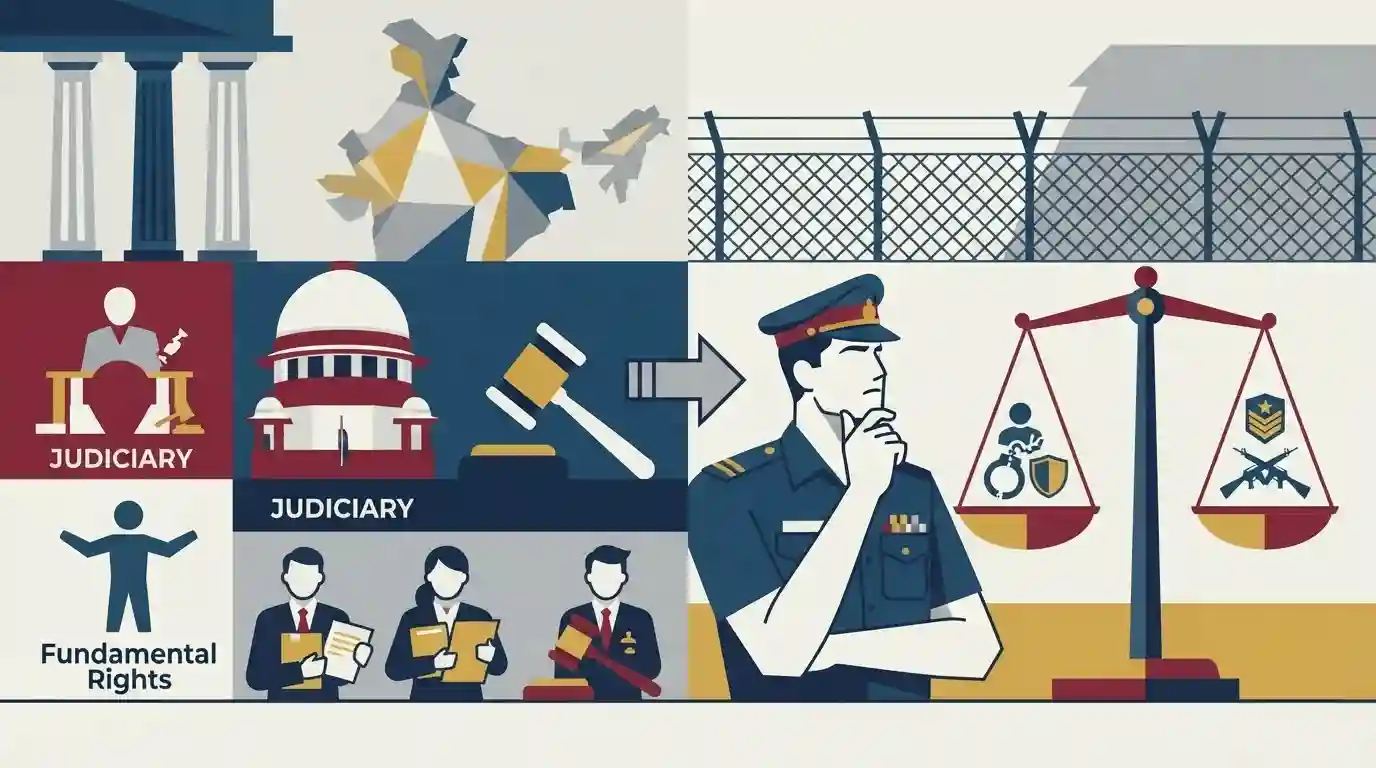
Why It Matters
It highlights the tension between fundamental rights (like privacy and equality) and special restrictions placed on armed forces under Article 33 for maintaining operational efficiency and military discipline.
Summary
The article examines the Supreme Court's legal scrutiny regarding whether adultery should remain a punishable criminal offence under military law (the Army Act) for armed forces personnel, even though it was decriminalized for civilians under Section 497 of the IPC following the landmark Joseph Shine judgment. The debate focuses on the scope of Article 33, military discipline, and the delicate balance between constitutional rights of soldiers and the functional necessities of armed forces.
Key Points
- The Supreme Court is examining the validity of treating adultery as a criminal offence under military law (specifically the Army Act), despite being struck down as unconstitutional for civilians in the 2018 Joseph Shine judgment.
- Article 33 of the Constitution empowers Parliament to restrict fundamental rights of members of the armed forces to ensure proper discharge of duties and maintenance of discipline.
- The core debate centers on balancing individual fundamental rights and privacy with the unique requirements of military discipline, unit cohesion, and command integrity.
Important Terms
Article 33 of the Constitution

A constitutional provision empowering Parliament to restrict or abrogate the fundamental rights of members of the armed forces and paramilitary forces to ensure the proper discharge of their duties and maintenance of discipline.
UPSC context
GS Paper II (Indian Constitution - Features and Significant Provisions). Tests understanding of exceptions to fundamental rights for national security and armed forces.
Joseph Shine v. Union of India
A landmark 2018 Supreme Court judgment that struck down Section 497 of the IPC, decriminalizing adultery for civilians on the grounds of gender equality and personal liberty.
UPSC context
GS Paper II (Judiciary, Basic Structure, Rights). Tests application of constitutional morality, privacy, and gender equality.
Army Act
A statutory legislation governing the Indian Army, providing a legal framework for court-martials, discipline, and penalizing conduct unbecoming of an officer or prejudicial to good order.
UPSC context
GS Paper II (Executive, Security Laws). Tests the balance between statutory military discipline and fundamental rights of soldiers.
Prelims Trap
Since the Supreme Court struck down Section 497 IPC as unconstitutional, criminal adultery is automatically void across all statutes in India.
Aspirants often assume that a judgment striking down a provision under IPC automatically invalidates identical penal provisions in special acts like the Army Act, ignoring the protective shield of Article 33.
Static Concepts Connected
What are the key provisions and scope of Article 33 of the Indian Constitution?
- Enabling Body: Empowering Parliament to restrict or abrogate Fundamental Rights (Part III) specifically for armed forces, paramilitary forces, intelligence agencies, and police.
- Primary Objective: Ensuring proper discharge of official duties and maintenance of discipline among force personnel.
- Immunity Scope: Exclusion of ordinary courts; laws made under Article 33 cannot be challenged simply for violating Part III rights if justified by military necessity.
Cross-Topic Patterns
Article 33 and Armed Forces Fundamental Rights
Article 33 permits Parliament to restrict fundamental rights for armed forces. This directly intersects with debates on whether military personnel should have unionization or collective bargaining rights under Article 19.
Civilian Decriminalization vs. Military Penal Code
The tension between the Joseph Shine civilian decriminalization and military penal provisions highlights how institutional autonomy must be balanced against evolving rights-based jurisprudence under Part III.

Expect a statement-based question combining Article 33 scope, Joseph Shine judgment, and military exception limits under Part III.
Linked PYQs · 1
Linked PYQs · 1
- 2024MainsGS2
Right to privacy is intrinsic to life and personal liberty and is inherently protected under Article 21 of the constitution. Explain. In this reference discuss the law relating to D.N.A. testing of child in the womb to establish its paternity.
