Armenia elections to decide geopolitical pivot between Russia and EU
Source:Indian Express ↗
Why It Matters
Understanding Armenia's strategic pivot helps aspirants analyze the shifting dynamics of the South Caucasus, the waning influence of Russia in post-Soviet spaces, and India's growing role as a defense exporter balancing against the Pakistan-Turkey-Azerbaijan nexus.
Summary
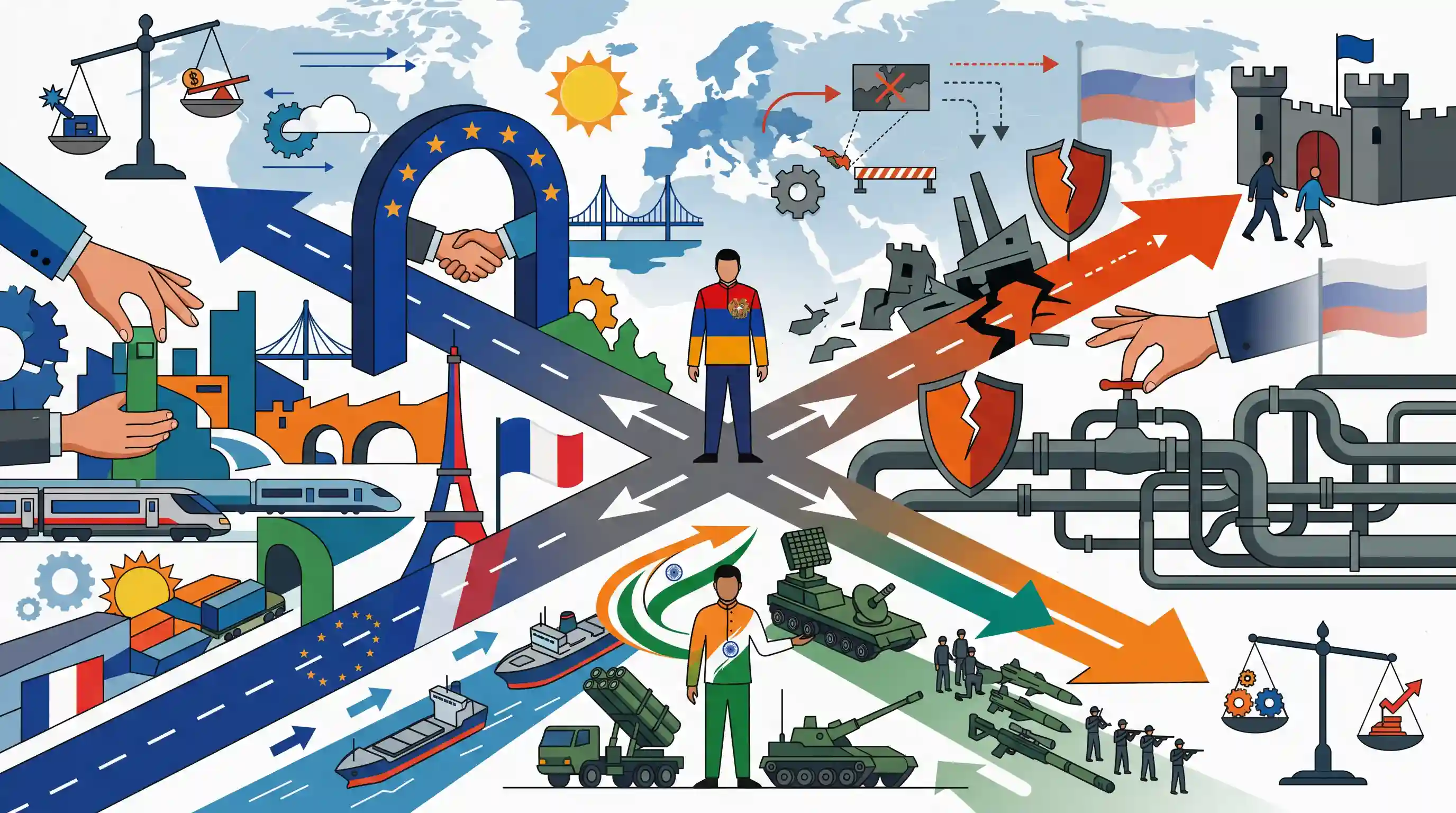
Armenia is at a critical geopolitical crossroads ahead of its 2026 elections, seeking to reduce its historical dependence on Russia and integrate closer with the European Union. Disillusioned by Russia's failure to protect it against Azerbaijan in the Nagorno-Karabakh conflict, Armenia has distanced itself from the CSTO and sought new defense partners, notably India and France. However, Russia retains significant economic leverage over Armenia through energy supplies and the Eurasian Economic Union. The outcome of this geopolitical realignment carries high stakes for regional stability, Russian hegemony in the post-Soviet space, and India's strategic defense footprint in the South Caucasus.
Key Points
- Armenia's upcoming 2026 parliamentary elections will serve as a crucial referendum on its geopolitical future, determining whether it continues pivoting towards the European Union or returns to Russia's orbit.
- Under PM Nikol Pashinyan, Armenia froze its participation in the Russia-led Collective Security Treaty Organisation (CSTO) after feeling abandoned during Azerbaijan's military takeover of the disputed Nagorno-Karabakh region.
- Despite seeking closer ties with the West, Armenia remains highly vulnerable to Russian economic coercion, as it relies on Russia for 82% of its gas and does over a third of its trade through the Russia-led Eurasian Economic Union (EAEU).
- The shift in South Caucasus geopolitics is strategically significant for India, which has become a major supplier of defense equipment (such as the PINAKA multi-barrel rocket launchers) to Armenia to counter the alignment of Pakistan, Turkey, and Azerbaijan.
Important Terms
Collective Security Treaty Organisation (CSTO)

A Russia-led military alliance of post-Soviet states for collective defense. Armenia recently "froze" its participation following dissatisfaction with the bloc's response to its security conflicts with Azerbaijan.
UPSC context
GS Paper II: International Relations. Tests knowledge of regional security architectures and shifts in Russia's traditional spheres of influence.
Eurasian Economic Union (EAEU)
A regional economic bloc of five post-Soviet states facilitating the free movement of goods, services, and labor. India launched formal Free Trade Agreement negotiations with the union in August 2025.
UPSC context
GS Paper II: International Relations. Relevant for studying regional trade integration and India's economic diplomacy in Eurasia.
South Caucasus
A strategic subregion at the border of Europe and Asia, comprising Armenia, Azerbaijan, and Georgia. It serves as a vital transit corridor for India’s International North-South Transport Corridor (INSTC).
UPSC context
GS Paper II: International Relations. Central to India’s "Extended Neighborhood" policy and strategic connectivity projects.
Nagorno-Karabakh
A mountainous region internationally recognized as Azerbaijan but formerly controlled by ethnic Armenians. Azerbaijan's 2023 victory in the territory fundamentally altered the geopolitical landscape and defense needs of Armenia.
UPSC context
GS Paper II: Current Affairs. Examines global conflict resolution and the impact of territorial disputes on regional defense partnerships.
Comprehensive and Enhanced Partnership Agreement (CEPA)
A comprehensive bilateral agreement between the EU and Armenia governing political and economic cooperation. It provides the legal framework for Armenia’s democratic reforms and closer integration with European standards.
UPSC context
GS Paper II: International Relations. Specific to Armenia’s "pivot to the West" and the EU’s expanding role in regional stability.
Prelims Trap
Armenia has withdrawn from both the CSTO and the Eurasian Economic Union (EAEU) to facilitate its integration into the European Union.
Armenia has frozen its participation in the military CSTO, but it remains a member of the economic EAEU due to its heavy reliance on Russian gas and trade.
Static Concepts Connected
What is the mandate and membership difference between CSTO and EAEU?
- CSTO Mandate: A Russia-led intergovernmental military alliance focusing on collective defense. Members: Russia, Belarus, Kazakhstan, Kyrgyzstan, Tajikistan, and Armenia (currently suspended).
- EAEU Mandate: An economic integration bloc ensuring free movement of goods, services, and capital. Members are identical to CSTO except Tajikistan is not a member.
What are the key features of the Indian defense systems exported to Armenia?
- Pinaka MBRL: An indigenous multi-barrel rocket launcher (MBRL) developed by DRDO, designed for rapid, high-density area saturation fire over varying ranges.
- Swathi WLR: An indigenous mobile artillery-locating radar that accurately tracks incoming artillery, mortars, and rockets to enable immediate counter-battery fire.
Cross-Topic Patterns
Defense exports countering the Turkey-Pakistan nexus
India's supply of Pinaka to Armenia marks a bold shift in its foreign policy, using indigenous defense exports to geopolitically counterbalance the trilateral alignment of Pakistan, Turkey, and Azerbaijan.
INSTC connectivity and Caucasus geography mapping
The South Caucasus is a vital geographical chokepoint. Armenia's stability connects directly to India's strategic push to secure alternative connectivity routes for the International North-South Transport Corridor (INSTC) via Iran.

Expect a 2026 Prelims multi-statement question testing the membership overlap of CSTO and EAEU alongside India's Pinaka MBRL exports.
Linked PYQs · 3
Linked PYQs · 3
- 2023PrelimsGS1
Consider the following pairs: Regions often mentioned in news Reason for being in news 1. North Kivu and Ituri : War between Armenia and Azerbaijan 2. Nagorno-Karabakh : Insurgency in Mozambique 3. Kherson and Zaporizhzhia : Dispute between Israel and Lebanon How many of the above pairs are correctly matched?
- 2022PrelimsGS1
Consider the following countries: 1. Armenia 2. Azerbaijan 3. Croatia 4. Romania 5. Uzbekistan Which of the above are members of the Organization of Turkic States?
- 2024MainsGS2
Critically analyse India's evolving diplomatic, economic and strategic relations with the Central Asian Republics (CARs) highlighting their increasing significance in regional and global geopolitics.
