Asteroid 2025 PN7 and Earth Quasi-Satellite Dynamics
Source:The Hindu ↗
Why It Matters
Understanding quasi-satellites and Arjuna asteroids is vital for tracking potential planetary hazards (planetary defense), a topic explicitly examined in UPSC Mains. Their Earth-like orbits also make them prime, fuel-efficient targets for upcoming space exploration missions and asteroid mining.
Summary
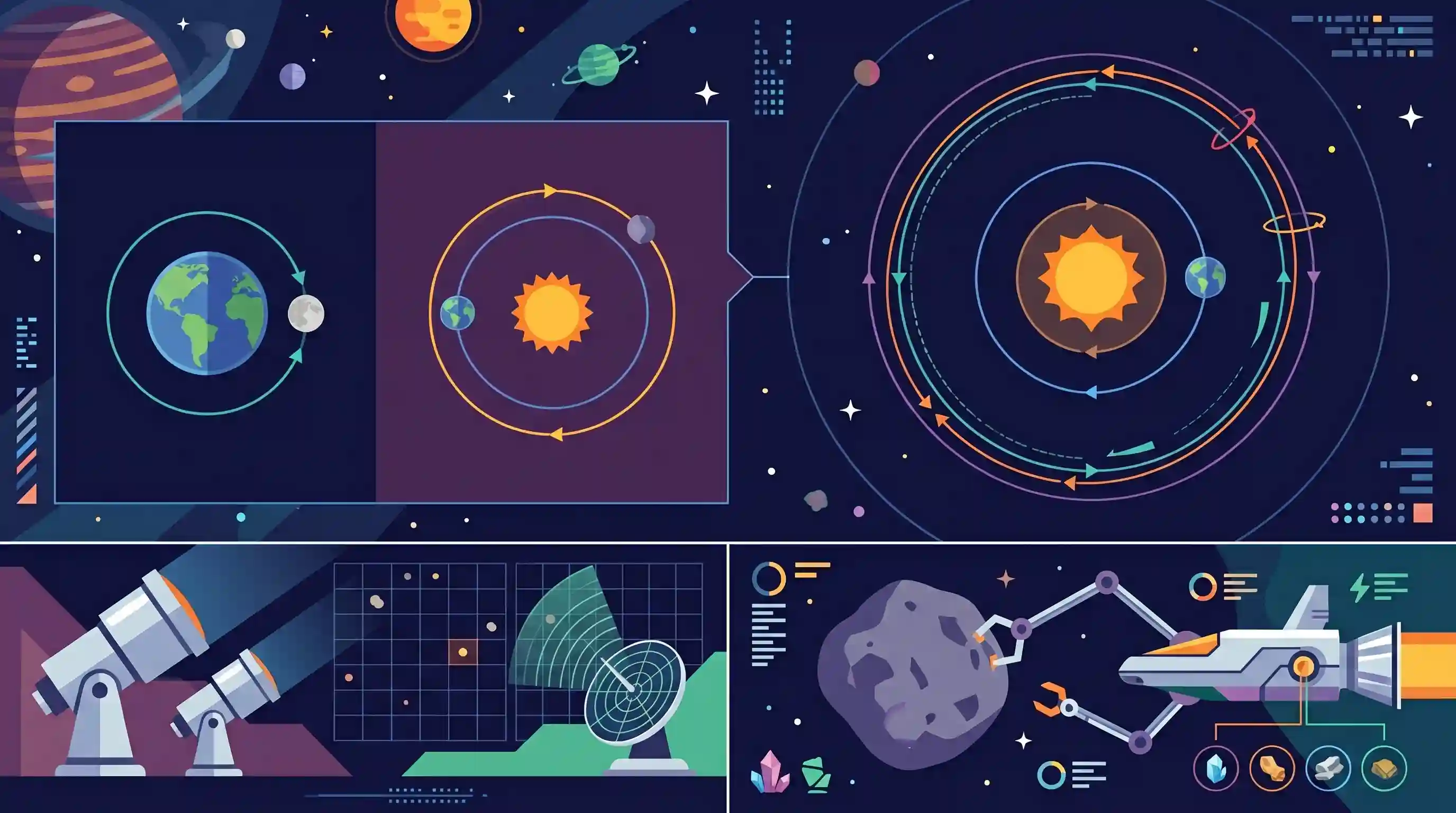
Astronomers have identified asteroid 2025 PN7 as Earth's newest quasi-satellite, a celestial body belonging to the Arjuna group of Near-Earth Objects (NEOs). The Arjuna group consists of small asteroids with orbits remarkably similar to Earth's in terms of duration, inclination, and eccentricity. While true satellites like the Moon are gravitationally tethered to Earth, quasi-satellites like 2025 PN7 orbit the Sun in a 1:1 resonance with Earth, making them appear to orbit our planet over long periods. The discovery emphasizes the importance of continuous monitoring of near-Earth space for planetary defense and highlights accessible targets for future deep-space exploration and potential resource extraction.
Key Points
- Asteroid 2025 PN7 has been identified as Earth's latest quasi-satellite, co-orbiting the Sun alongside our planet in a 1:1 orbital resonance.
- It is classified as an Arjuna asteroid, a group of Near-Earth Objects (NEOs) with Earth-like orbits, characterized by low inclination, low eccentricity, and an orbital period of roughly one Earth year.
- Unlike a true satellite (such as the Moon) that is gravitationally bound to Earth, a quasi-satellite orbits the Sun but its trajectory keeps it in close proximity to Earth for extended durations.
- Such near-Earth asteroids are critical for planetary defense tracking and offer scientifically significant targets for potential future exploration or asteroid mining due to their low relative velocity to Earth.
Important Terms
Near-Earth Objects (NEOs)

Asteroids or comets with orbits that bring them within approximately 195 million kilometers of the Sun, potentially passing close to Earth’s orbital path.
UPSC context
GS Paper III: Science & Technology and Disaster Management; critical for monitoring celestial threats and planetary defense strategies.
Quasi-satellite
A celestial body in a 1:1 orbital resonance with a planet. It orbits the Sun, but its synchronised path makes it appear to orbit the planet from a specific reference frame.
UPSC context
GS Paper III: Space Technology; tests knowledge of orbital mechanics, resonant motion, and Earth's temporary celestial companions.
Arjuna Asteroids
A dynamical group of small Near-Earth asteroids with Earth-like orbits (low inclination, eccentricity, and periods near one year). Named after the Mahabharata hero for their elusive, fast-moving nature.
UPSC context
GS Paper III: Science & Technology; relevant for understanding specific asteroid classifications and the 'secondary asteroid belt' near Earth.
Planetary Defense
The international cooperation and technological strategies (like NASA's DART mission) aimed at detecting, tracking, and mitigating potential impact threats from hazardous asteroids or comets.
UPSC context
GS Paper III: Science & Technology and Security; involves global space governance and technological efforts to prevent catastrophic impacts.
International Astronomical Union (IAU)
The global non-governmental organization founded in 1919, headquartered in Paris, recognized as the official authority for naming celestial bodies and promoting international astronomical research.
UPSC context
GS Paper II & III: International Institutions and Science; governs astronomical nomenclature and standardization of celestial data.
NASA
The United States' independent space agency responsible for the civil space program and aerospace research, leading initiatives like the Center for Near-Earth Object Studies (CNEOS).
UPSC context
GS Paper III: Space Technology; as a primary partner for ISRO and a leader in global planetary defense and exploration.
Prelims Trap
Quasi-satellites like 2025 PN7 are gravitationally bound to Earth and orbit it in elongated trajectories.
Quasi-satellites orbit the Sun, not Earth. They only *appear* to orbit Earth because they share a 1:1 orbital resonance, but their primary gravitational tether is the Sun.
Static Concepts Connected
What defines a Quasi-Satellite compared to a regular natural satellite?
- Central Body: It orbits the Sun (or parent star), whereas a true natural satellite like the Moon directly orbits a planet.
- Gravitational Bind: It is primarily tethered to the Sun's gravity, escaping the dominant gravitational pull of the host planet.
- Orbital Resonance: It maintains a 1:1 orbital resonance with Earth, completing an orbit in the exact same time, thus remaining nearby.
What are the characteristics of the Arjuna group of asteroids?
- Classification: They form a distinct dynamical class of Near-Earth Objects (NEOs).
- Orbital Traits: They possess extremely Earth-like orbits characterized by low inclination, low eccentricity, and orbital periods of about one Earth year.
- Exploration Potential: Their slow relative velocity to Earth makes them low-energy (low delta-v) targets, ideal for future sample-return missions and asteroid mining.
Cross-Topic Patterns
Asteroid mining & Space Treaties
The accessibility of Arjuna asteroids for resource extraction revives debates around the 1967 Outer Space Treaty and Artemis Accords regarding sovereign or commercial property rights on celestial bodies.
Planetary Defense & DART mission
Identifying Near-Earth Objects directly connects to kinetic impactor technologies, recently demonstrated by NASA's DART mission, to mitigate potential extinction-level impact events.

Expect a 2026 prelims question contrasting the gravitational mechanics of quasi-satellites, Lagrange points, and true satellites.
Linked PYQs · 2
Linked PYQs · 2
- 2024MainsGS3
What are asteroids? How real is the threat of them causing extinction of life? What strategies have been developed to prevent such a catastrophe?
- 2022PrelimsGS1
Which one of the following statements best reflects the idea behind the "Fractional Orbital Bombardment System" often talked about in media?
