Dr BR Ambedkar Contributions to Indian Economic Thought
Source:Indian Express ↗
Why It Matters
Ambedkar’s multi-dimensional role is a recurring theme in UPSC. Understanding his specific economic contributions—particularly his intellectual role in the creation of the RBI and his views on agriculture/industrialization—provides critical fodder for Mains answers in both GS-1 (Modern History/Personalities) and GS-3 (Economy/Land Reforms).
Summary
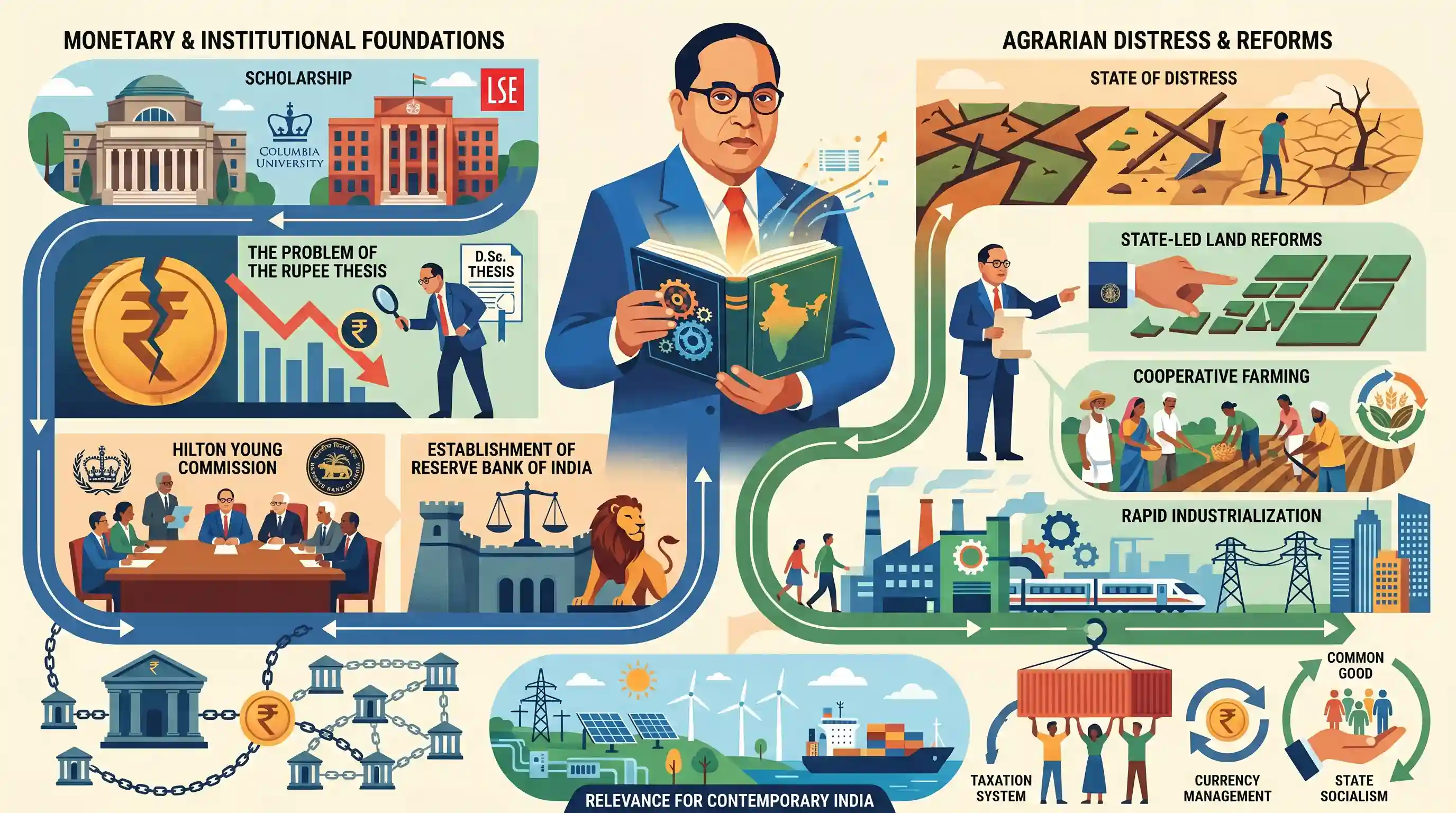
Arjun Ram Meghwal's article highlights Dr. B.R. Ambedkar’s profound yet often underappreciated contributions as an economist. Drawing from his extensive academic research at Columbia University and the London School of Economics, Ambedkar formulated economic policies that deeply influenced India's modern institutional framework. Notably, his thesis on the 'Problem of the Rupee' was instrumental in the conceptualization and establishment of the Reserve Bank of India via the Hilton Young Commission. Furthermore, Ambedkar offered pragmatic solutions for India's agrarian distress, advocating for state-led land reforms, cooperative farming, and rapid industrialization to shift surplus labor away from agriculture. The article underscores how his economic vision regarding taxation, currency management, and state socialism remains highly relevant for contemporary economic policy.
Key Points
- Dr. B.R. Ambedkar made seminal contributions to economic thought in India, extending far beyond his recognized role as the chief architect of the Constitution.
- His research, particularly 'The Problem of the Rupee: Its Origin and Its Solution', laid the conceptual framework that guided the Hilton Young Commission in establishing the Reserve Bank of India (RBI).
- Ambedkar advocated for radical land reforms, including state ownership of agricultural land, to address the core issues of agricultural productivity and equitable distribution.
- His economic vision stressed rapid industrialization as a prerequisite to absorb surplus agricultural labor, thereby increasing wages and reducing poverty.
Important Terms
Reserve Bank of India (RBI)

India's central bank and monetary authority, established in 1935 to regulate the issue of banknotes and maintain reserves for monetary stability.
UPSC context
GS Paper III: Indian Economy. Essential for understanding monetary policy and the historical development of India's financial architecture.
Hilton Young Commission
The 1926 Royal Commission on Indian Currency and Finance whose recommendations, influenced by Ambedkar's evidence, led to the creation of the RBI.
UPSC context
GS Paper I: Modern Indian History. Tests knowledge of colonial-era institutional reforms and Ambedkar's contributions as an economist.
The Problem of the Rupee
Ambedkar’s 1923 doctoral thesis which analyzed the Indian currency system and proposed the Gold Standard to ensure price stability.
UPSC context
GS Paper I: Significant Personalities. Demonstrates Ambedkar’s academic rigor and his influence on India's early monetary policy debates.
State Socialism
An economic model proposed by Ambedkar advocating state ownership of key industries and agricultural land to prevent private exploitation.
UPSC context
GS Paper II: Social Justice. Crucial for understanding Ambedkar's vision for economic democracy and constitutional protection of social rights.
Cooperative Farming
A system where farmers pool land for joint cultivation; advocated by Ambedkar to overcome the inefficiencies of small, fragmented landholdings.
UPSC context
GS Paper III: Land Reforms. Relevant for discussing historical and contemporary solutions to India's agricultural productivity and land distribution issues.
Industrialization
The transition to an industrial economy; Ambedkar viewed it as essential for moving surplus labor out of agriculture to reduce poverty.
UPSC context
GS Paper III: Economic Development. Tests the understanding of structural shifts in the Indian economy and Ambedkar’s early advocacy for it.
Prelims Trap
Ambedkar's economic model prioritized self-sufficient village economies and individual peasant-owned agriculture over state control.
This conflates his views with Gandhi's. Ambedkar actually viewed villages as oppressive, advocating for state ownership of agricultural land, collective farming, and rapid industrialization to absorb surplus rural labor.
Static Concepts Connected
What was the Hilton Young Commission and how did it lead to the RBI?
- Royal Commission: The Royal Commission on Indian Currency and Finance, set up in 1926 under Edward Hilton Young to advise on currency and exchange rates.
- Ambedkar's Input: Ambedkar presented his guidelines and thesis, 'The Problem of the Rupee', to the Commission, forming the conceptual basis for India's central bank.
- Legislative Outcome: The Commission's recommendations directly led to the drafting of the Reserve Bank of India Act, 1934, establishing the RBI in 1935.
What is Ambedkar's concept of 'State Socialism'?
- Resource Nationalization: He advocated for state ownership of agricultural land and state monopolies over key industries to ensure equitable distribution of resources.
- Collective Farming: State-owned land was to be leased to groups of cultivators for collective or cooperative farming under state direction.
- Democratic Means: Unlike Marxist socialism, Ambedkar insisted these radical economic reforms must be achieved strictly through democratic and constitutional means, without violent revolution.
Cross-Topic Patterns
Ambedkar vs. Gandhi on rural economics
While Gandhi envisioned self-sufficient village republics, Ambedkar viewed villages as oppressive and argued for rapid industrialization to pull surplus labor away from agriculture, shaping post-independence development debates.
Historical roots of Fiscal Federalism
Ambedkar’s 1921 thesis on the decentralization of imperial finance laid the early intellectual groundwork for India's constitutional fiscal federalism, directly connecting to the mandate of the modern Finance Commission.

A 2026 Prelims question will likely contrast Ambedkar’s 'State Socialism' and industrial focus with Gandhian village economics.
Linked PYQs · 4
Linked PYQs · 4
- 2023MainsGS3
State the objectives and measures of land reforms in India. Discuss how land ceiling policy on landholding can be considered as an effective reform under economic criteria.
- 2024MainsGS3
What are the causes of persistent high food inflation in India? Comment on the effectiveness of the monetary policy of the RBI to control this type of inflation.
- 2022PrelimsGS1
With reference to the Indian economy, consider the following statements: 1. If the inflation is too high, Reserve Bank of India (RBI) is likely to buy government securities. 2. If the rupee is rapidly depreciating, RBI is likely to sell dollars in the market. 3. If interest rates in the USA or European Union were to fall, that is likely to induce RBI to buy dollars. Which of the statements given above are correct?
- 2024PrelimsGS1
Consider the following statements in respect of the digital rupee : 1. It is a sovereign currency issued by the Reserve Bank of India (RBI) in alignment with its monetary policy. 2. It appears as a liability on the RBI's balance sheet. 3. It is insured against inflation by its very design. 4. It is freely convertible against commercial bank money and cash. Which of the statements given above are correct?
