External Affairs Minister Slams Pakistan Over Terrorism at UNGA
Source:The Hindu ↗
हे का महत्त्वाचे आहे
This article captures the core dynamics of India-Pakistan diplomatic engagement at multilateral forums like the UNGA, highlighting India's firm stance against cross-border terrorism and evolving positions on crucial bilateral arrangements like the Indus Waters Treaty, which is essential for GS2 International Relations.
सारांश
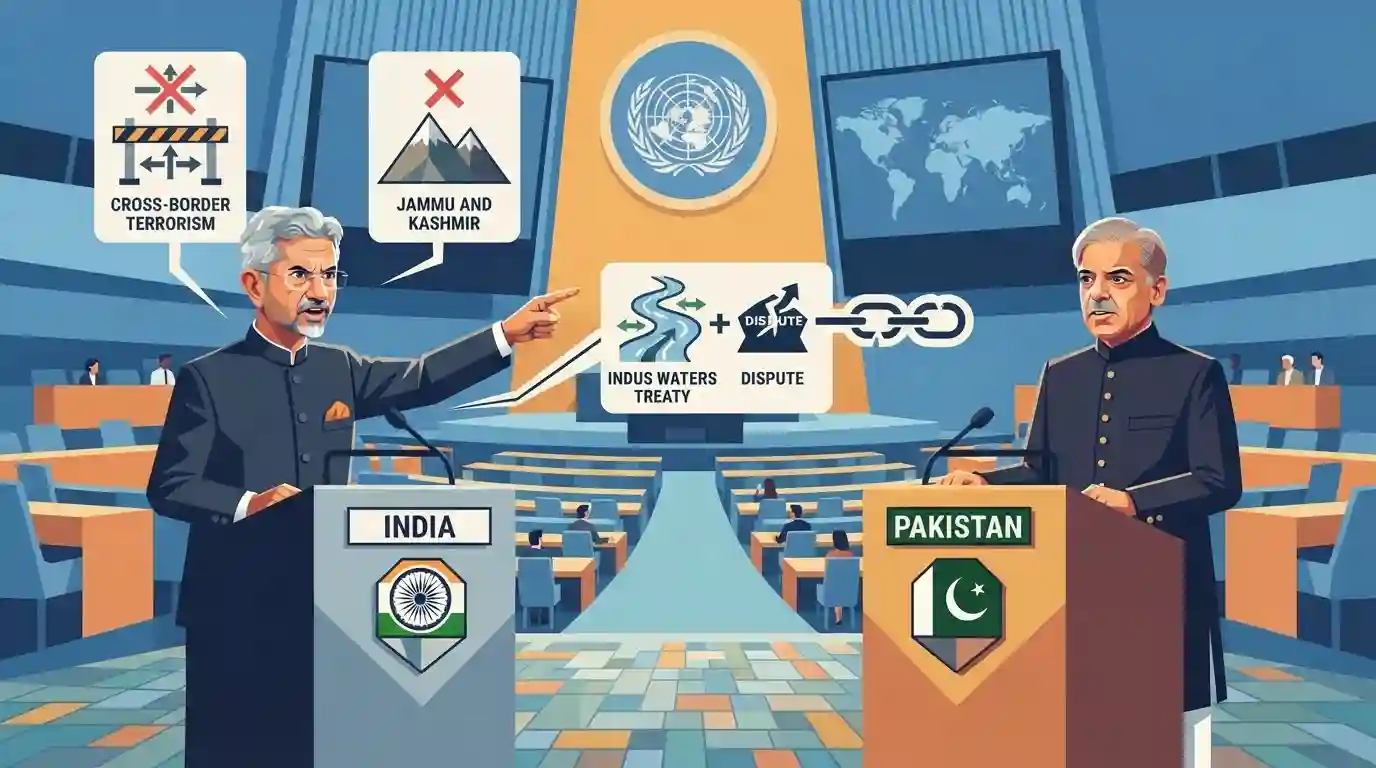
At the United Nations General Assembly, External Affairs Minister S. Jaishankar delivered a sharp rebuke to Pakistan Prime Minister Shehbaz Sharif, asserting that arguments from a country with a track record of state-sponsored terrorism hold no validity. Jaishankar emphasized that cross-border terrorism remains the central impediment to bilateral engagement and addressed friction points including Jammu and Kashmir and the Indus Waters Treaty.
मुख्य मुद्दे
- External Affairs Minister S. Jaishankar strongly criticized Pakistan at the UNGA, labeling it a 'serial practitioner of terrorism'.
- Jaishankar responded to Pakistan Prime Minister Shehbaz Sharif's remarks regarding Jammu and Kashmir and terrorism.
- The address highlighted cross-border terrorism as a fundamental obstacle to normal bilateral relations and multilateral dialogue.
- The context includes ongoing friction surrounding water-sharing treaties, notably the Indus Waters Treaty modification demands by India.
महत्त्वाच्या संज्ञा
Indus Waters Treaty

A 1960 water-distribution treaty between India and Pakistan, brokered by the World Bank, governing the Indus river system and its tributaries.
UPSC context
Important for GS Paper II (International Relations - India and its Neighborhood), testing bilateral water diplomacy and treaty mechanisms.
United Nations General Assembly (UNGA)
The main deliberative, policymaking, and representative organ of the United Nations, where all 193 member states have equal voting rights.
UPSC context
Crucial for GS Paper II (Important International Institutions), focusing on multilateral diplomacy, global governance, and India's foreign policy pronouncements.
Permanent Court of Arbitration
An intergovernmental organization established by the 1899 Hague Convention to provide services for the resolution of international disputes through arbitration and other tribunals.
UPSC context
Relevant for GS Paper II (International Relations / International Law), testing mechanisms for dispute resolution involving sovereign states.
संबंधित स्थिर संकल्पना
What is the institutional framework and dispute resolution mechanism under the Indus Waters Treaty (1960)?
- Indus Commission: Permanent Commission supervises the treaty, meets regularly, and exchanges data on river flows.
- World Bank Role: World Bank acts as guarantor and procedural facilitator; it appoints Neutral Experts or Courts of Arbitration.
- Dispute Tiers: Dispute tiers distinguish between Questions (Commission), Differences (Neutral Expert), and Disputes (Court of Arbitration).
आंतर-विषय नमुने
IWT Modification vs. International Arbitration Law
Indus Waters Treaty disputes test the boundaries of World Bank-brokered instruments, highlighting legal tensions between Permanent Court of Arbitration rulings and Neutral Expert determinations under international water law.

Expect a conceptual question combining the Indus Waters Treaty modification mechanism, the role of the World Bank, and PCA vs. Neutral Expert roles.
संबंधित PYQ · 2
संबंधित PYQ · 2
- 2015MainsGS2
Terrorist activities and mutual distrust have clouded India-Pakistan relations. To what extent the use of soft power like sports and cultural exchanges could help generate goodwill between the two countries? Discuss with suitable examples.
- 2012MainsGS2
The situation today is far different to that prevalent fifty years back when the Indus Water Treaty was signed." Highlight the complexity of the current challenges on both sides of the border in this regard. Do you think that a review of the Treaty is in India's best interests?
