Andes hantavirus outbreak investigation and zoonotic risks
Source:The Hindu ↗
Why It Matters
Zoonotic diseases and viral outbreaks are highly recurring themes in UPSC Prelims (General Science) and Mains (GS3 Science & Tech). The unique human-to-human transmission of the Andes hantavirus makes it a notable pathogen. Additionally, the specific geographical references to Argentina, Chile, and the Andes region present potential map-based questions for Prelims.
Summary
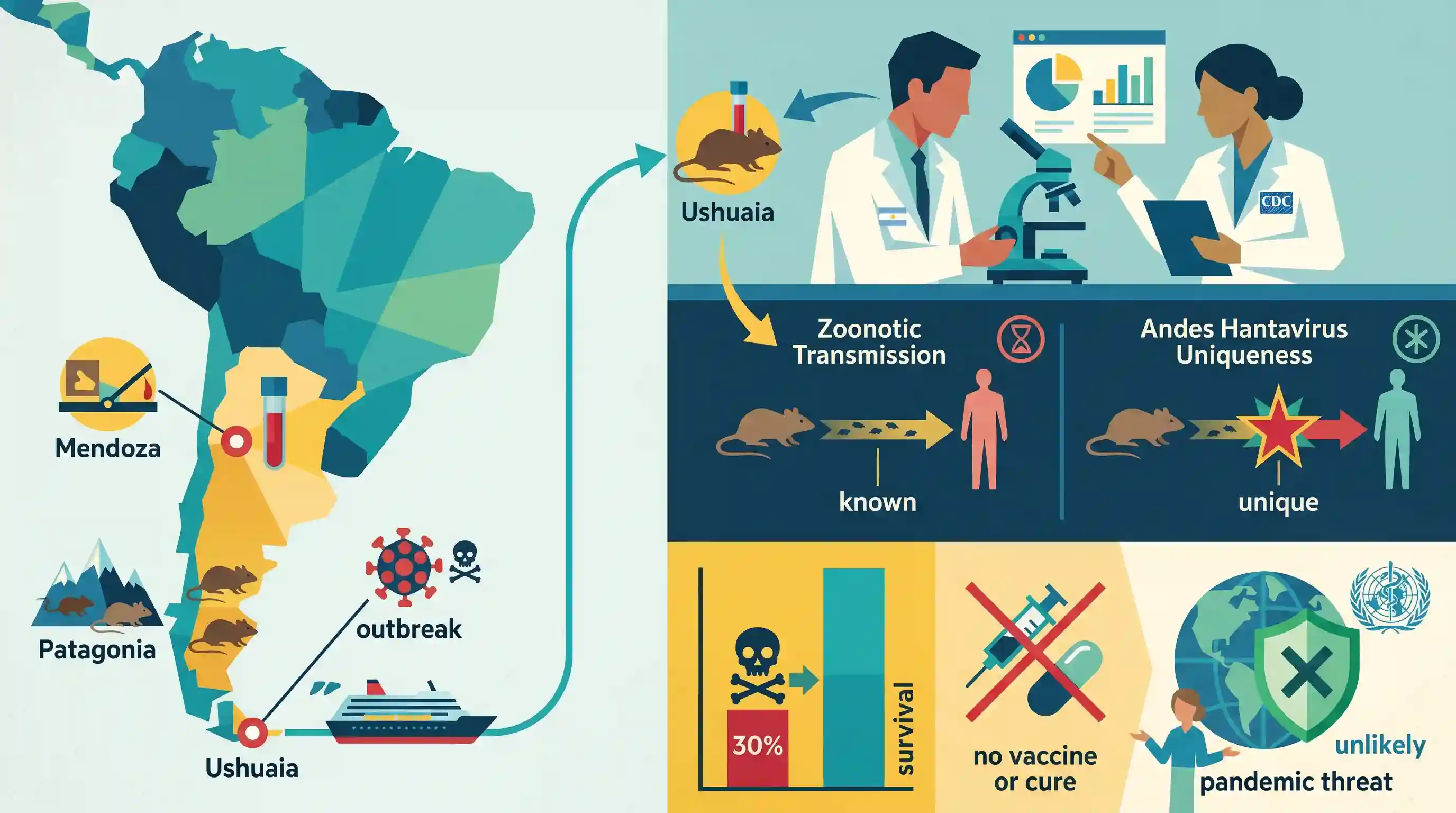
Argentina, in collaboration with the US CDC, has expanded its investigation into a fatal outbreak of the Andes hantavirus linked to a cruise ship. Health teams are testing rodents in Mendoza and awaiting lab results from Ushuaia to trace the contagion. The Andes hantavirus, endemic to the Patagonia region of Argentina and Chile, is distinct as it is the only hantavirus known to be capable of human-to-human transmission. Although the disease carries a high mortality rate of up to 30% and currently lacks a vaccine or cure, the World Health Organization asserts that it is unlikely to become a pandemic threat.
Key Points
- Argentine authorities and the US CDC are investigating a deadly outbreak of the Andes hantavirus linked to the MV Hondius cruise ship.
- The Andes hantavirus is endemic to Argentina and Chile, primarily spread to humans through exposure to the urine or droppings of infected rodents.
- Uniquely, the Andes variant is the only hantavirus believed to occasionally transmit from person-to-person.
- The virus has a high mortality rate of up to 30%, with no known cure or vaccine, and a long incubation period of 3 to 8 weeks.
- Despite the high mortality rate, the WHO has stated that the virus poses a low risk of sparking a global pandemic due to its transmission dynamics.
Important Terms
Andes Hantavirus

A rare rodent-borne viral strain endemic to South America causing Hantavirus Pulmonary Syndrome (HPS). It is the only hantavirus known to be capable of direct human-to-human transmission.
UPSC context
GS III: Science and Technology (Health). Tests knowledge of emerging pathogens, unique viral transmission modes, and public health threats.
Zoonotic Disease
Infections that are naturally transmitted from vertebrate animals to humans. Caused by viruses, bacteria, or parasites, they constitute roughly 60% of all known human infectious diseases.
UPSC context
GS III: Environment and Science. Essential for understanding "One Health" and the impact of environmental changes on pandemic emergence.
World Health Organization (WHO)
The United Nations' specialized agency for global public health. It provides leadership on health matters, sets norms and standards, and assesses pandemic threats to coordinate international responses.
UPSC context
GS II: International Institutions. Evaluates understanding of global health governance and the authority of multilateral organizations during crises.
Centers for Disease Control and Prevention (CDC)
The national public health agency of the United States. It provides global technical support, laboratory expertise, and collaborates with international partners to detect and respond to disease outbreaks.
UPSC context
GS II: International Relations. Relevant for studying bilateral health cooperation and technical partnerships in global disease surveillance.
ANLIS (Malbrán Institute)
Argentina's National Administration of Laboratories and Institutes of Health. It is the country's central institution for infectious disease research, diagnosis, and monitoring, including the Malbrán Institute.
UPSC context
GS II: Health Policy/International Cooperation. Example of national health infrastructure collaborating globally to manage localized zoonotic outbreaks.
One Health
An integrated approach that recognizes the interconnectedness of human, animal, and environmental health. It is the primary framework for managing zoonoses and antimicrobial resistance.
UPSC context
GS III: Science/Environment. A critical policy concept for sustainable health management and preventing future global pandemics.
Prelims Trap
All variants of the Hantavirus are capable of human-to-human transmission and pose a severe global pandemic threat.
Only the Andes variant has documented human-to-human transmission. Furthermore, the WHO classifies hantaviruses as a low pandemic risk despite high mortality.
Static Concepts Connected
What is the 'One Health' approach in managing zoonotic diseases?
- Core Philosophy: An integrated, unifying approach that balances and optimizes the health of people, animals, and ecosystems concurrently.
- Zoonotic Focus: Crucial for preventing spillovers, as over 60% of emerging infectious diseases in humans (like Nipah, Ebola, and Hantavirus) originate from animals or wildlife.
- Global Institutional Support: Backed globally by the Quadripartite alliance (WHO, FAO, UNEP, and WOAH) to coordinate surveillance and responses to cross-species disease threats.
What distinguishes RNA viruses from DNA viruses regarding mutation and stability?
- Genomic Material: RNA viruses (like Hantavirus, Nipah, COVID-19) carry RNA as their genetic material, whereas DNA viruses (like Poxviruses, Herpes) carry DNA.
- Mutation Rates: RNA viruses generally mutate much faster because the enzymes that replicate RNA (RNA polymerases) largely lack proofreading and error-correction abilities.
- Vaccine Complexity: Higher mutation rates and genetic instability in RNA viruses often complicate long-term vaccine development, making them harder to eradicate.
Cross-Topic Patterns
Zoonotic spillovers + Climate shifts
Deforestation and climate anomalies alter rodent habitats, increasing human-wildlife overlap. This directly links environmental degradation to the rise in zoonotic spillovers like Hantavirus and Nipah.
South American mapping: Patagonia & Mendoza
Endemic zones like Patagonia, Tierra del Fuego, and Mendoza are ripe for Prelims 'Places in News' matching questions, testing South American geographical features alongside the Andes mountains.

Expect a 2026 question comparing transmission vectors of RNA viruses (Hantavirus, Nipah) alongside the One Health environmental framework.
Linked PYQs · 5
Linked PYQs · 5
- 2015PrelimsGS1
H1N1 virus is sometimes mentioned in the news with reference to which one of the following diseases?
- 2019PrelimsGS1
Which one of the following statements is not correct?
- 2017PrelimsGS1
Consider the following statements: 1. In tropical regions, Zika virus disease is transmitted by the same mosquito that transmits dengue. 2. Sexual transmission of Zika virus disease is possible. Which of the statements given above is/are correct?
- 2024PrelimsGS1
Consider the following information (Region — Name of the mountain range — Type of mountain): 1. Central Asia — Vosges — Fold mountain 2. Europe — Alps — Block mountain 3. North America — Appalachians — Fold mountain 4. South America — Andes — Fold mountain In how many of the above rows is the given information correctly matched?
- 2024PrelimsGS1
The longest border between any two countries in the world is between :
