Legal Guarantees and Social Realities in Abolishing Untouchability
Source:The Hindu ↗
ఇది ఎందుకు ముఖ్యం
It addresses a foundational moral and constitutional commitment of India—the eradication of untouchability—analyzing the gap between legal protections on paper and lived social realities.
సారాంశం
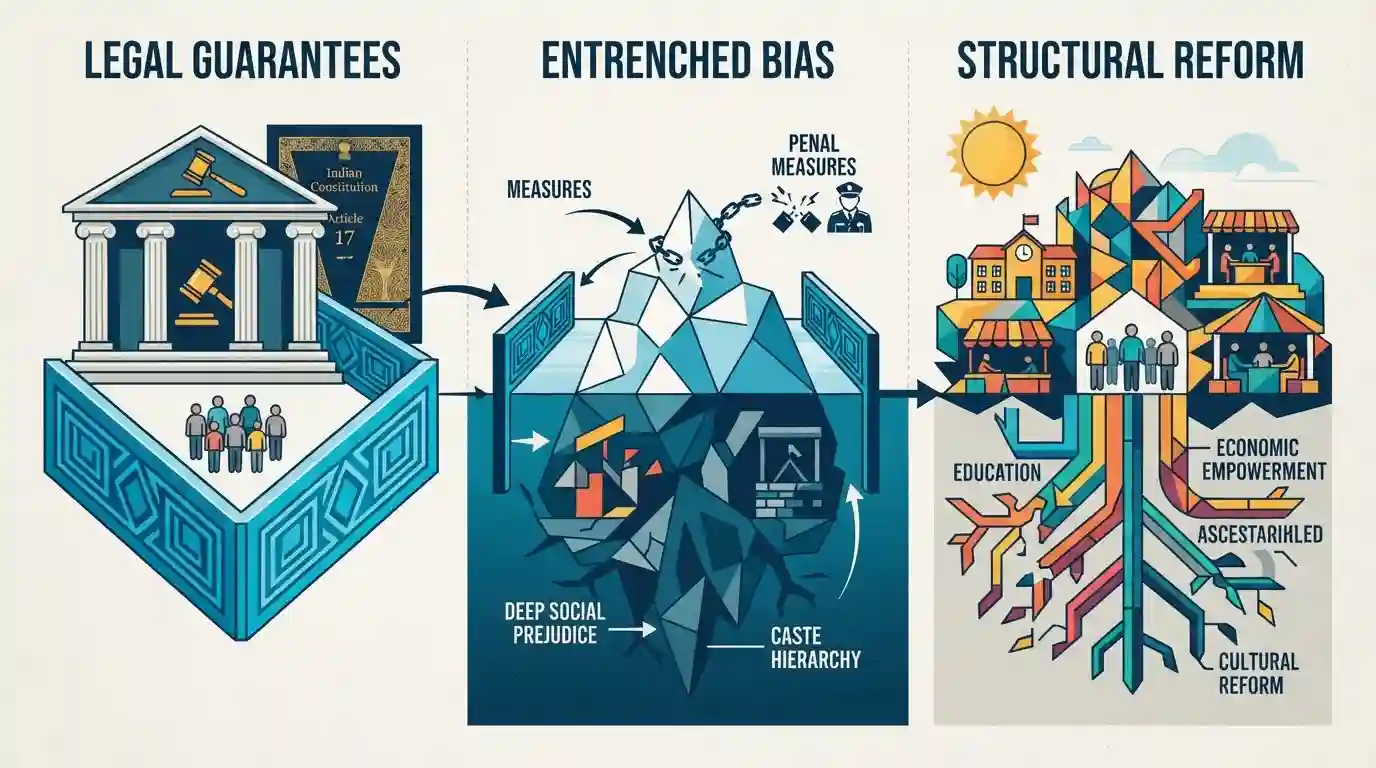
The article examines whether legal guarantees alone are sufficient to eradicate untouchability in India. It highlights the limitations of penal measures and constitutional provisions like Article 17 in changing deeply entrenched social biases, arguing that structural socio-economic changes and cultural reform are equally critical for true emancipation.
ముఖ్య అంశాలు
- Legal guarantees and constitutional provisions like Article 17 are essential for abolishing untouchability, but they are insufficient on their own without deep societal transformation.
- Caste prejudices and discriminatory social practices persist in covert and overt forms despite strict penal laws.
- Effective eradication of untouchability requires a combination of robust legal enforcement, socio-economic empowerment, and radical changes in societal mindset and cultural values.
ముఖ్యమైన పదాలు
Protection of Civil Rights Act

A 1955 statute enacted to operationalize Article 17 of the Constitution by penalizing the enforcement of civil disabilities and untouchability practices in India.
UPSC context
UPSC GS Paper I & II (Social Justice, Vulnerable Sections): Tests knowledge of statutory safeguards against caste-based discrimination and untouchability.
Scheduled Castes and the Scheduled Tribes (Prevention of Atrocities) Act
A 1989 landmark penal legislation enacted to prevent hate crimes, atrocities, and indignities against members of Scheduled Castes and Scheduled Tribes.
UPSC context
UPSC GS Paper II (Polity & Social Justice): Tests legal mechanisms for protecting vulnerable communities and ensuring social justice.
ప్రిలిమ్స్ ఉచ్చు
Article 17 of the Constitution is self-executing and completely eradicates untouchability without requiring separate statutory penal laws.
Article 17 is not a self-enforcing right alone; it explicitly mandates parliamentary legislation to prescribe punishments, leading to acts like the PCR Act and SC/ST Atrocities Act.
అనుసంధానమైన స్థిర భావనలు
What are the constitutional provisions and statutory frameworks for the eradication of untouchability in India?
- Constitutional Mandate: Article 17 abolishes untouchability and forbids its practice in any form, making it a punishable offense under the law.
- PCR Act 1955: The Protection of Civil Rights Act, 1955 (originally Untouchability Offences Act) penalizes civil disabilities arising from untouchability.
- Atrocities Act 1989: The SC/ST (Prevention of Atrocities) Act, 1989 prevents atrocities, provides special courts, and ensures rehabilitation.
- Judicial Expansion: Supreme Court in Safai Karamchari Andolan (2014) linked manual scavenging directly to violations under Article 17.
అంతర-అంశ నమూనాలు
Constitutional Morality vs. Social Prejudice
Explores how constitutional morality (Article 17) intersects with substantive equality under Article 14 and 15, moving beyond formal anti-discrimination laws.
Atrocities Act and Institutional Accountability
Examines how manual scavenging and caste segregation in state institutions violate basic human rights despite legislative bans under the PoA Act.

Article 17 + PoA Act + judicial widening via Safai Karamchari case likely to feature in a multi-statement Mains or Prelims question.
అనుసంధాన PYQలు · 2
అనుసంధాన PYQలు · 2
- 2018MainsGS1
Caste system is assuming new identities and associational forms. Hence, caste system cannot be eradicated in India." Comment.
- 2024MainsGS1
Despite comprehensive policies for equity and social justice, underprivileged sections are not yet getting the full benefits of affirmative action envisaged by the Constitution. Comment.
