Evaluating Biomass Stoves As Clean Cooking Alternative to LPG
Source:The Hindu ↗
Why It Matters
It highlights the critical challenge of energy affordability and reliability in India's clean cooking transition. Addressing indoor air pollution from traditional biomass is essential for public health, women's empowerment, and achieving SDG 7 (Affordable and Clean Energy), making it highly relevant for GS Paper 2 (Social Justice/Welfare Schemes) and GS Paper 3 (Environment/Energy).
Summary
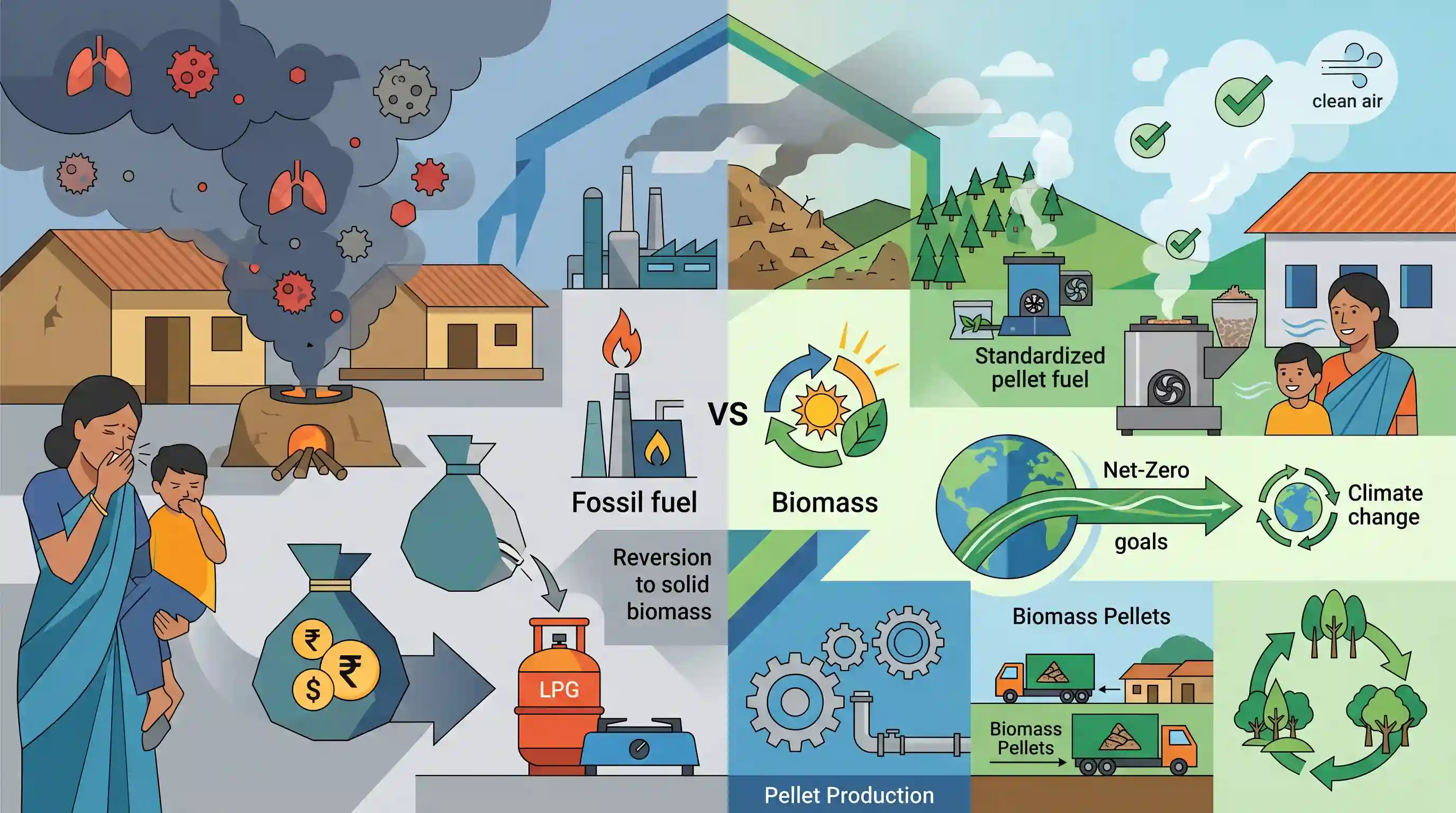
The article evaluates whether advanced biomass cookstoves can serve as cleaner and more affordable alternatives to Liquefied Petroleum Gas (LPG) for rural households in India. While the Pradhan Mantri Ujjwala Yojana (PMUY) successfully provided initial LPG connections, high recurring refill costs have led many households to revert to traditional, polluting *chulhas*. Burning solid biomass inefficiently in these traditional stoves causes severe indoor air pollution, leading to respiratory diseases that heavily impact women and children. Modern, improved biomass cookstoves—particularly those running on standardized pellets—offer high combustion efficiency and significantly lower harmful emissions (like PM2.5). Furthermore, sustainably sourced biomass is a renewable resource, potentially aligning India's cooking fuel transition with its climate change mitigation and net-zero targets, unlike fossil-fuel-based LPG. However, significant challenges remain in establishing a reliable supply chain for high-quality biomass pellets and ensuring the affordability and convenience of advanced cookstoves.
Key Points
- The Pradhan Mantri Ujjwala Yojana (PMUY) expanded initial access to LPG, but high refill costs often force rural households to revert to traditional 'chulhas' (biomass stoves).
- Traditional chulhas burn solid fuels (wood, cow dung, crop residue) inefficiently, causing severe indoor air pollution (PM2.5, carbon monoxide) which disproportionately impacts the health of women and children.
- Advanced or Improved Biomass Cookstoves (ICS), especially those using standardized biomass pellets, offer a cleaner alternative to traditional stoves by significantly reducing toxic emissions and improving combustion efficiency.
- Unlike LPG, which is a fossil fuel, sustainably sourced biomass is renewable and can help align India's clean cooking transition with its net-zero and climate mitigation goals.
- Scaling up advanced biomass stoves faces hurdles such as high initial costs, standardizing pellet quality, and building a robust supply chain to rival the convenience of the established LPG network.
Important Terms
Pradhan Mantri Ujjwala Yojana (PMUY)

A flagship scheme under the Ministry of Petroleum and Natural Gas providing deposit-free LPG connections to adult women of BPL households to promote clean cooking.
UPSC context
GS2: Welfare schemes for vulnerable sections; GS3: Energy security and health impacts of indoor air pollution.
Unnat Chulha Abhiyan (UCA)
A Ministry of New and Renewable Energy (MNRE) initiative aimed at developing and deploying high-efficiency improved biomass cookstoves (ICS) to reduce smoke and fuel consumption.
UPSC context
GS3: Infrastructure (Energy) and Science & Technology; tests knowledge of biomass energy interventions beyond LPG.
Sustainable Development Goal 7 (SDG 7)
Sustainable Development Goal 7, which mandates ensuring access to affordable, reliable, sustainable, and modern energy for all by 2030.
UPSC context
GS3: Environment and Sustainable Development; critical for linking domestic energy policies to global commitments.
Biomass Pellets
A biofuel made from compressed organic matter (agricultural or forestry residues), offering high energy density and carbon-neutrality when used in modern cookstoves.
UPSC context
GS3: Science and Technology (Biofuels); Environment (solution to stubble burning and carbon emissions).
PM2.5 (Fine Particulate Matter)
Atmospheric particulate matter with a diameter less than 2.5 micrometers; a major byproduct of inefficient biomass combustion causing severe respiratory and cardiovascular diseases.
UPSC context
GS3: Environmental Pollution and Degradation; critical for understanding public health risks of traditional cooking.
Ministry of New and Renewable Energy (MNRE)
The nodal ministry of the Government of India for all matters relating to new and renewable energy, including biomass, solar, and wind power.
UPSC context
GS2: Statutory/Regulatory/Administrative bodies; tests understanding of departmental jurisdictions in energy transition.
Prelims Trap
"LPG provided under the PMUY is a renewable, carbon-neutral fuel helping India achieve its net-zero targets."
LPG is a cleaner-burning fossil fuel, not renewable or carbon-neutral. Only sustainably sourced biomass is considered a renewable, carbon-neutral energy source.
Static Concepts Connected
What is 'Fuel Stacking' in the context of rural energy consumption?
- Definition: The practice of using multiple fuels concurrently, such as combining LPG for quick tasks with traditional biomass for long-cooking meals.
- Cause: Driven primarily by the high recurring cost of LPG cylinder refills, making exclusive reliance on modern clean fuels unaffordable for low-income households.
How do Advanced Biomass Cookstoves (ICS) differ from traditional chulhas?
- Fuel type: ICS often use standardized, densified biomass pellets rather than raw firewood or cow dung cakes.
- Efficiency: They achieve higher thermal efficiency (38-45%) and ensure near-complete combustion compared to traditional open fires.
- Emissions: They significantly reduce toxic indoor air pollutants like PM2.5, Carbon Monoxide, and Benzene.
Cross-Topic Patterns
Stubble burning to Pelletization
Converting agricultural residue into standardized biomass pellets tackles two major issues simultaneously: North India's winter air pollution from stubble burning and the deficit of affordable clean-cooking fuels in rural areas.
Gender equity and Energy Poverty
Lack of clean cooking fuel remains a structural gender issue. Women bear the time-burden of foraging for firewood and suffer disproportionately from respiratory diseases caused by indoor air pollution.

Prelims 2026: Expect a multi-statement question contrasting LPG (fossil) with biomass pellets (renewable) and the concept of fuel stacking.
Linked PYQs · 4
Linked PYQs · 4
- 2020PrelimsGS1
Which of the following are the reasons/factors for exposure to benzene pollution? 1. Automobile exhaust 2. Tobacco smoke 3. Wood burning 4. Using varnished wooden furniture 5. Using products made of polyurethane Select the correct answer using the code given below:
- 2018MainsGS3
“Access to affordable, reliable, sustainable and modern energy is the sine qua non to achieve Sustainable Development Goals (SDGs).” Comment on the progress made in India in this regard.
- 2022MainsGS3
Do you think India will meet 50 percent of its energy needs from renewable energy by 2030 ? Justify your answer. How will the shift of subsidies from fossil fuels to renewables help achieve the above objective ? Explain.
- 2022PrelimsGS1
In the context of WHO Air Quality Guidelines, consider the following statements: 1. The 24-hour mean of PM2.5 should not exceed 15 µg/m³ and annual mean of PM2.5 should not exceed 5 µg/m³. 2. In a year, the highest levels of ozone pollution occur during the periods of inclement weather. 3. PM10 can penetrate the lung barrier and enter the bloodstream. 4. Excessive ozone in the air can trigger asthma. Which of the statements given above are correct?
