Prehistoric Skeletons Unearthed at Tekkalakota in Karnataka
Source:Indian Express ↗
Why It Matters
Recent archaeological findings are a staple for UPSC Prelims matching questions (Site vs. Era/State). The continuous habitation at Tekkalakota underscores the importance of geographical factors in the sustained development of ancient cultures, a prominent theme in GS1 Mains.
Summary
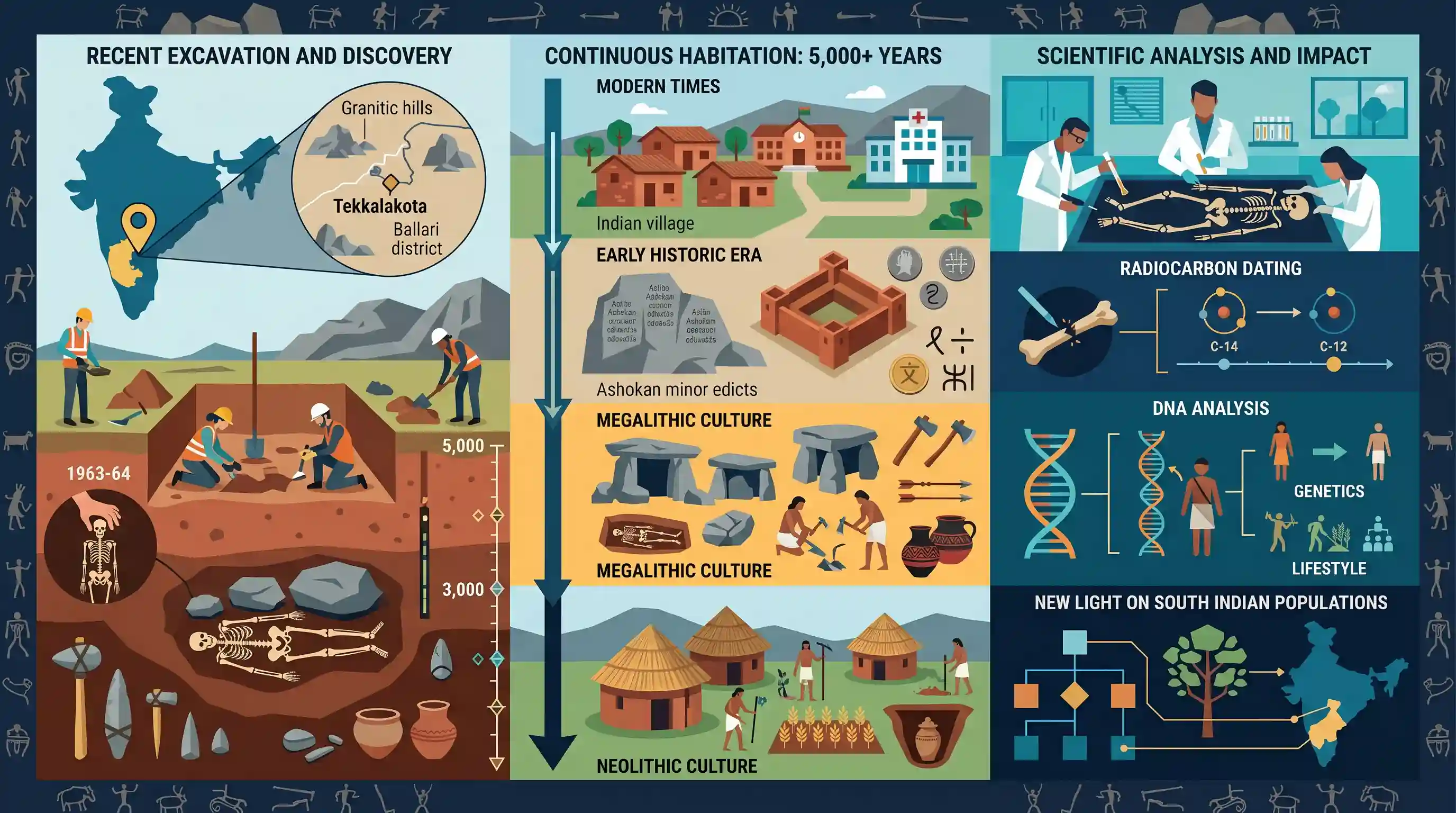
Recent archaeological excavations at Tekkalakota in Karnataka's Ballari district have yielded 3,000 to 5,000-year-old human skeletons, the first discovery of its kind at the site since 1963-64. The site is notable for exhibiting continuous human habitation from the Neolithic period down to modern times. Ongoing radiocarbon dating and DNA analysis on the remains are expected to shed new light on the genetics and lifestyle of prehistoric South Indian populations.
Key Points
- Archaeologists have unearthed 3,000 to 5,000-year-old human skeletons at Tekkalakota in Karnataka's Ballari district, marking the first such discovery there in over six decades.
- The remains, which include one complete skeleton and a partial lower body, will undergo radiocarbon dating and DNA analysis to reveal information on the inhabitants' diet, lifestyle, and genetic profile.
- Tekkalakota is highly significant as a continuous human habitation site spanning over five millennia, from the Neolithic period (3000-1200 BCE) through the Megalithic, Iron Age, early historic, and medieval periods.
- The excavation is a collaborative effort involving researchers from Hartwick College (USA), Central University of Karnataka, and the state Department of Archaeology, Museums and Heritage.
Important Terms
Tekkalakota

A major Neolithic-Chalcolithic site in Ballari, Karnataka, featuring "Ash Mounds" and rock paintings. Recent skeletal discoveries confirm continuous human habitation at the site spanning over 5,000 years.
UPSC context
GS Paper I: Ancient Indian History. Tests knowledge of prehistoric settlements and cultural transitions in South India.
Neolithic Period
The "New Stone Age" (approx. 3000–1200 BCE in South India) marked by settled agriculture, cattle pastoralism, and polished stone tools. It is uniquely associated with the "Ash Mound" tradition.
UPSC context
GS Paper I: Ancient History. Focuses on the transition to food production and early socio-economic evolution.
Ash Mound Culture
A prehistoric culture in the South Deccan characterized by mounds of vitrified cow dung. These mounds represent seasonal cattle-penning activities of early pastoralist communities during the Neolithic phase.
UPSC context
GS Paper I: Ancient History. Tests understanding of regional prehistoric variants and pastoral economies in Peninsular India.
Radiocarbon Dating (Carbon-14)
A scientific technique used to determine the age of organic materials by measuring the decay of the carbon-14 isotope. It is essential for establishing precise prehistoric chronologies.
UPSC context
GS Paper I: Ancient History/Archaeology. Tests understanding of scientific methods used to reconstruct historical timelines.
Department of Archaeology, Museums and Heritage (Karnataka)
The state agency responsible for protecting monuments and conducting excavations in Karnataka. It manages the conservation of regional heritage and assists in major archaeological research projects.
UPSC context
GS Paper I & III: Art, Culture, and Conservation. Relevant for institutional roles in heritage management.
Hartwick College, USA
An American liberal arts college whose anthropology department co-leads the current Tekkalakota excavations. This partnership facilitates advanced international research and archaeogenetic analysis on ancient Indian remains.
UPSC context
GS Paper I: Art and Culture. Highlights international academic collaboration in advancing Indian archaeological research.
Prelims Trap
"Ash mounds at Tekkalakota and Utnur represent Harappan cultural expansion into peninsular India."
Ash mounds (burnt cattle dung) are a unique feature of the indigenous South Indian Neolithic pastoral culture, entirely distinct from the Indus Valley Civilization.
Static Concepts Connected
What are the distinguishing features of the South Indian Neolithic culture?
- Ash Mounds: Accumulations of vitrified burnt cattle dung, indicating significant pastoral activity and seasonal cattle camps.
- Agro-pastoral Economy: Strong reliance on cattle domestication alongside early dry-farming cultivation of millets and pulses.
- Tool Typology: Characterized by polished stone axes, microlithic blades, and distinctive handmade, pale grey or burnished pottery.
Which are the prominent Neolithic and Megalithic transition sites in Peninsular India?
- Karnataka Sites: Tekkalakota, Brahmagiri, Maski, and Piklihal; famous for continuous habitation, rock art, early gold ornaments, and ash mounds.
- Andhra & Telangana: Utnur and Palavoy, renowned for their extensive Neolithic ash mounds and cattle pen enclosures.
- Tamil Nadu: Paiyampalli, which yielded evidence of early Neolithic habitation seamlessly transitioning into Megalithic Iron Age burial cultures.
Cross-Topic Patterns
Ancient History + Genetic Mapping
Recent skeletal discoveries at Tekkalakota and Rakhigarhi link Ancient History with Biotechnology (DNA sequencing), forming a rising trend of multidisciplinary science-history questions exploring ancient population genetics.
Continuous habitation cultural sequences
Sites exhibiting unbroken chronological sequences (Neolithic to Medieval), like Tekkalakota, are frequently tested for cultural transition indicators and sequence mapping in Prelims.

Expect a 'Site vs Feature' Prelims 2026 matching question: Tekkalakota (Ash mounds), Burzahom (Pit dwellings), Dholavira (Water).
Linked PYQs · 3
Linked PYQs · 3
- 2024PrelimsGS1
Consider the following information (Archaeological Site — State — Description): 1. Chandraketugarh — Odisha — Trading port town 2. Inamgaon — Maharashtra — Chalcolithic site 3. Mangadu — Kerala — Megalithic site 4. Salihundam — Andhra Pradesh — Rock-cut cave shrines In which of the above rows is the given information correctly matched?
- 2021PrelimsGS1
Consider the following pairs : Historical place : Well-known for 1. Burzahom : Rock-cut shrines 2. Chandra-ketugarh : Terracotta art 3. Ganeshwar : Copper artefacts Which of the pairs given above is/are correctly matched?
- 2023MainsGS1
Explain the role of geographical factors towards the development of Ancient India.
