VMAT Cancer Treatment: Advanced Medical Technology Innovations
Source:The Hindu ↗
Why It Matters
UPSC frequently asks questions about emerging medical technologies (e.g., CyberKnife, CRISPR, RNAi) and their applications in treating chronic diseases. Understanding VMAT is crucial for both Prelims (S&T current affairs) and Mains (GS3 - S&T developments and their applications in health).
Summary
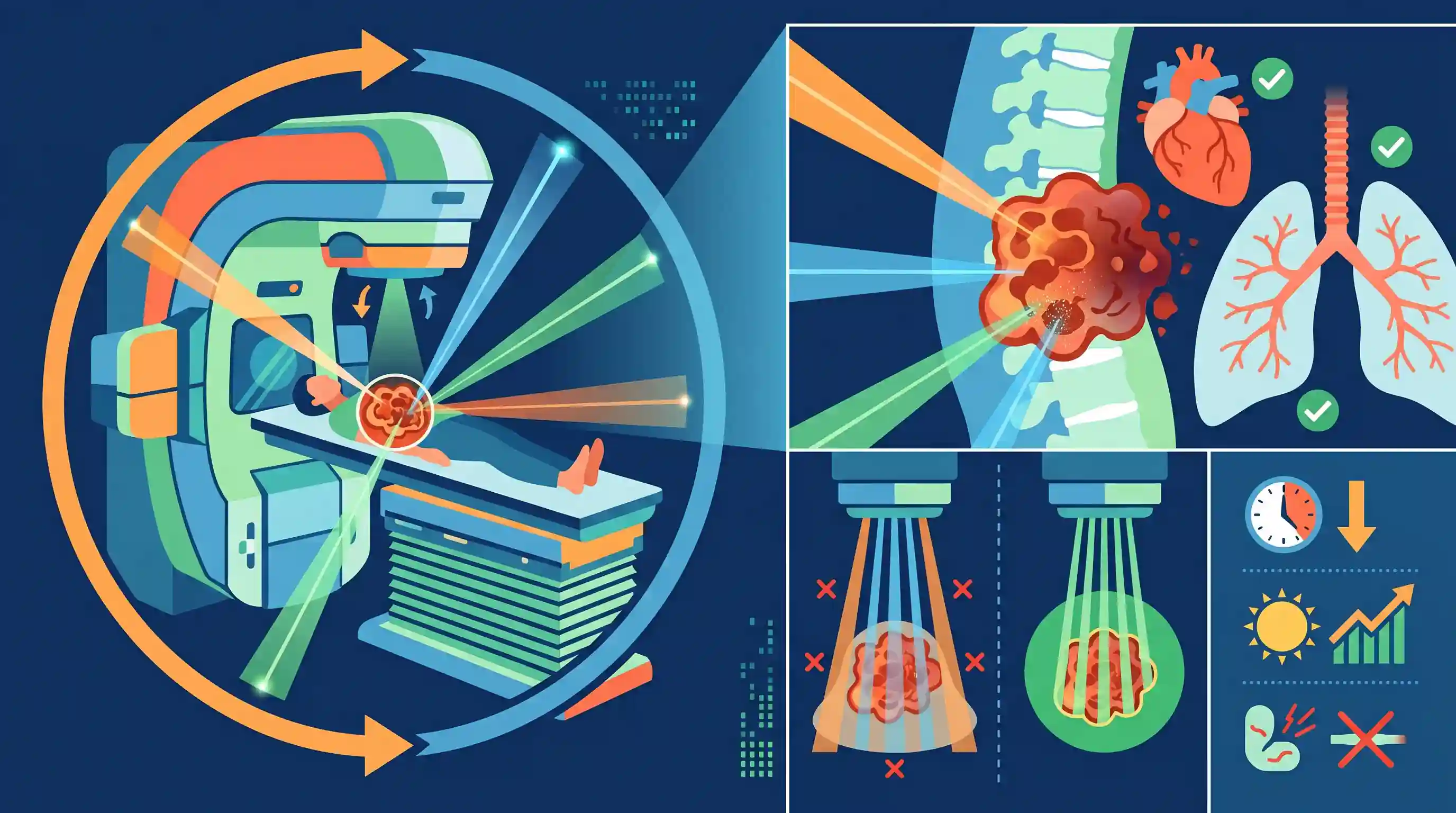
Volumetric Modulated Arc Therapy (VMAT) is emerging as a game-changer in cancer treatment by delivering highly precise radiation doses to complex tumors. Unlike conventional radiotherapy, VMAT utilizes a linear accelerator that rotates continuously around the patient, modulating the beam's shape and intensity in real time. This dynamic approach allows for highly conformal radiation delivery, effectively destroying tricky tumors situated near vital organs while minimizing collateral damage to healthy tissues. The advancement not only improves clinical outcomes and reduces side effects but also shortens treatment durations, marking a significant leap in medical technology and oncological care.
Key Points
- Volumetric Modulated Arc Therapy (VMAT) represents a significant advancement in radiation oncology, delivering continuous radiation while rotating 360 degrees around the patient.
- The technology relies on real-time modulation of the radiation beam's intensity and shape to conform precisely to the 3D shape of a tumor.
- Its primary clinical advantage lies in effectively targeting complex tumors near critical organs, thereby maximizing the radiation dose to cancer cells while sparing surrounding healthy tissues.
- VMAT drastically reduces treatment time compared to traditional methods, enhancing patient comfort and minimizing errors caused by involuntary patient movement.
Prelims Trap
VMAT utilizes advanced radioactive implants placed directly inside the tumor to deliver 360-degree targeted radiation.
VMAT is an external beam radiation technique using a Linear Accelerator (LINAC) to generate X-rays. It does not use internal radioactive implants (which is brachytherapy).
Static Concepts Connected
What differentiates Linear Accelerators (LINAC) from traditional Cobalt-60 machines in radiotherapy?
- Radiation source: Cobalt-60 relies on a constantly decaying radioactive isotope. LINACs generate high-energy X-rays electrically and emit absolute zero radiation when powered off.
- Waste management: LINACs do not leave behind spent radioactive materials, completely eliminating the nuclear security, transport, and disposal risks associated with Cobalt-60 machines.
- Energy modulation: LINACs offer variable energy levels for both photons and electrons, allowing highly precise depth control (vital for VMAT), whereas Cobalt-60 has a fixed gamma emission.
How does ionizing radiation physically destroy malignant tumors in the human body?
- DNA breakdown: High-energy radiation directly breaks the DNA double-helix inside cancer cells or interacts with water to generate highly reactive free radicals that cause severe oxidative damage.
- Defective repair pathways: Unlike healthy tissue, rapidly dividing cancer cells possess highly defective DNA repair pathways. The accumulated structural damage triggers apoptosis (programmed cell death).
Cross-Topic Patterns
Advanced oncology vs PM-JAY limits
High-end treatments like VMAT challenge the ₹5-lakh coverage limit of Ayushman Bharat (PM-JAY), sparking debates on managing out-of-pocket expenditure (OOPE) for severe non-communicable diseases.
Nuclear security & the LINAC transition
The transition from Cobalt-60 to LINAC-based VMAT removes radioactive isotopes from civilian hospitals, reducing orphan source/dirty bomb risks and aligning with IAEA nuclear security goals.

Expect a 'pairs matching' question distinguishing medical tech: VMAT (external beam), Brachytherapy (internal), CAR-T (immunotherapy).
Linked PYQs · 3
Linked PYQs · 3
- 2010PrelimsGS1
With reference to the treatment of cancerous tumours, a tool called cyberknife has been making the news. In this context, which one of the following statements is not correct?
- 2015PrelimsGS1
With reference to the use of nano-technology in health sector, which of the following statements is/are correct? 1. Targeted drug delivery is made possible by nanotechnology. 2. Nanotechnology can largely contribute to gene therapy. Select the correct answer using the code given below.
- 2020MainsGS3
What do you understand by nanotechnology and how is it helping in health sector?
