Judicial intervention in defining Aravalli ecological boundaries
Source:The Hindu ↗
Why It Matters
This article underscores the ongoing conflict between resource extraction (mining) and environmental conservation in ecologically sensitive zones. It highlights the crucial role of the judiciary in interpreting and enforcing environmental protections, making it highly relevant for questions on EIA, conservation, and the ecological significance of the Aravalli range.
Summary
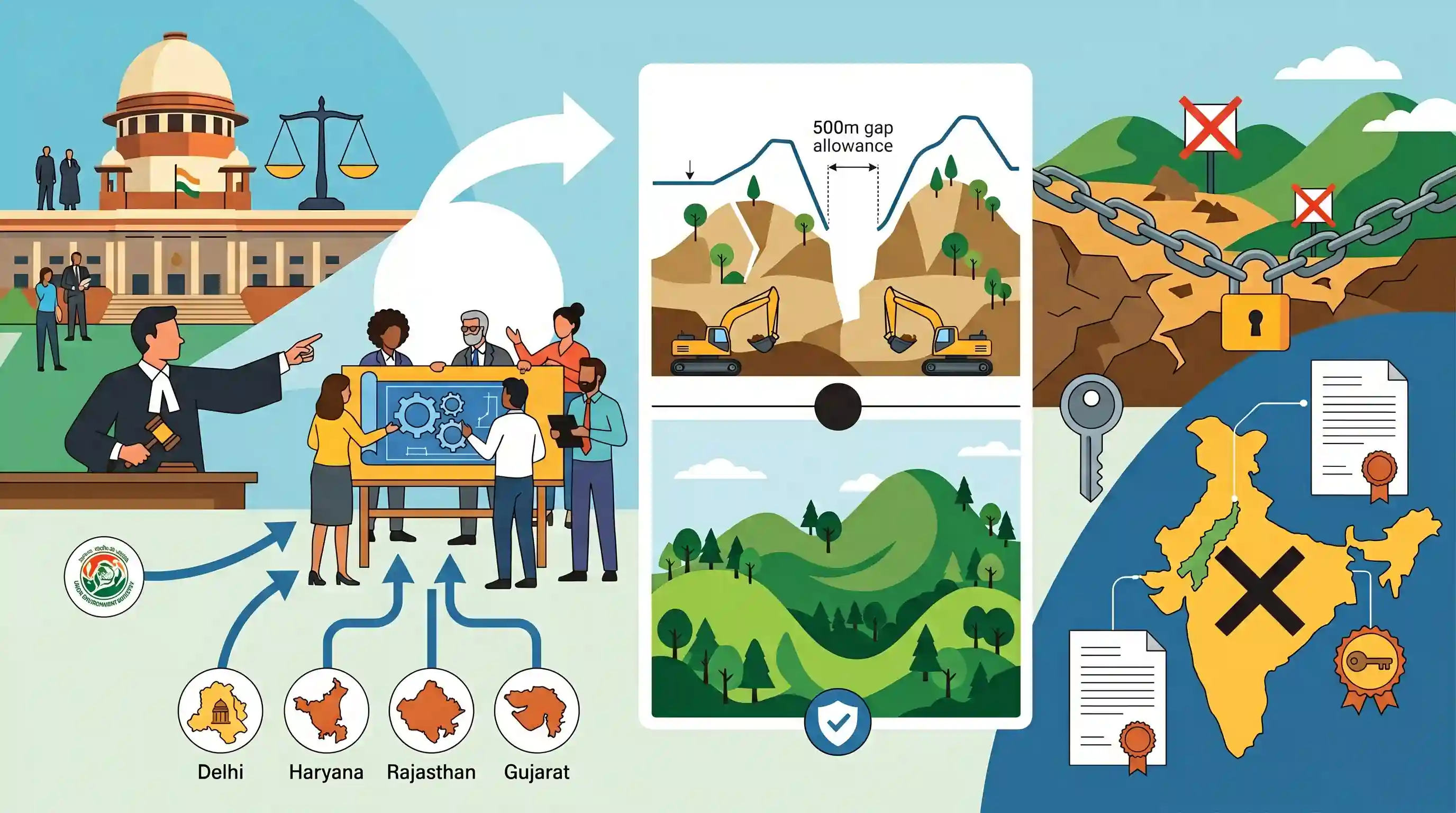
The Supreme Court of India has directed the Union Environment Ministry and four state governments (Delhi, Haryana, Rajasthan, and Gujarat) to recommend domain experts for a panel tasked with providing a uniform definition of the Aravalli hills. The initiative aims to address "critical ambiguities" in proposed criteria—specifically a 100-metre elevation threshold and a 500-metre gap allowance—which environmentalists fear would remove protections from vast tracts of the hills, making them vulnerable to unregulated mining. To safeguard the world's oldest mountain system, the Court has barred all mining in areas classified as Aravallis under the 2010 Forest Survey of India report unless explicitly permitted by the bench.
Key Points
- The Supreme Court mandated the formation of a domain expert panel to establish a uniform definition for the Aravalli hills across Delhi, Haryana, Rajasthan, and Gujarat.
- A major dispute centers on state-proposed criteria—requiring a 100-metre elevation and allowing a 500-metre gap between hills—which experts warn could strip critical areas of environmental protection and expose them to mining.
- The Court extended its stay order, strictly prohibiting any mining in areas identified as the Aravalli Hills and Ranges (per the August 2010 FSI report) without its prior permission.
- The Aravalli range, considered the world's oldest mountain system, acts as a vital ecological barrier, and the Court emphasized that only strictly lawful mining operations would be permitted to prevent degradation.
Important Terms
Aravalli Range

The world's oldest fold mountain system, spanning ~800km from Gujarat to Delhi. It acts as a critical 'Green Wall' preventing the Thar Desert's eastward expansion into the Indo-Gangetic plains.
UPSC context
GS Paper I (Geography) & III (Environment). Tests knowledge of physical barriers, desertification, and ecological conservation of ancient mountain systems.
Supreme Court of India
India’s highest judicial body which, through environmental jurisprudence, interprets the 'Right to Life' (Article 21) to include the right to a clean environment and acts as a 'sentinel' for conservation.
UPSC context
GS Paper II (Judiciary) & III (Environment). Essential for understanding judicial activism and landmark environmental cases like M.C. Mehta or T.N. Godavarman.
Ministry of Environment, Forest and Climate Change (MoEFCC)
The nodal central ministry responsible for planning, promoting, and overseeing India's environmental, forestry, and wildlife policies. It implements key legislations like the Environment (Protection) Act, 1986.
UPSC context
GS Paper II (Governance) & III (Environment). Tests knowledge of executive roles in environmental regulation and international climate commitments.
Forest Survey of India (FSI)
A Dehradun-based organization under MoEFCC that conducts biennial assessments of India's forest and tree cover, published as the 'India State of Forest Report' (ISFR).
UPSC context
GS Paper III (Environment). Key for data-driven questions on forest cover, land degradation, and scientific monitoring of natural resources.
Eco-Sensitive Zones (ESZ)
Ecologically fragile areas around Protected Areas (National Parks/Sanctuaries) notified to create 'shock absorbers' and regulate activities like mining to prevent environmental degradation.
UPSC context
GS Paper III (Environment). Focuses on the balance between developmental activities (mining/urbanization) and conservation in biodiversity hotspots.
Prelims Trap
"The Aravalli Range is a block mountain system that acts as an ecological barrier strictly confined to the states of Rajasthan and Haryana."
Aravallis are the world's oldest relict FOLD mountains (not block). They extend across four states/UTs (Gujarat, Rajasthan, Haryana, Delhi), not just two.
Static Concepts Connected
What are the key geographical features of the Aravalli Range?
- Relict Fold Mountains: Originated in the Proterozoic Era, making them one of the world's oldest fold mountain systems. They are now highly denuded relict mountains.
- Span and Peak: Extends ~700 km from Palanpur (Gujarat) through Rajasthan and Haryana, ending at the Delhi Ridge. The highest peak is Guru Shikhar (Mt. Abu).
- Crucial Watershed: Acts as a major water divide. It births west-flowing rivers (Luni, Sabarmati) and east-flowing rivers (Banas, a tributary of the Chambal).
What is the Aravalli Green Wall Project?
- Green Buffer: A national initiative to create a 1,400 km long and 5 km wide green buffer zone around the Aravalli mountain range.
- Combating Desertification: Aims to prevent the eastward expansion of the Thar Desert, mitigate dust storms, and restore degraded land across Gujarat, Rajasthan, Haryana, and Delhi.
Cross-Topic Patterns
Judicial definition of ecological entities
The SC's attempt to define the Aravallis mirrors the Godavarman case (1996), where the judiciary stepped in to define "forests" based on dictionary meaning against state resistance.
UNCCD and the Great Green Wall
The Aravalli Green Wall project directly links to India's commitments under UNCCD to restore 26 million hectares of degraded land by 2030, inspired by Africa's Sahel region.

Multi-statement Qs combining Aravalli geography (rivers: Luni, Banas), extent (GJ, RJ, HR, DL), and the Green Wall project are highly likely.
Linked PYQs · 2
Linked PYQs · 2
- 2025MainsGS3
Mineral resources are fundamental to the country's economy and these are exploited by mining. Why is mining considered an environmental hazard? Explain the remedial measures required to reduce the environmental hazard due to mining.
- 2013MainsGS3
What are the consequences of Illegal mining ? Discuss the Ministry of Environment and Forests' concept of GO AND NO GO zones for coal mining sector.
