Araria Dolphin Tourism and River Conservation Project
Source:times-of-india ↗
Why It Matters
Gangetic dolphins (India's National Aquatic Animal) and river conservation are high-priority topics for the Bihar Public Service Commission (BPSC). Highlighting regional administrative initiatives on Bihar's rivers (such as the Parman River in Araria) and ecotourism linkages connects localized development with national biodiversity conservation targets.
Summary
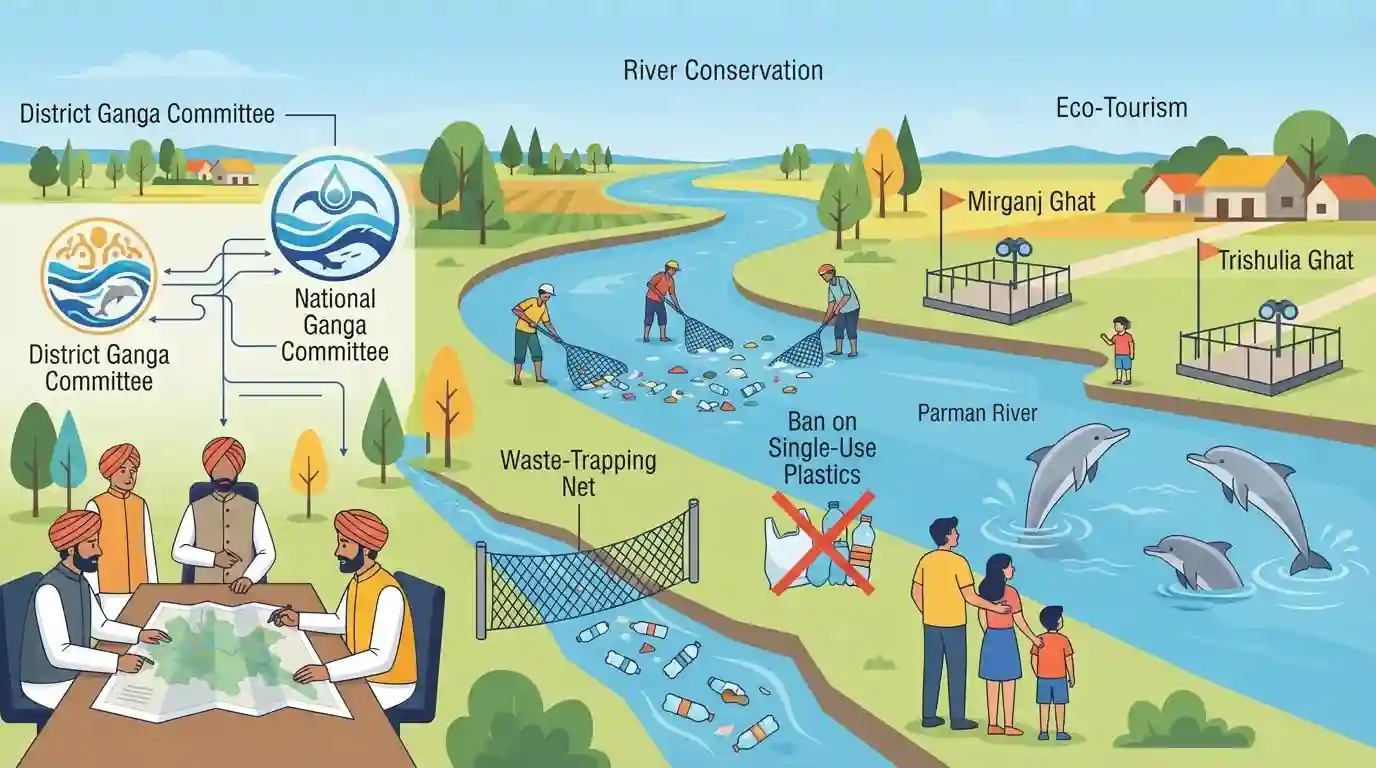
The Araria district administration in Bihar, through its District Ganga Committee, is set to launch a river conservation and dolphin eco-tourism initiative. Mirganj Ghat and Trishulia Ghat on the Parman River are proposed to be developed as dolphin viewing points. Alongside eco-tourism, the administration plans to clean up district rivers, restrict single-use plastics, install waste-trapping nets, and coordinate with the National Ganga Committee to implement structured environmental protection measures under the Namami Gange framework.
Key Points
- The Araria district administration plans to develop Mirganj Ghat and Trishulia Ghat on the Parman River as eco-tourism destinations and dolphin viewing points.
- The decision was taken in a meeting of the District Ganga Committee led by District Magistrate Vinod Duhan.
- The Forest Division of Araria will submit a proposal to the National Ganga Committee and prepare a Detailed Project Report (DPR).
- Waste mitigation strategies will be implemented, including installing nets to trap floating river waste under the Jogbani Municipal Council and executing strict single-use plastic bans.
- Regular monthly water quality tests and ecological procedures for idol immersions will be monitored to maintain the river ecosystem.
Important Terms
Namami Gange Programme

An integrated conservation mission approved as a flagship program in June 2014 to accomplish effective pollution abatement, conservation, and rejuvenation of the National River Ganga and its tributaries.
UPSC context
GS Paper II (Government Schemes) and Paper III (Environment); tests knowledge of national river rejuvenation and biodiversity conservation initiatives.
District Ganga Committee
A district-level statutory body created under the Environment (Protection) Act, 1986, chaired by the District Magistrate to monitor and execute pollution abatement schemes locally.
UPSC context
GS Paper II (Local Governance) and Paper III; tests decentralized governance and environmental policy implementation across Bihar's districts.
National Ganga Council
The apex body chaired by the Prime Minister of India, established in 2016, with overall responsibility for pollution prevention and rejuvenation of the Ganga River Basin.
UPSC context
GS Paper II (Governance & Federalism); tests understanding of the apex federal architecture for river conservation and planning.
Jogbani Municipal Council
An urban local body in the Araria district of Bihar, responsible for local administration, sanitation, and municipal solid waste management near the Nepal-India border.
UPSC context
GS Paper II (Urban Local Bodies); tests the role of grassroots administration in managing waste and environmental conservation directives.
Araria Forest Division
A territorial administrative unit of the Bihar Forest Department responsible for managing state forests, eco-tourism, and wildlife conservation initiatives within the district.
UPSC context
GS Paper III (Geography/Biodiversity of Bihar); tests the local role of forest departments in coordinating environmental and eco-tourism projects.
Prelims Trap
The Parman River, home to the Parman Dolphin Sanctuary, is a direct right-bank tributary of the Ganga River.
Aspirants often assume all major dolphin habitats in Bihar lie directly in the Ganga mainstem, or misidentify the Parman River as a direct tributary of the Ganga rather than a tributary of the Mahananda River.
Static Concepts Connected
What is the conservation status and ecological role of the Gangetic Dolphin?
- Conservation Status: Classified as **Endangered** on the IUCN Red List and protected under Schedule I of India's Wildlife (Protection) Act, 1972.
- Biological Traits: Commonly called 'Susu', it is practically **blind** and relies entirely on echolocation (ultrasound clicks) to navigate and forage in muddy river waters.
- Ecological Role: Serves as a reliable **indicator species**; its presence reflects the overall hydrological health, depth, and clean flow of the river system.
What is the geographic profile of the Mahananda-Parman River system in Bihar?
- Mahananda River: Originates in the Darjeeling hills, enters Bihar at Kishanganj, and serves as the **easternmost left-bank tributary** of the Ganga in India.
- Parman River: A perennial, rain-fed tributary of the Mahananda River flowing through **Araria district**, harboring a unique resident population of Gangetic dolphins.
Cross-Topic Patterns
Eco-tourism vs. Wildlife Protection Act
Balancing community livelihood through dolphin tourism in Araria while strictly complying with Schedule I protection mandates under the Wildlife (Protection) Act, 1972.
Decentralized waste mitigation in Namami Gange
District Ganga Committees operationalize river cleaning via solid waste interceptor nets, linking local municipal governance directly with national environmental conservation targets.

BPSC may ask a multi-statement question mapping Bihar's dolphin sanctuaries (Vikramshila vs Parman) and their respective river basins.
Linked PYQs · 3
Linked PYQs · 3
- 2024-EBPSC_PRELIMSGS1
In which city of Bihar the recently inaugurated National Dolphin Research Centre is located?
- 2023BPSC_PRELIMSGS1
Consider the following statements regarding the ‘Gangetic Dolphin’: 1. The Gangetic River Dolphin has been categorized as ‘endangered’ under the IUCN’s Red List. 2. It does not have a crystalline eye lens rendering it effectively blind. 3. Navigation and hunting are carried out using echolocation. 4. It has been recognized as India’s National Aquatic Animal.
- 2024-EBPSC_PRELIMSGS1
Which of the following drainage systems drains the lands of Bihar?
