Delhi Air Quality Enters Severe Category Amid Stubble Burning Spike
Source:Indian Express ↗
Why It Matters
The recurrent air pollution crisis in Delhi-NCR is a classic case study of overlapping geographical, agricultural, and administrative challenges. For UPSC aspirants, understanding the interplay of meteorology (temperature inversion, wind direction), emission sources (stubble burning, vehicular pollution), and policy responses (GRAP, CAQM) is highly relevant for GS1 (Geography) and GS3 (Environment).
Summary
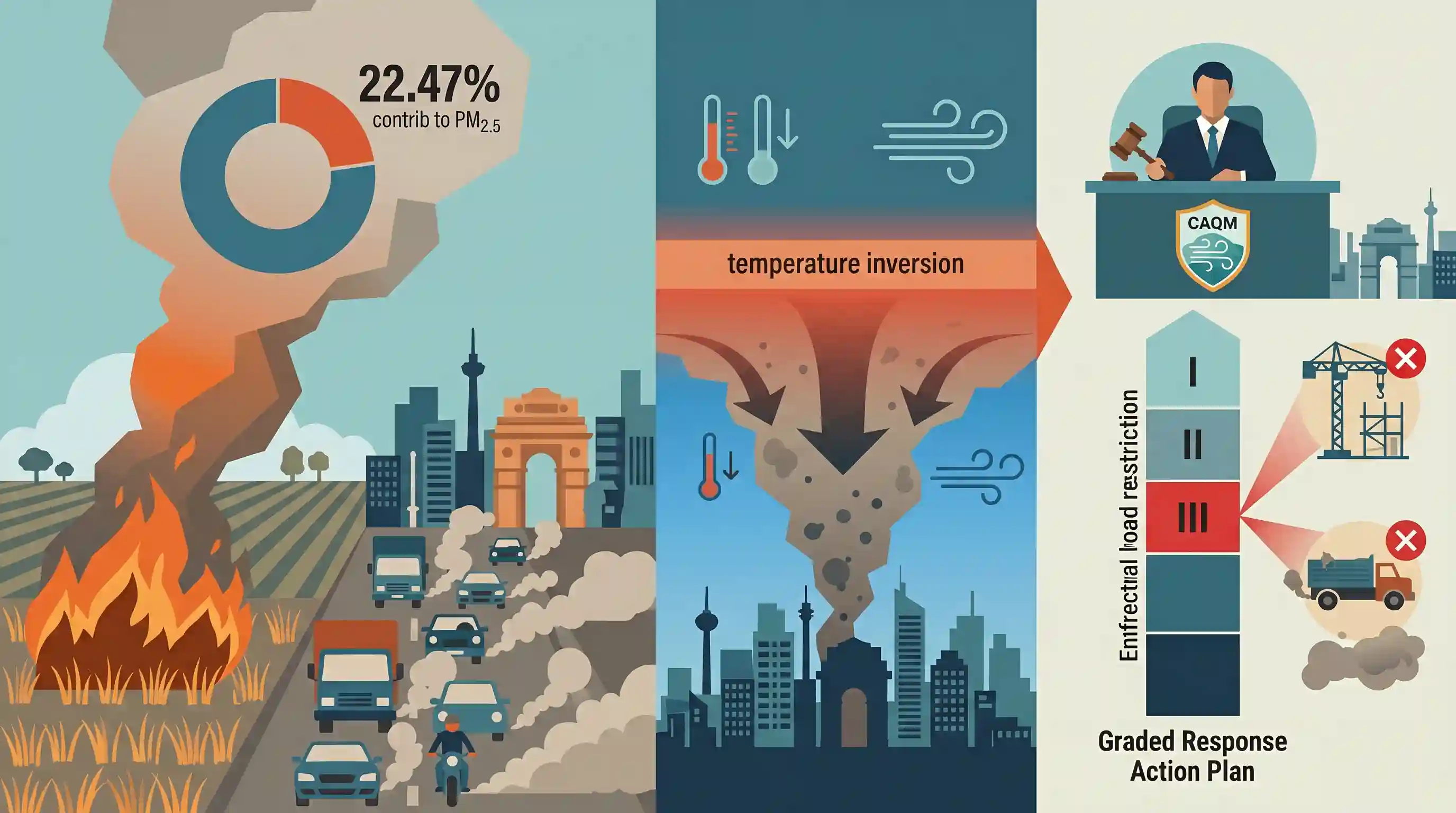
Delhi's air quality has plunged into the 'severe' category, primarily driven by the season's highest spike in the share of stubble burning (22.47%) contributing to PM2.5 levels. Meteorological phenomena, including calm winds, falling temperatures, and temperature inversion, are trapping vehicular emissions, road dust, and transported farm fire smoke near the surface. In response, the Commission for Air Quality Management (CAQM) has enacted Stage III of the Graded Response Action Plan (GRAP), enforcing strict bans on non-essential construction and older vehicles to mitigate the crisis.
Key Points
- Delhi's Air Quality Index (AQI) remained in the severe category for the second consecutive day, peaking at 428.
- The contribution of stubble burning from neighboring states to Delhi's PM2.5 levels reached its highest for the season at 22.47%.
- Meteorological factors such as calm surface winds, dropping temperatures, and strong nighttime temperature inversion trapped pollutants close to the ground.
- Westerly and north-westerly winds actively transported smoke from farm fires in Punjab, Haryana, and other regions into the National Capital.
- The Commission for Air Quality Management (CAQM) invoked Stage III of the Graded Response Action Plan (GRAP), imposing restrictions on construction, specific vehicle categories, and shifting primary classes to a hybrid mode.
Important Terms
Commission for Air Quality Management (CAQM)

A statutory body established in 2021 to coordinate and oversee air quality management in Delhi-NCR and adjoining states, replacing the earlier EPCA.
UPSC context
GS Paper II (Statutory Bodies) & GS Paper III (Environment). Tests regulatory frameworks for pollution control.
Graded Response Action Plan (GRAP)
An emergency framework for Delhi-NCR that activates stage-wise restrictive measures based on Air Quality Index (AQI) levels to curb severe air pollution.
UPSC context
GS Paper III (Environmental Pollution). Tests understanding of policy interventions and urban pollution management.
Temperature Inversion
A meteorological phenomenon where a layer of warm air traps cooler air near the surface, preventing the vertical dispersion of pollutants.
UPSC context
GS Paper I (Physical Geography). Tests knowledge of atmospheric dynamics and their environmental impacts.
Stubble Burning
The practice of burning crop residue to clear fields for the next crop, significantly contributing to seasonal air pollution in North India.
UPSC context
GS Paper III (Agriculture & Environment). Tests issues of crop residue management and sustainable farming.
PM2.5
Fine inhalable particles (<=2.5 micrometers) that can penetrate deep into the lungs and bloodstream, posing severe health risks.
UPSC context
GS Paper III (Pollution & Health). Tests knowledge of pollutants and air quality standards.
Indian Agricultural Research Institute (IARI)
India's premier agricultural research body, known for developing the Pusa Decomposer and satellite monitoring (CREAMS) to combat stubble burning.
UPSC context
GS Paper III (Science & Tech; Agriculture). Tests roles of research institutions in national environmental solutions.
Prelims Trap
The jurisdiction of the Commission for Air Quality Management (CAQM) is strictly limited to the National Capital Territory of Delhi.
False. CAQM's statutory jurisdiction explicitly extends to adjoining states (Punjab, Haryana, Rajasthan, UP) to address source-level pollution affecting the NCR.
Static Concepts Connected
How does temperature inversion exacerbate winter air pollution in North India?
- The Mechanism: The normal lapse rate is reversed; a layer of warm air traps cooler, dense air near the surface.
- Trapping Effect: It effectively caps the atmosphere, preventing the vertical dispersion (convection) of pollutants like PM2.5 from vehicular emissions and farm fires.
- Favorable Conditions: Long winter nights, clear skies, and calm surface winds facilitate rapid cooling of the earth's surface via terrestrial radiation.
What is the statutory mandate of the Commission for Air Quality Management (CAQM)?
- Statutory Origin: Established via the CAQM in NCR and Adjoining Areas Act, 2021, replacing the Supreme Court-mandated EPCA.
- Overriding Powers: Its directives legally override those of the State Pollution Control Boards of Delhi, Punjab, Haryana, Rajasthan, and UP regarding NCR air quality.
- Enforcement Mandate: Empowered to issue binding directions, monitor agricultural fires, levy penalties, and enforce the emergency Graded Response Action Plan (GRAP).
Cross-Topic Patterns
Agricultural Policy & Groundwater Acts
Stubble burning in Punjab/Haryana is structurally linked to MSP-driven paddy cultivation and state groundwater acts that delay paddy sowing, leaving a dangerously narrow 15-day window before wheat sowing.
Continental Effect on Dispersion
Delhi's landlocked geography and absence of moderating sea breezes make it structurally vulnerable to winter smog accumulation, heavily contrasting with the high-dispersion coastal climates of Mumbai or Chennai.

Expect a 2026 Prelims multi-statement question integrating CAQM's overriding statutory jurisdiction, temperature inversion, and GRAP stages.
Linked PYQs · 4
Linked PYQs · 4
- 2015MainsGS1
Mumbai, Delhi and Kolkata are the three mega cities of the country but the air pollution is much more serious problem in Delhi as compared to the other two. Why is this so?
- 2013MainsGS1
What do you understand by the phenomenon of 'temperature inversion' in meteorology? How does it affect weather and the habitants of the place?
- 2022PrelimsGS1
In the context of WHO Air Quality Guidelines, consider the following statements: 1. The 24-hour mean of PM2.5 should not exceed 15 µg/m³ and annual mean of PM2.5 should not exceed 5 µg/m³. 2. In a year, the highest levels of ozone pollution occur during the periods of inclement weather. 3. PM10 can penetrate the lung barrier and enter the bloodstream. 4. Excessive ozone in the air can trigger asthma. Which of the statements given above are correct?
- 2025PrelimsGS1
Artificial way of causing rainfall to reduce air pollution makes use of
