APSEZ Colombo Terminal Doubles Capacity To 32 Million TEUs
Source:adani ↗
Why It Matters
Important for understanding regional infrastructure development, India-Sri Lanka economic ties, and geopolitics of major transshipment hubs in the Indian Ocean.
Summary
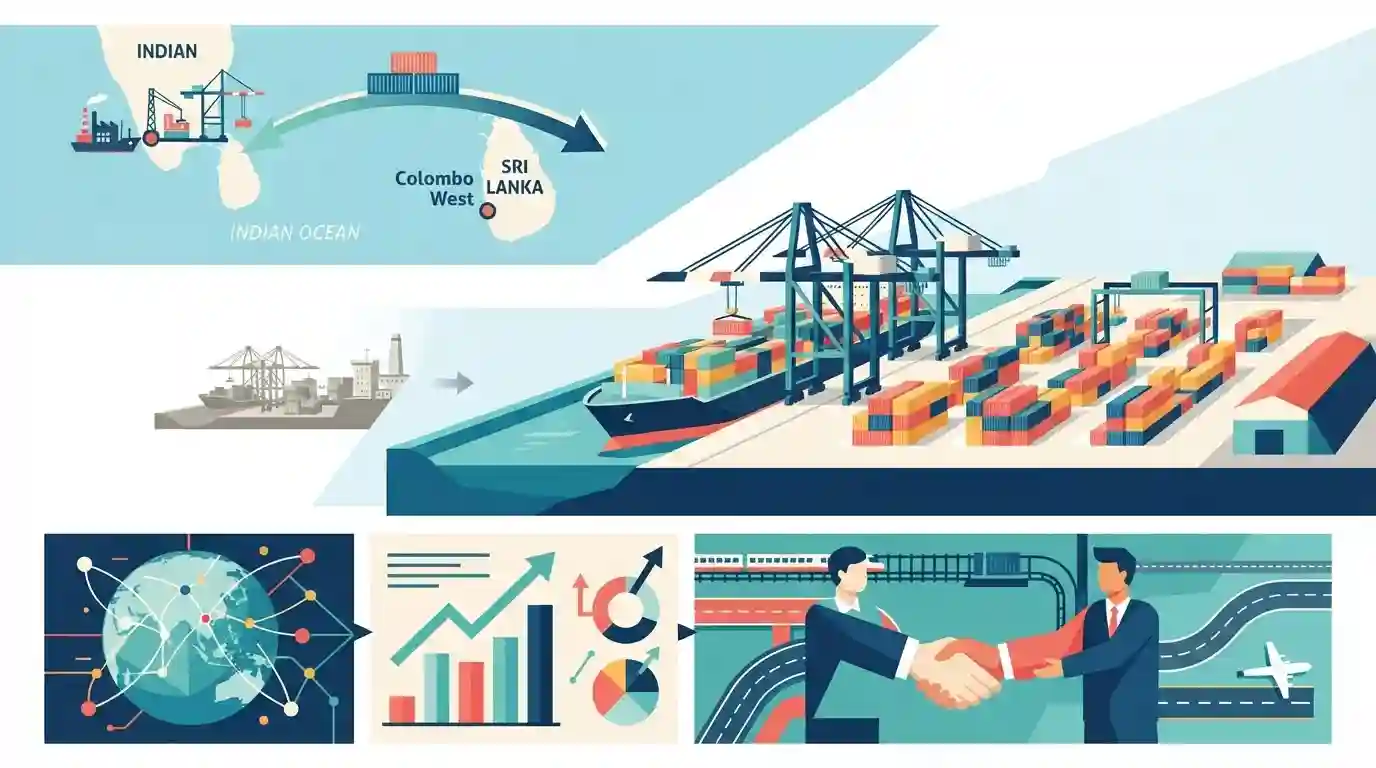
Adani Ports and Special Economic Zone Limited (APSEZ) has expanded the capacity of the Colombo West International Terminal (CWIT) in Sri Lanka to 3.2 million TEUs. This development highlights crucial cross-border infrastructure investment, strengthens regional maritime trade, and reinforces strategic economic connectivity in the Indian Ocean.
Key Points
- Adani Ports and Special Economic Zone Ltd (APSEZ)'s Colombo West International Terminal (CWIT) has scaled up its handling capacity significantly, reaching 3.2 million TEUs (Twenty-Foot Equivalent Units).
- The terminal project underscores growing economic and infrastructure cooperation between India and Sri Lanka in the strategic Indian Ocean region.
- Colombo Port serves as a major transshipment hub for global trade, enhancing connectivity across South Asia and international maritime corridors.
Important Terms
Adani Ports and Special Economic Zone Limited (APSEZ)

India's largest private port operator and a key subsidiary of the Adani Group, engaged in developing port infrastructure and logistics globally, including strategic investments in South Asia.
UPSC context
Important for APPSC/UPSC under Economic Development and Infrastructure, testing private sector participation in cross-border strategic projects.
Colombo West International Terminal (CWIT)
A deep-water container terminal at the Port of Colombo in Sri Lanka, developed jointly by APSEZ, John Keells Holdings, and the Sri Lanka Ports Authority.
UPSC context
Crucial for APPSC questions on bilateral relations, Indian Ocean geopolitics, and regional maritime trade connectivity.
Static Concepts Connected
What are the key institutional frameworks governing India-Sri Lanka bilateral economic and maritime cooperation?
- ISFTA (2000): India-Sri Lanka Free Trade Agreement (ISFTA) operationalized in March 2000 to boost bilateral merchandise trade.
- Transshipment Hub: Colombo Port is a critical transshipment hub handling nearly 70% of India's transshipment cargo, making regional connectivity vital.
- Infrastructure MoUs: Memorandum of Understanding (MoU) on energy, power grid interconnection, and infrastructure projects like CWIT.
Cross-Topic Patterns
Cross-Border Ports + Strategic Maritime Diplomacy
APSEZ's deep-water port investment in Sri Lanka mirrors India's strategic footprint expansion in Chabahar (Iran) and Sittwe (Myanmar) to secure regional maritime dominance.
Bilateral Infrastructure + Trade Agreements
Colombo Port's heavy reliance on Indian cargo traffic tests the bilateral economic synergy under the India-Sri Lanka FTA and proposed ETCA framework.

APSEZ Colombo terminal expansion + India-Sri Lanka maritime cooperation likely to feature in bilateral relations or infrastructure MCQs.
Linked PYQs · 1
Linked PYQs · 1
- 2024APPSC_PRELIMSGS1
Which of the following statement/statements can best describe the nature of security concerns/developments for India ? I. The development of the Hambantota Development Zone can be seen or viewed as a policy of containment funded by Pakistan. II. India's support in building the Chabahar port in Iran may serve as a strategic act to balance the Chinese-funded Gwadar port in Yemen. III. Indian Ocean Rim Association (IORA) is an extension of the Economic and Social Commission for Asia and the Pacific (ESCAP) and serves as a platform for maritime security. IV. The Malabar Exercise is connected with the Quadrilateral Security Dialogue (QSD). Select the correct answer using the codes given below :
